
LiFePO4 Battery
Quality Control & Testing
ZJBESS LiFePO4 battery quality control connects cell matching, BMS checks and final inspection with model-specific test reports and quality documents for your order.
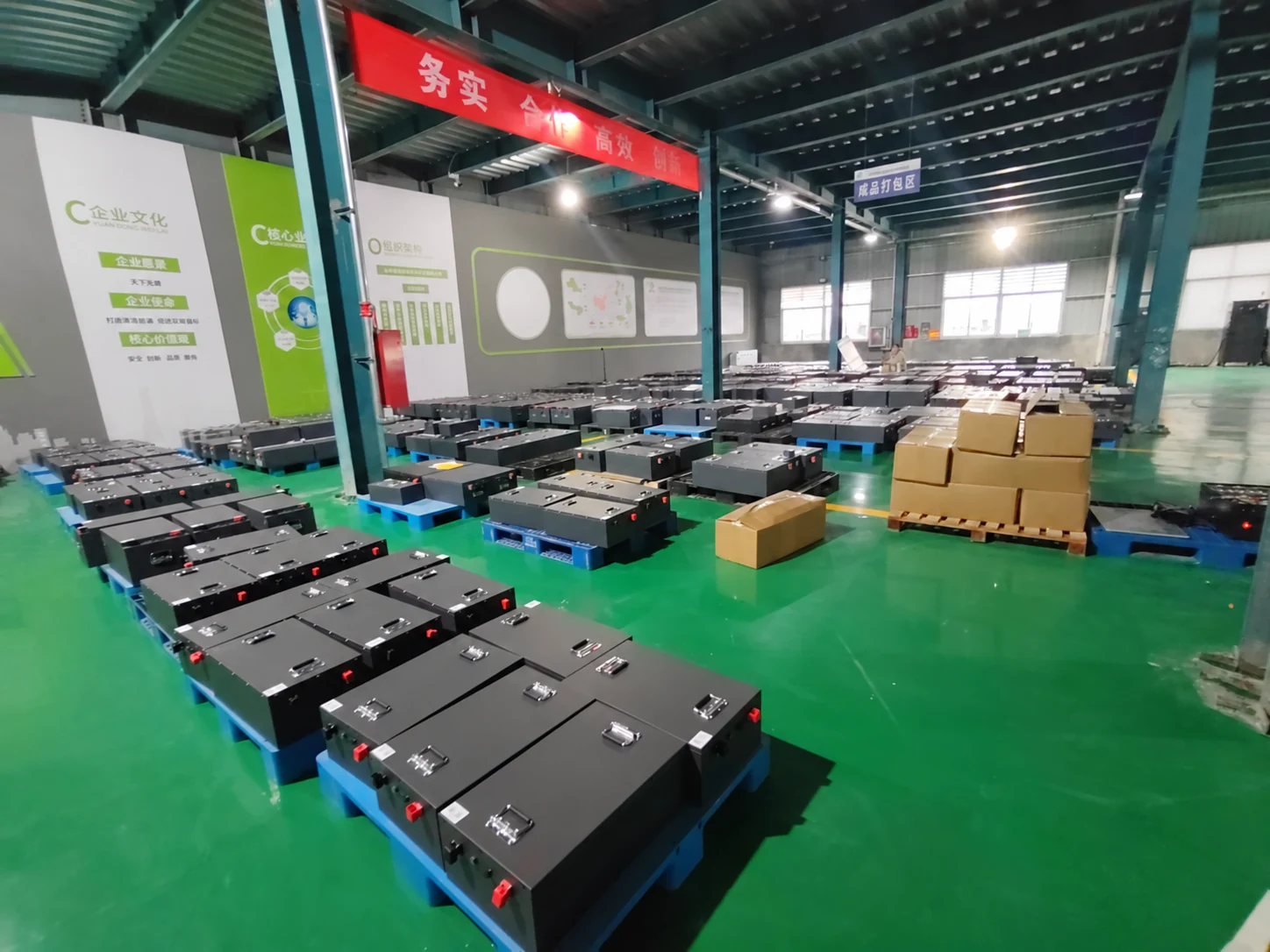
The process you can see.
The documents you can review.
ZJBESS brings cell matching, module assembly, BMS integration, electrical testing, aging and final checks into the battery pack production workflow. For importers, distributors and installers, the next step is to connect that workflow to the exact product being purchased.
Explore the workshop images and supplied document pages below. Bring the battery model, configuration and destination market into the same review.
Certificates & Battery Test Reports
Review the document, its named parties and its model list. Our library brings together conformity attestations, UN38.3 reports, safety data sheets and transport classification documents.
23 document pages available to review.

EMC certificate
HTT202604749E
Multi-model list in document
HTT · Issued 21 Apr 2026Read document fields
- Applicant
- Shandong Zhuji Energy Technology Co., Ltd.
- Manufacturer
- Shandong Zhuji Energy Technology Co., Ltd.
- Model information
- Includes 51.2V 50Ah, 100Ah, 150Ah, 200Ah, 280Ah, 300Ah, 314Ah, 330Ah, 400Ah, 420Ah, 450Ah, 500Ah, 600Ah, 628Ah, 800Ah, 1000Ah and 1200Ah
- Scope note
- Selected entries from a longer multi-voltage model list. Request the complete list for model applicability.
- Document issuer
- Shenzhen HTT Technology Co., Ltd.
- Date shown
- Issued 21 Apr 2026
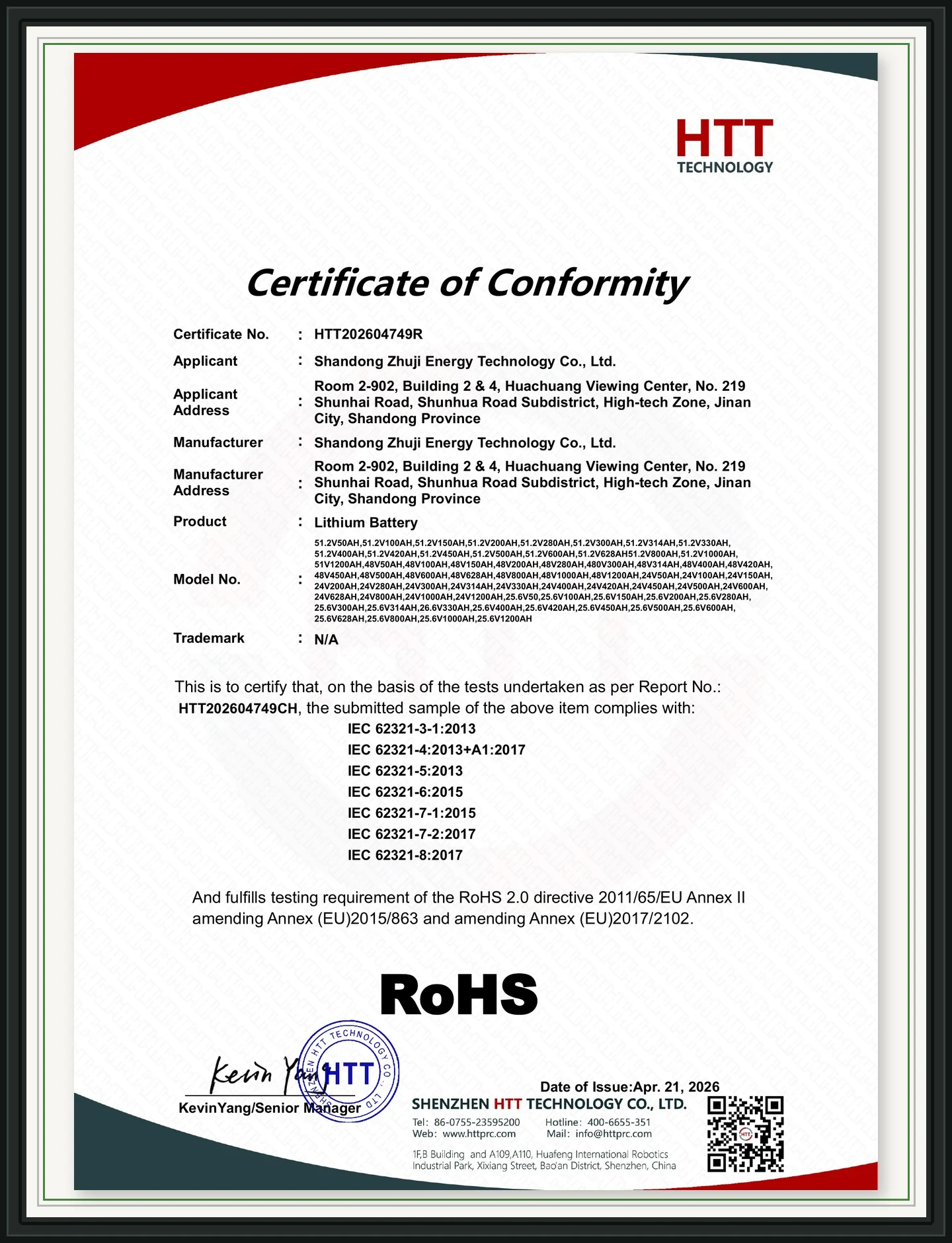
RoHS certificate
HTT202604749R
Multi-model list in document
HTT · Issued 21 Apr 2026Read document fields
- Applicant
- Shandong Zhuji Energy Technology Co., Ltd.
- Manufacturer
- Shandong Zhuji Energy Technology Co., Ltd.
- Model information
- Includes 51.2V 50Ah, 100Ah, 150Ah, 200Ah, 280Ah, 300Ah, 314Ah, 330Ah, 400Ah, 420Ah, 450Ah, 500Ah, 600Ah, 628Ah, 800Ah, 1000Ah and 1200Ah
- Scope note
- Selected entries from a longer multi-voltage model list. Request the complete list for model applicability.
- Document issuer
- Shenzhen HTT Technology Co., Ltd.
- Date shown
- Issued 21 Apr 2026

LVD attestation · EN IEC 62619:2022
M.2025.206.C126825
51.2V model list in document
UDEM · Registered 23 Sep 2025Read document fields
- Company named on attestation
- Shandong Zhuji Energy Technology Co., Ltd.
- Model information
- 51.2V 50Ah, 100Ah, 150Ah, 200Ah, 280Ah, 300Ah, 314Ah, 400Ah, 420Ah, 450Ah, 500Ah, 600Ah, 628Ah, 800Ah, 1000Ah, 1200Ah
- Scope note
- Model list printed on supplied attestation; match the ordered configuration separately.
- Document issuer
- UDEM (as named on the supplied attestation)
- Date shown
- Registered 23 Sep 2025
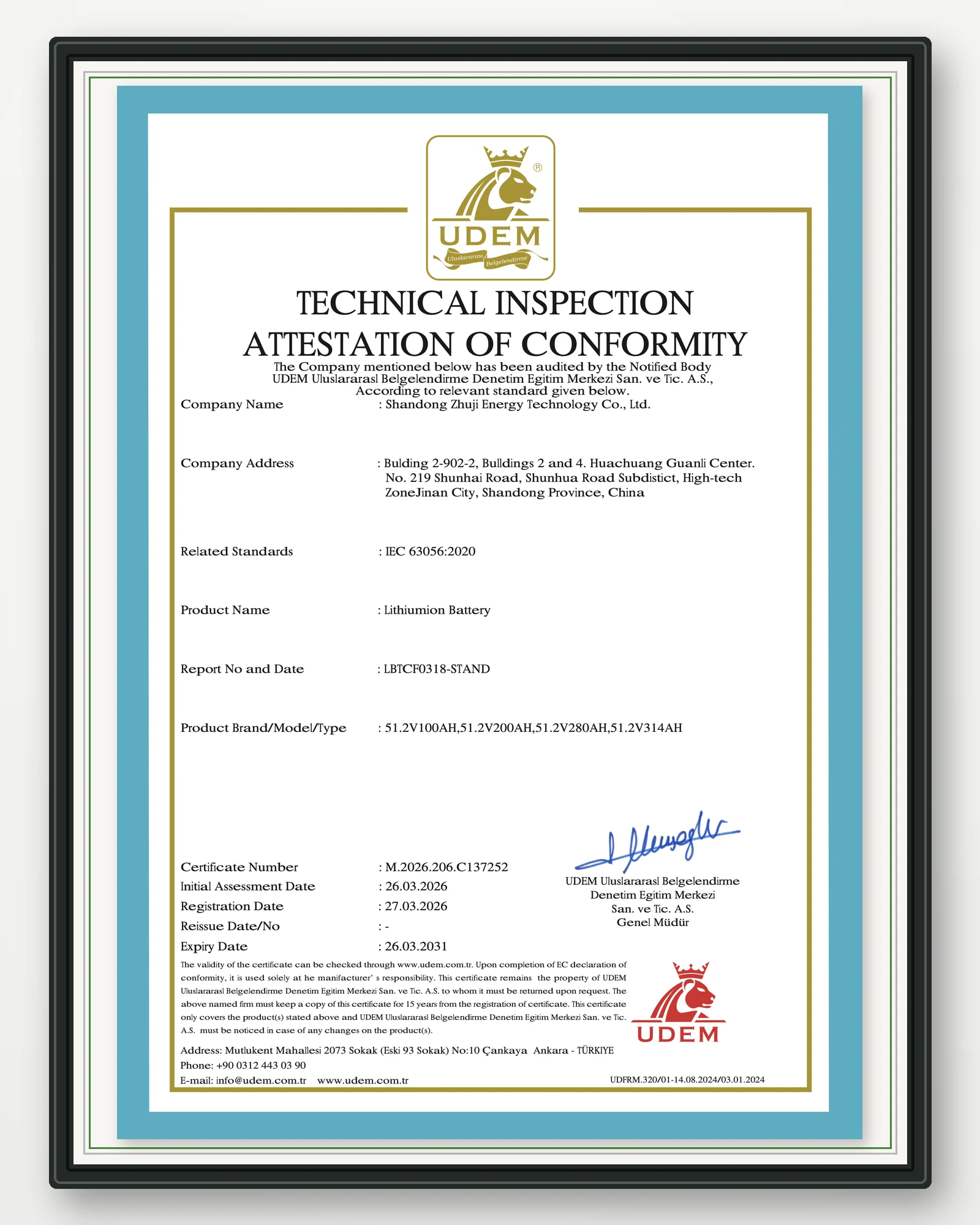
Technical attestation · IEC 63056:2020
M.2026.206.C137252
51.2V 100 / 200 / 280 / 314Ah
UDEM · Registered 27 Mar 2026Read document fields
- Company named on attestation
- Shandong Zhuji Energy Technology Co., Ltd.
- Model information
- 51.2V 100Ah, 200Ah, 280Ah, 314Ah
- Scope note
- Model list printed on supplied attestation.
- Document issuer
- UDEM (as named on the supplied attestation)
- Date shown
- Registered 27 Mar 2026

UN38.3 test report
TCT250902B042
51.2V 314Ah
TCT · Report dated 03 Sep 2025Read document fields
- Applicant
- Shandong Zhuji Energy Technology Co., Ltd.
- Model information
- 51.2V 314Ah
- Scope note
- Model designation printed on supplied page.
- Document issuer
- Shenzhen TCT Testing Technology Co., Ltd.
- Date shown
- Report dated 03 Sep 2025
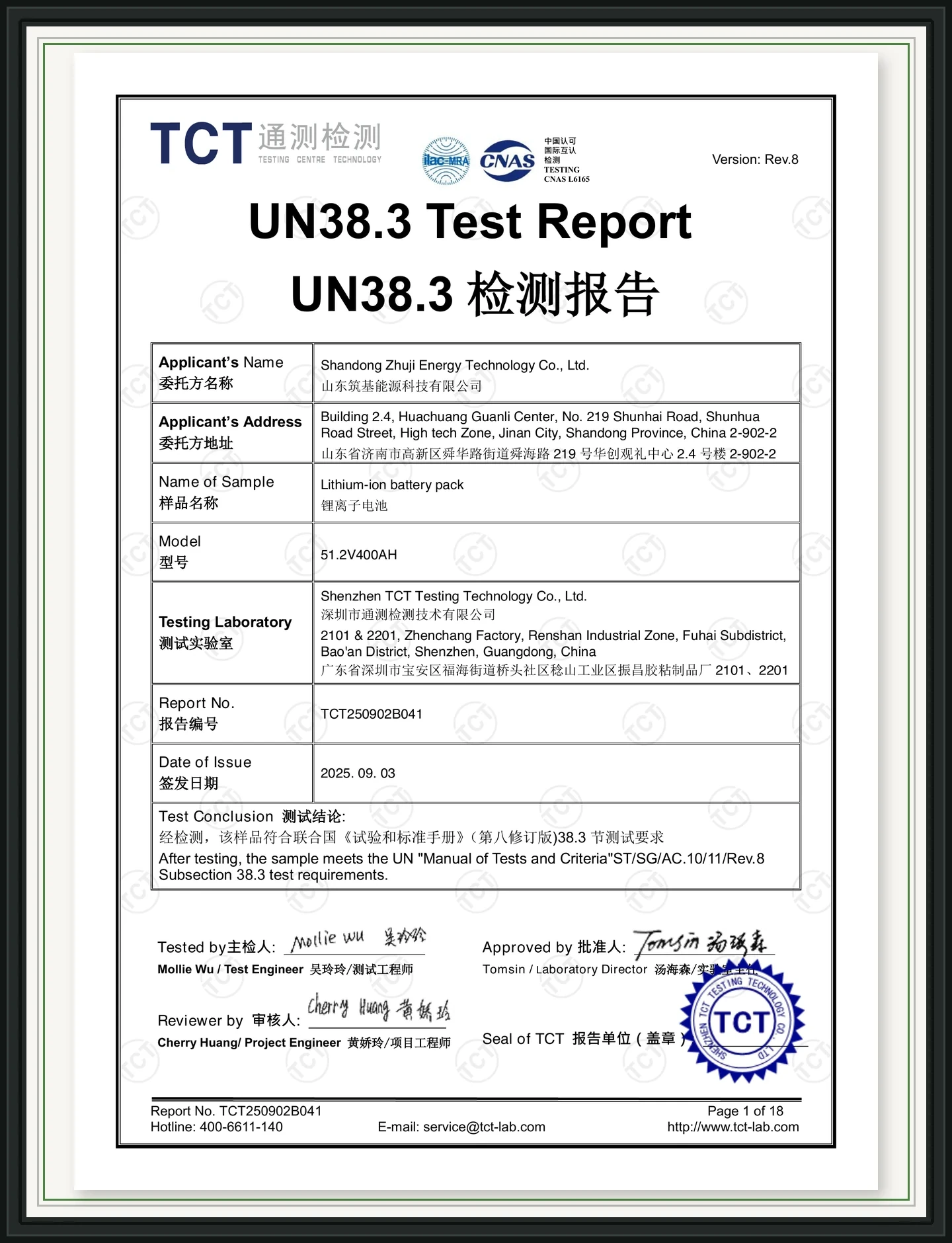
UN38.3 test report
TCT250902B041
51.2V 400Ah
TCT · Report dated 03 Sep 2025Read document fields
- Applicant
- Shandong Zhuji Energy Technology Co., Ltd.
- Model information
- 51.2V 400Ah
- Scope note
- Model designation printed on supplied page.
- Document issuer
- Shenzhen TCT Testing Technology Co., Ltd.
- Date shown
- Report dated 03 Sep 2025

UN38.3 test report
TCT250902B043
51.2V 628Ah
TCT · Report dated 03 Sep 2025Read document fields
- Applicant
- Shandong Zhuji Energy Technology Co., Ltd.
- Model information
- 51.2V 628Ah
- Scope note
- Model designation printed on supplied page.
- Document issuer
- Shenzhen TCT Testing Technology Co., Ltd.
- Date shown
- Report dated 03 Sep 2025
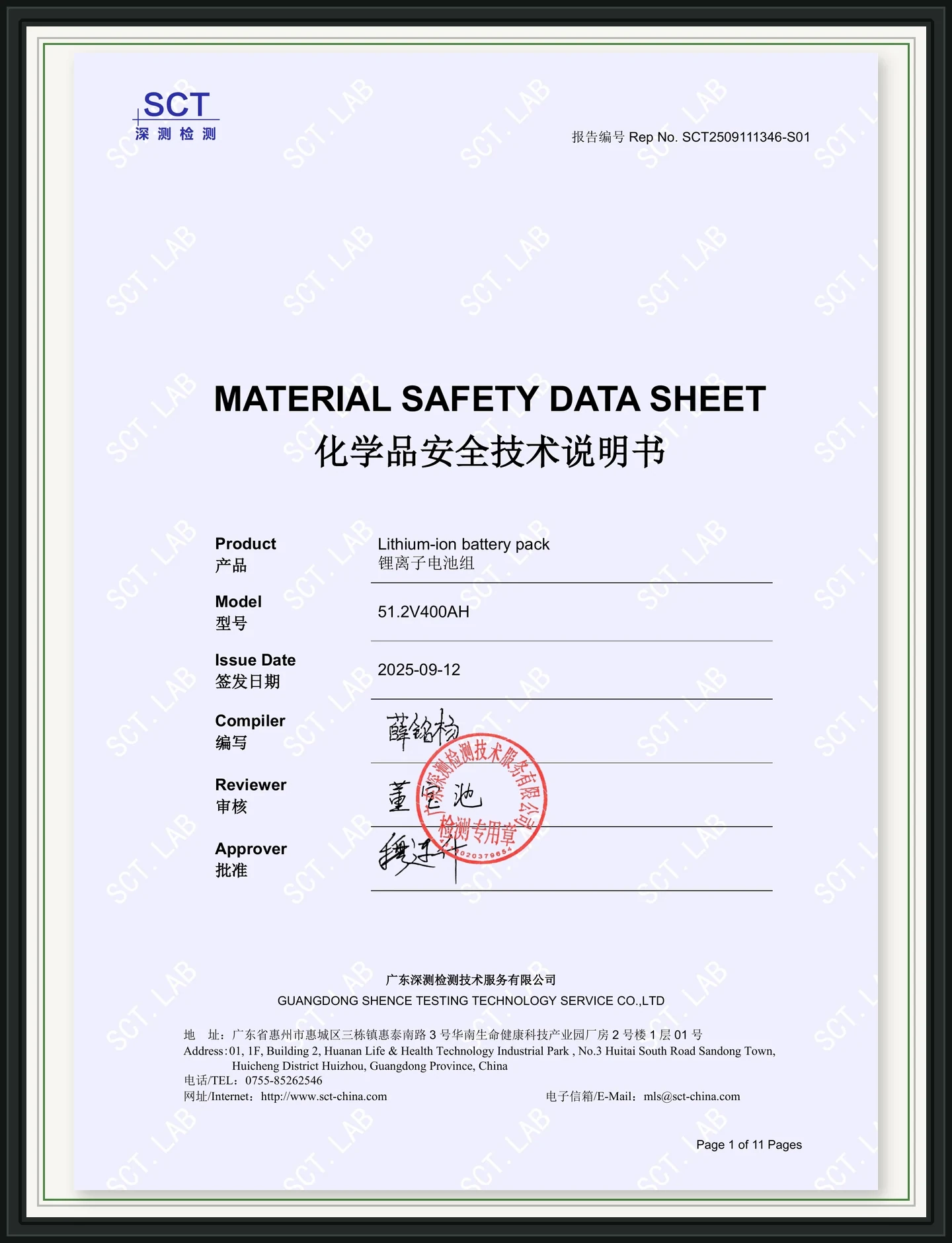
Material safety data sheet
SCT2509111346-S01
51.2V 400Ah
SCT · Issued 12 Sep 2025Read document fields
- Company / manufacturer
- Not shown on this cover page; request the complete file.
- Model information
- 51.2V 400Ah
- Scope note
- Model designation printed on supplied page.
- Document issuer
- Guangdong Shence Testing Technology Service Co., Ltd.
- Date shown
- Issued 12 Sep 2025

EMC directive attestation
M.2025.206.C121948
Model list in document
UDEM · Registered 02 Jul 2025Read document fields
- Company named on attestation
- Shandong Zhuji Energy Technology Co., Ltd.
- Model information
- 48V, 24V and 12V series listed in the document
- Scope note
- The page contains a longer model list. Request the full list and the exact model correspondence.
- Document issuer
- UDEM (as named on the supplied attestation)
- Date shown
- Registered 02 Jul 2025

EMC directive attestation
M.2025.206.C129519
Model list in document
UDEM · Registered 13 Nov 2025Read document fields
- Company named on attestation
- Shandong Zhuji Energy Technology Co., Ltd.
- Model information
- Includes 51.2V 50Ah, 100Ah, 150Ah, 200Ah, 280Ah, 300Ah, 314Ah, 330Ah, 400Ah, 420Ah, 450Ah, 500Ah, 600Ah, 628Ah, 800Ah, 1000Ah and 1200Ah
- Scope note
- Selected entries from a longer multi-voltage model list. Request the complete list for model applicability.
- Document issuer
- UDEM (as named on the supplied attestation)
- Date shown
- Registered 13 Nov 2025

EMC directive attestation
M.2025.206.C131020
Model list in document
UDEM · Registered 09 Dec 2025Read document fields
- Company named on attestation
- Shandong Zhuji Energy Technology Co., Ltd.
- Model information
- ZJ60261, ZJ60241, ZJ30157, ZJ30112, ZJ60215, ZJ100215, ZJ100241, ZJ125261, ZJ100261, ZJ125215, ZJ125241
- Scope note
- Model list printed on supplied attestation.
- Document issuer
- UDEM (as named on the supplied attestation)
- Date shown
- Registered 09 Dec 2025

LVD attestation · EN IEC 62133-1:2017
M.2025.206.C124994
51.2V 100 / 200 / 300 / 400 / 500 / 600Ah
UDEM · Registered 25 Aug 2025Read document fields
- Company named on attestation
- Shandong Zhuji Energy Technology Co., Ltd.
- Model information
- 51.2V 100Ah, 200Ah, 300Ah, 400Ah, 500Ah, 600Ah
- Scope note
- Model list printed on supplied attestation. Standard designation is reproduced from that file.
- Document issuer
- UDEM (as named on the supplied attestation)
- Date shown
- Registered 25 Aug 2025

UN38.3 test summary
TCT250902B042
51.2V 314Ah
TCT · Report dated 03 Sep 2025Read document fields
- Consignor
- Shandong Zhuji Energy Technology Co., Ltd.
- Manufacturer named in summary
- 山东速久新能源有限公司
- Model information
- 51.2V 314Ah
- Scope note
- Model designation printed on supplied page.
- Document issuer
- Shenzhen TCT Testing Technology Co., Ltd.
- Date shown
- Report dated 03 Sep 2025

UN38.3 test summary
TCT250902B041
51.2V 400Ah
TCT · Report dated 03 Sep 2025Read document fields
- Consignor
- Shandong Zhuji Energy Technology Co., Ltd.
- Manufacturer named in summary
- 山东速久新能源有限公司
- Model information
- 51.2V 400Ah
- Scope note
- Model designation printed on supplied page.
- Document issuer
- Shenzhen TCT Testing Technology Co., Ltd.
- Date shown
- Report dated 03 Sep 2025
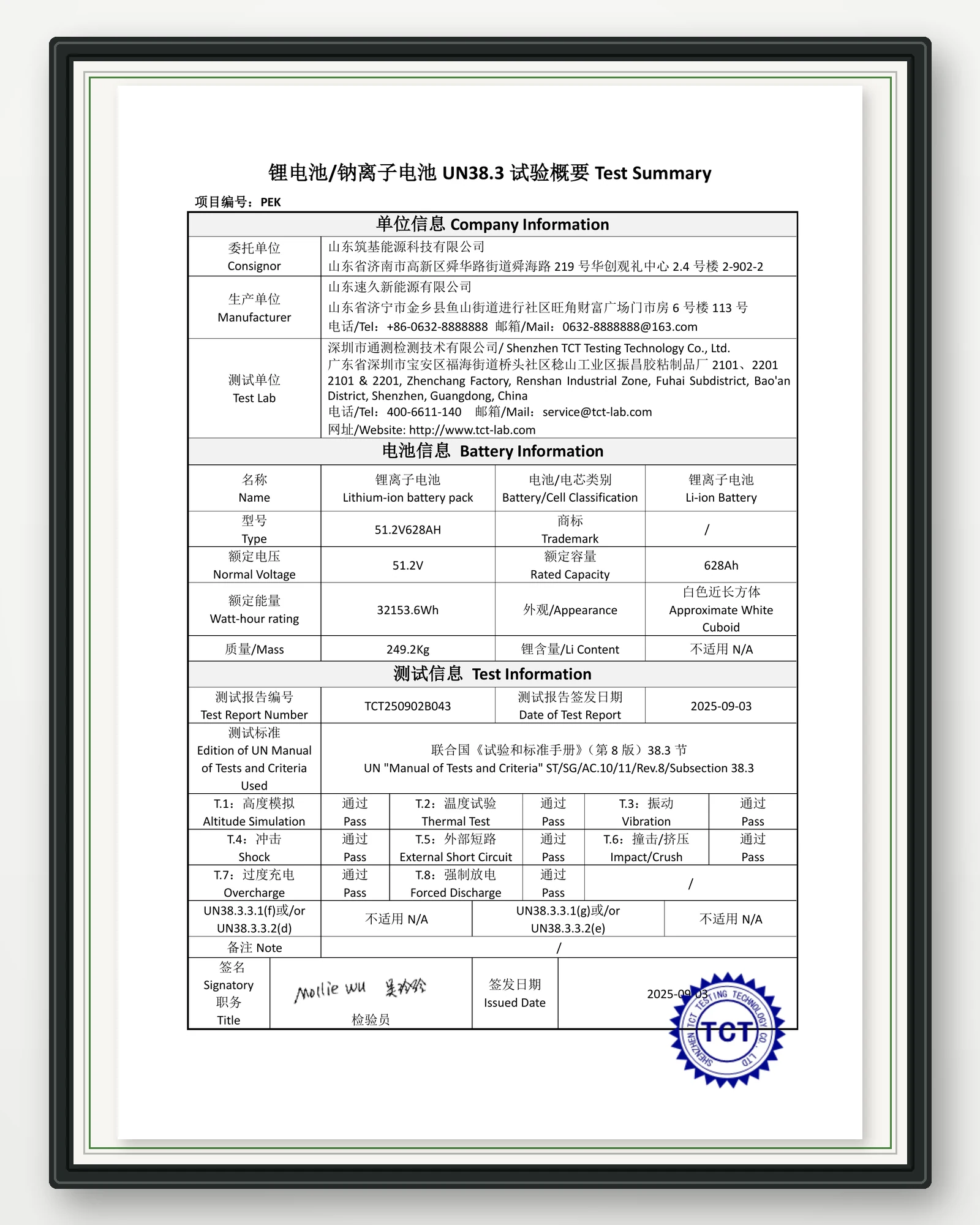
UN38.3 test summary
TCT250902B043
51.2V 628Ah
TCT · Report dated 03 Sep 2025Read document fields
- Consignor
- Shandong Zhuji Energy Technology Co., Ltd.
- Manufacturer named in summary
- 山东速久新能源有限公司
- Model information
- 51.2V 628Ah
- Scope note
- Model designation printed on supplied page.
- Document issuer
- Shenzhen TCT Testing Technology Co., Ltd.
- Date shown
- Report dated 03 Sep 2025

Material safety data sheet
SCT2509111343-S01
51.2V 314Ah
SCT · Issued 12 Sep 2025Read document fields
- Company / manufacturer
- Not shown on this cover page; request the complete file.
- Model information
- 51.2V 314Ah
- Scope note
- Model designation printed on supplied page.
- Document issuer
- Guangdong Shence Testing Technology Service Co., Ltd.
- Date shown
- Issued 12 Sep 2025
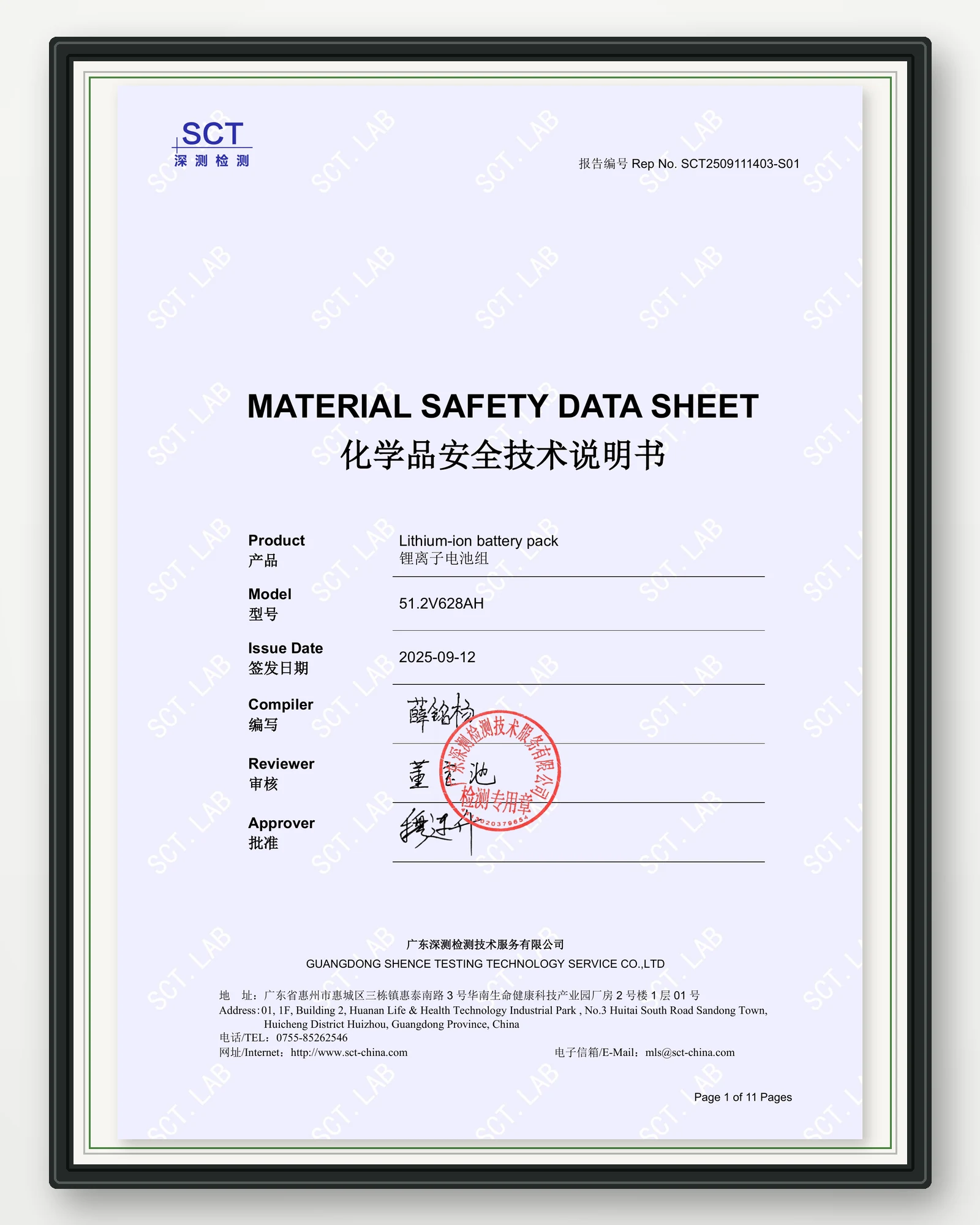
Material safety data sheet
SCT2509111403-S01
51.2V 628Ah
SCT · Issued 12 Sep 2025Read document fields
- Company / manufacturer
- Not shown on this cover page; request the complete file.
- Model information
- 51.2V 628Ah
- Scope note
- Model designation printed on supplied page.
- Document issuer
- Guangdong Shence Testing Technology Service Co., Ltd.
- Date shown
- Issued 12 Sep 2025

Transport classification
250100320157085
51.2V 314Ah
CCIC Jiangsu · Dated 11 Sep 2025Read document fields
- Entrusting party
- Shandong Zhuji Energy Technology Co., Ltd.
- Supplier named on page
- 山东速久新能源有限公司
- Model information
- 51.2V 314Ah
- Scope note
- Model designation printed on supplied page.
- Document issuer
- CCIC Jiangsu Co., Ltd.
- Date shown
- Dated 11 Sep 2025
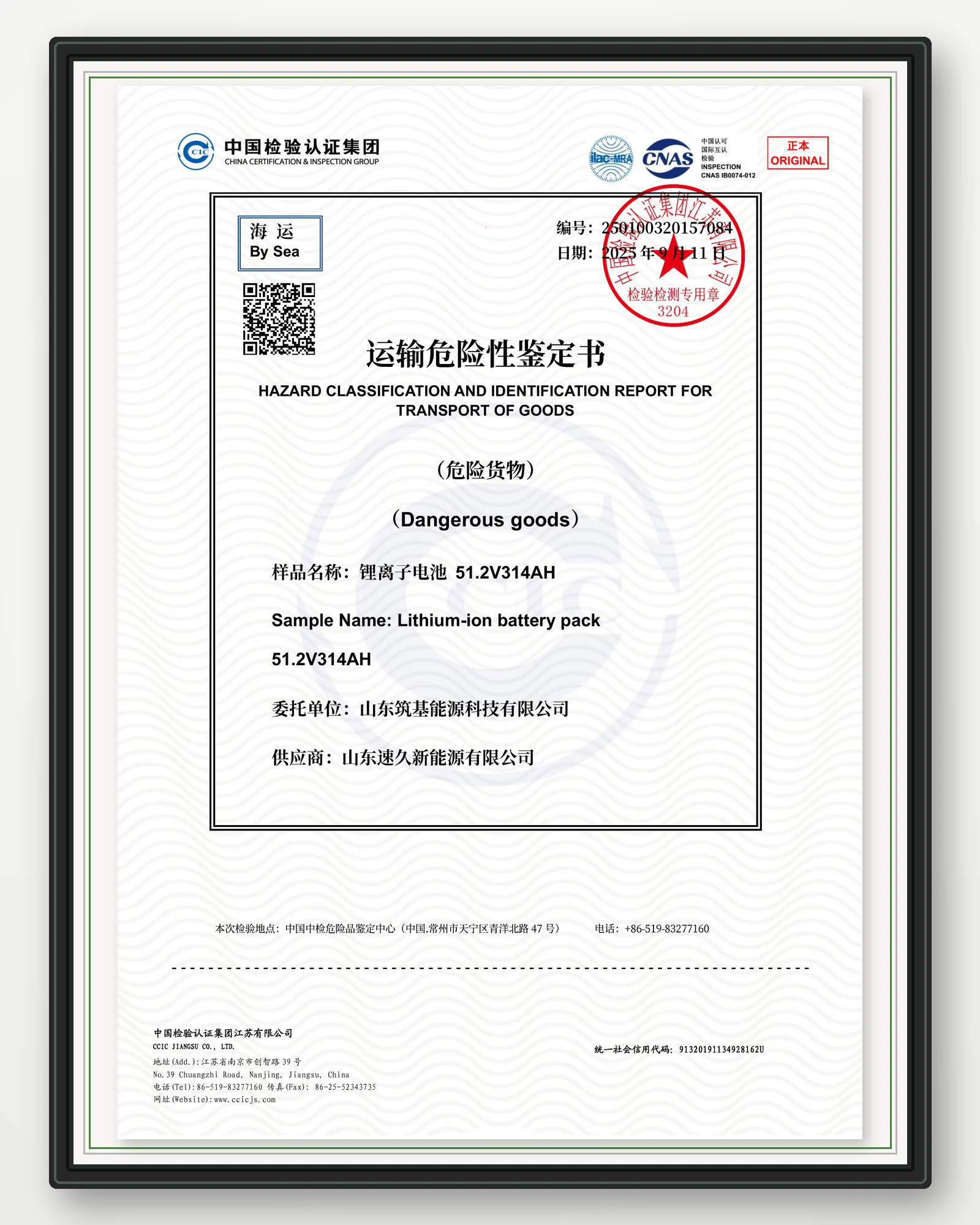
Sea transport classification
250100320157084
51.2V 314Ah
CCIC Jiangsu · Dated 11 Sep 2025Read document fields
- Entrusting party
- Shandong Zhuji Energy Technology Co., Ltd.
- Supplier named on page
- 山东速久新能源有限公司
- Model information
- 51.2V 314Ah
- Scope note
- Model designation printed on supplied page.
- Document issuer
- CCIC Jiangsu Co., Ltd.
- Date shown
- Dated 11 Sep 2025
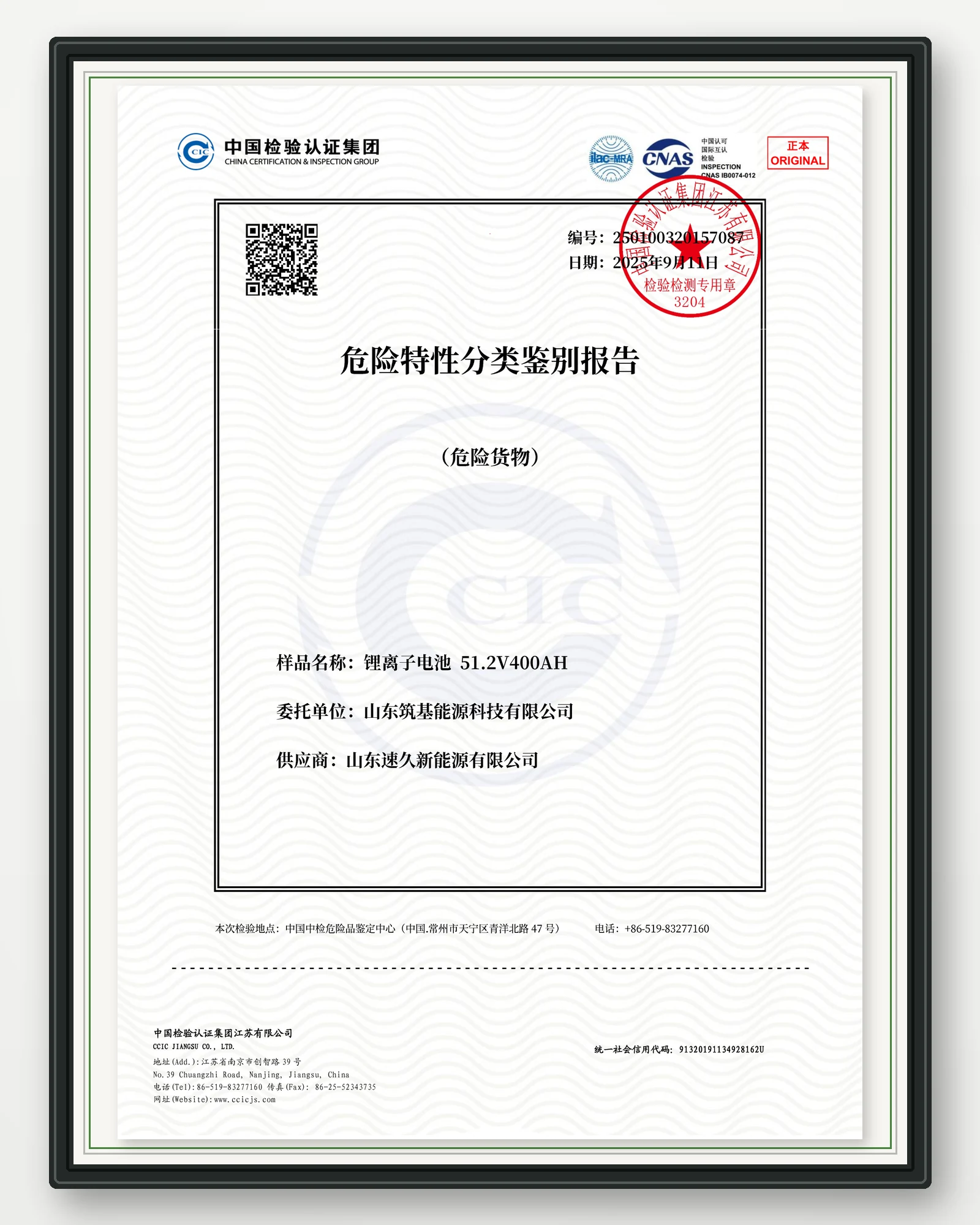
Transport classification
250100320157087
51.2V 400Ah
CCIC Jiangsu · Dated 11 Sep 2025Read document fields
- Entrusting party
- Shandong Zhuji Energy Technology Co., Ltd.
- Supplier named on page
- 山东速久新能源有限公司
- Model information
- 51.2V 400Ah
- Scope note
- Model designation printed on supplied page.
- Document issuer
- CCIC Jiangsu Co., Ltd.
- Date shown
- Dated 11 Sep 2025
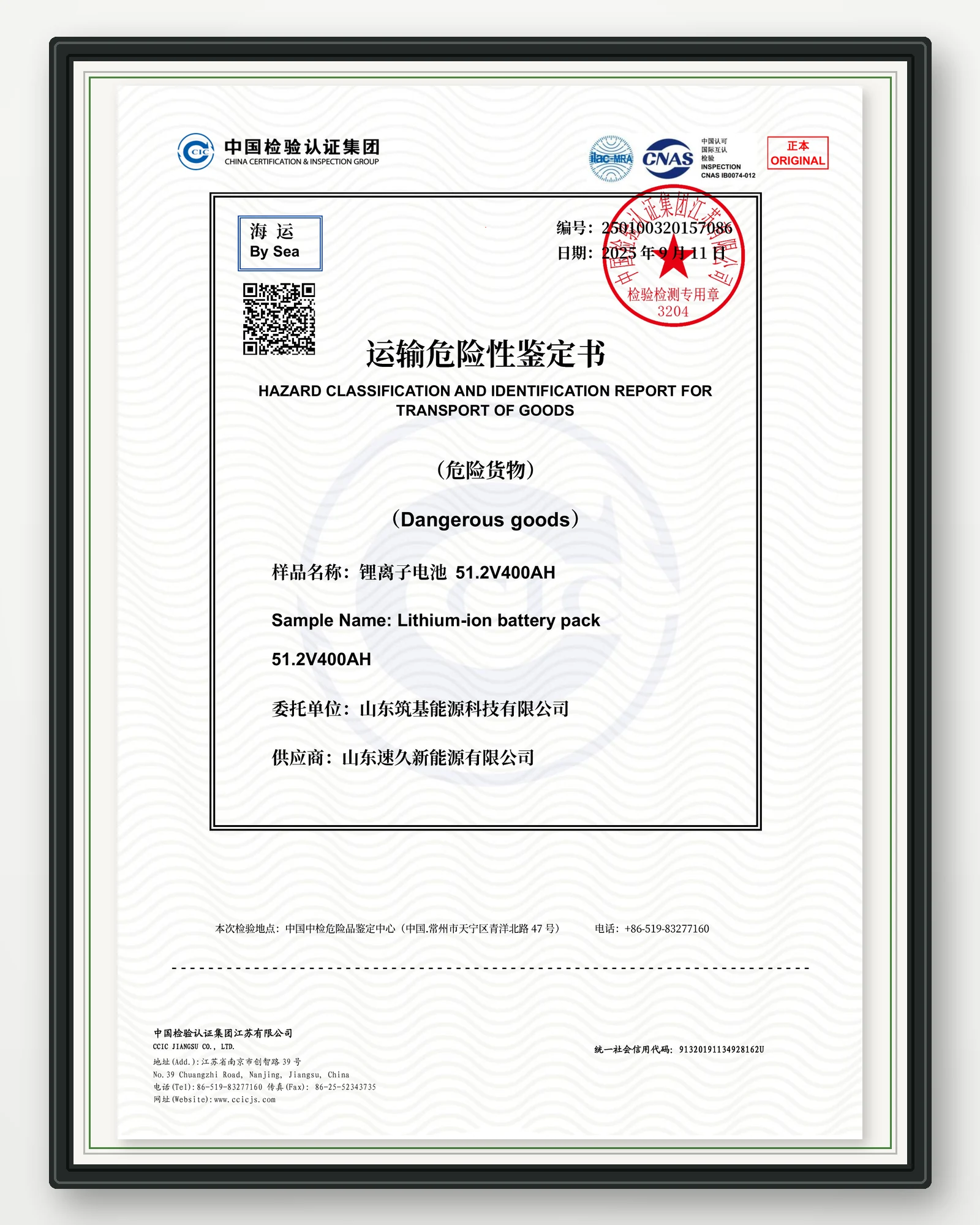
Sea transport classification
250100320157086
51.2V 400Ah
CCIC Jiangsu · Dated 11 Sep 2025Read document fields
- Entrusting party
- Shandong Zhuji Energy Technology Co., Ltd.
- Supplier named on page
- 山东速久新能源有限公司
- Model information
- 51.2V 400Ah
- Scope note
- Model designation printed on supplied page.
- Document issuer
- CCIC Jiangsu Co., Ltd.
- Date shown
- Dated 11 Sep 2025

Transport classification
250100320157089
51.2V 628Ah
CCIC Jiangsu · Dated 11 Sep 2025Read document fields
- Entrusting party
- Shandong Zhuji Energy Technology Co., Ltd.
- Supplier named on page
- 山东速久新能源有限公司
- Model information
- 51.2V 628Ah
- Scope note
- Model designation printed on supplied page.
- Document issuer
- CCIC Jiangsu Co., Ltd.
- Date shown
- Dated 11 Sep 2025

Sea transport classification
250100320157088
51.2V 628Ah
CCIC Jiangsu · Dated 11 Sep 2025Read document fields
- Entrusting party
- Shandong Zhuji Energy Technology Co., Ltd.
- Supplier named on page
- 山东速久新能源有限公司
- Model information
- 51.2V 628Ah
- Scope note
- Model designation printed on supplied page.
- Document issuer
- CCIC Jiangsu Co., Ltd.
- Date shown
- Dated 11 Sep 2025
Shown pages identify the document type and covered model information. Request the complete file set and confirm applicability to your configuration and destination before placing an order. Certificates, test reports and MSDS serve different purposes.
Request a Model-Specific Document SetQuality Control from Materials to Shipment
A finished battery depends on the materials, the assembly and the final handover. These three inspection stages organize the review.
Incoming materials
Cell identity, component condition and material specifications before assembly.
In-process control
Module assembly, connections, BMS integration and configuration checks.
Outgoing inspection
Finished battery, identification, accessories, packing and order documents.
Follow the battery pack through seven checkpoints.
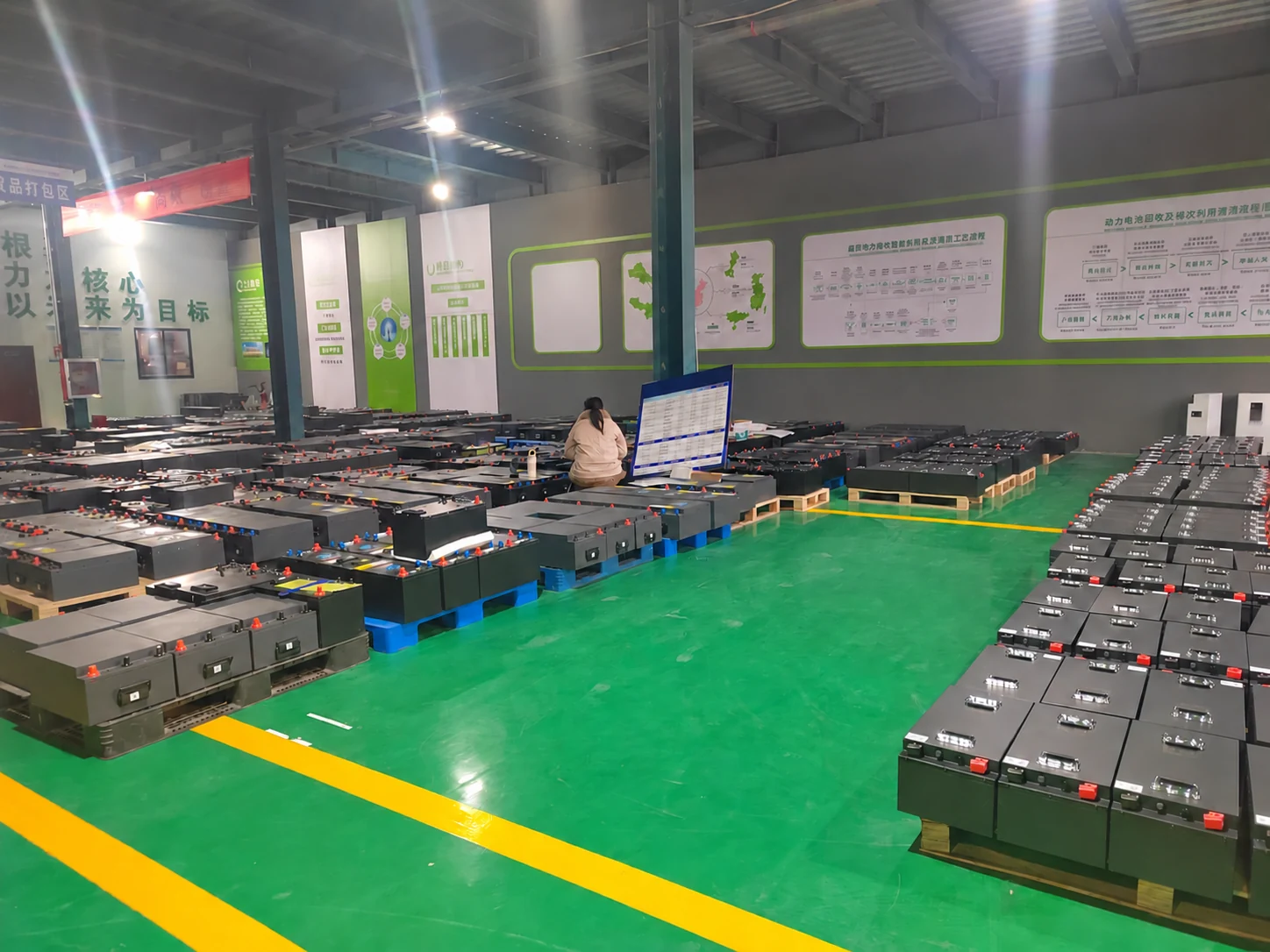
Cell & material identification
Match cell specification, batch identity and the incoming components to the approved battery configuration.
Record to reviewComponent identity and incoming inspection reference

Cell matching & module preparation
Review the relevant capacity, voltage and resistance matching information before the cells become a pack.
Record to reviewCell matching data and module configuration

Assembly & connection checks
Check connection layout, polarity, fastening, insulation arrangement and the mechanical assembly.
Record to reviewAssembly checkpoints and correction records

BMS & communication setup
Match the BMS, firmware, protection settings and communication arrangement to the intended battery system.
Record to reviewConfiguration revision and functional check

Charge–discharge & aging
Review the test conditions, measured results and operating observations for the selected battery model.
Record to reviewApplicable test curve or run record

Final battery inspection
Reconcile the battery identity, appearance, labels, functions and included accessories with the order.
Record to reviewFinal inspection and unit or batch reference

Packing & document handover
Check protection, markings, accessories and the documents required for the shipment and receiving team.
Record to reviewPacking list and shipment document set
Inspection items, limits, frequency and release criteria follow the selected model and agreed purchase specification.
What the Inspection Needs to Cover
Cells, current paths and control electronics work as one battery. A review should connect each part to its function and its inspection evidence.

Cell consistency
Cell identity and matching information help explain how the pack is assembled.
Connections & insulation
Review busbars, terminals, cable routing, polarity and the applicable electrical checks.
BMS & protection
Confirm the BMS version, settings and relevant protection-function results.
System communication
Match protocol, firmware and cable arrangement to the exact inverter model.
LiFePO4 Battery Testing & Performance
Review the purpose of each test alongside its conditions, scope and recorded result. Open a test topic for the details to confirm.
Capacity & charge–discharge
Review measured energy or capacity against the selected model’s stated rating and agreed test procedure.
- Conditions to check
- Charge and discharge current, voltage limits, temperature, rest periods, units and measurement method.
- Evidence to request
- Identified test record and charge–discharge data, where available. A single cycle does not establish cycle life.
BMS protection & settings
Review the relevant protection functions and configuration against the model’s approved specification.
- Conditions to check
- Firmware revision, configured limits, test method, event response and recovery conditions.
- Evidence to request
- Applicable functional check sheet and configuration reference. Test coverage must be confirmed for the order.
Communication & inverter matching
A CAN or RS485 connector does not, on its own, confirm compatibility with an inverter.
- Conditions to check
- Exact inverter model, battery BMS and firmware, protocol selection, pinout, cable and operating configuration.
- Evidence to request
- Model-pair verification information or an agreed integration check for the intended setup.
Aging / burn-in observation
Review the operating sequence and observations covered by any aging or burn-in procedure offered for the model.
- Conditions to check
- Duration, current or load, ambient conditions, monitored values, coverage and acceptance limits.
- Evidence to request
- Applicable run record with the unit or batch reference. Duration and coverage need explicit confirmation.
Connections & electrical safety
Review connection integrity, polarity, insulation and other applicable electrical checks under the model’s inspection plan.
- Conditions to check
- Test points, approved method, equipment reference and model-specific limits.
- Evidence to request
- Inspection or test sheet identifying the checked configuration. Specialist tests require an appropriate procedure.
Final identification & packing
Reconcile the battery, its label, accessories and shipment documentation before dispatch.
- Conditions to check
- Model, serial identification, label revision, included cables, manual, packing method and shipping requirements.
- Evidence to request
- Final checklist and packing reference connected to the agreed order.
Test Coverage: Unit, Batch & Product Validation
Routine inspection, sampling and product validation should be read with their own scope.
| Scope | What the evidence can describe | What to confirm |
|---|---|---|
| Individual unit check | A result connected to an identified finished battery. | Which checks apply to each unit, and how the serial number links to the result. |
| Batch sampling | An inspection of selected items from a defined lot. | Lot definition, sample size, selection method, limits and the response to a failed sample. |
| Design / type validation | Performance or behavior of a specified design and configuration under stated conditions. | Tested design revision, conditions and whether later changes affect applicability. |
| External laboratory report | The identified sample and assessment scope recorded by the issuing laboratory. | Report authenticity, model list, configuration, issue date and any stated limitations. |
Confirm the coverage of each test in the agreed inspection plan. Routine factory checks and external laboratory assessments have different scopes.
Battery Identification
& Quality Records
A useful inspection trail connects product identity, configuration, test conditions and the release decision.
Request an available, redacted record for the model you are considering. Use these fields to review what it actually covers and which links still need clarification.
Discuss a record reviewFields that connect an inspection record
Record structure to review with the quality team
- Product identityModel · serial number or batch · order reference
- Approved configurationCell / pack specification · BMS · firmware revision
- Test conditions & resultsProcedure · equipment reference · date · measured values
- Decision & reviewAcceptance criteria · disposition · reviewer · re-test link
Confirm which fields and records are available, their retention period and what can be shared.
Find the Documents for Your Battery Specification
The supplied transport and safety-data files identify three 51.2V specifications. Use the document model, then confirm the commercial SKU and ordered configuration with ZJBESS.
| Model shown | UN38.3 report & summary | MSDS | Transport classification |
|---|---|---|---|
| 51.2V 314Ah | TCT250902B042 ReportTCT250902B042 Summary | SCT2509111343-S01 Safety data sheet | 250100320157085 Classification250100320157084 By sea |
| 51.2V 400Ah | TCT250902B041 ReportTCT250902B041 Summary | SCT2509111346-S01 Safety data sheet | 250100320157087 Classification250100320157086 By sea |
| 51.2V 628Ah | TCT250902B043 ReportTCT250902B043 Summary | SCT2509111403-S01 Safety data sheet | 250100320157089 Classification250100320157088 By sea |
Report references are shown as printed on the supplied pages. Complete files, named manufacturer, current shipment acceptance and exact SKU correspondence are confirmed for the order.
Choose your product format.
Nonconforming Items:
Hold, Review & Recheck
Agree the exception process before the shipment is due.
Ask how a nonconforming item is identified, kept from release, corrected and checked again. Confirm the handling, approval and notification arrangements with the quality team for your order.
- 01
Identify & hold
Identify affected units or material, record the issue and confirm the release hold.
- 02
Review & decide
Review the cause and scope. Agree the authorized disposition and any buyer notification.
- 03
Correct & recheck
Record the action and repeat the relevant checks against the agreed criteria.
- 04
Review release
Link the recheck to the original issue and confirm who can approve release.
Questions Buyers Ask
About Battery Quality
Start with the product and the purpose of the document. These distinctions help your team request the right evidence.
Download the QC review checklistWhich quality documents can I review?
The library includes supplied EMC and RoHS certificates, LVD and technical attestations, UN38.3 reports and summaries, MSDS and transport classification pages. Open each document for its title, parties and model list, then ask for the complete file set for your selected battery.
Do all documents cover all ZJBESS battery models?
Each document has its own model list and scope. The UN38.3 and MSDS files shown here identify 51.2V 314Ah, 400Ah or 628Ah batteries. A product’s similar capacity or format does not establish the correspondence: confirm the exact SKU and configuration.
What is the difference between UN38.3 and MSDS?
A UN38.3 report and summary identify transport-test information for a battery type. An MSDS provides safety information for handling and related purposes. Request the relevant documents together with the current shipment requirements; one document does not replace the other.
Read the UN38.3 test summary guideWhat quality-control stages are covered?
The battery pack workflow covers cell preparation and matching, module assembly, BMS and electrical integration, charge–discharge testing, aging, final inspection and packing. Confirm inspection limits, frequency, test conditions and required records for the chosen model.
Can I request factory test records or a pre-shipment inspection?
Share the model, order quantity and checks your team requires. Discuss available records, inspection access, timing, sample selection, acceptance criteria and release arrangements before production or travel is booked.
Does a battery certificate confirm inverter compatibility?
Inverter integration requires a separate check of the exact inverter, battery BMS, firmware, protocol and cable arrangement. The presence of CAN or RS485 and a battery certificate do not establish a working model pair.
Review battery–inverter compatibilityContinue Your Supplier Review
Bring manufacturing, product selection and shipment preparation into the same purchase decision.
Last updated:
Request the Quality Files
for Your Battery Order.
Tell us the battery specification and destination. We can review the document and inspection requirements with your team.
Include the battery model or format, target market, quantity and intended inverter. Include the document numbers you are reviewing, plus any sample checks or shipment acceptance points you want to discuss.
- Model and approved configuration
- Test items, conditions and coverage
- Available records and document applicability
- Sample, inspection and release requirements