

Off-Grid Battery Storage for Remote & Weak-Grid Sites
Plan power around the supply you have.
Plan off-grid battery storage around solar generation, priority loads and the next recharge. For remote or weak-grid sites, review daily energy, starting power and backup reserves together.
Planning details
Plan off-grid battery storage around solar generation, priority loads and the next recharge. For remote or weak-grid sites, review daily energy, starting power and backup reserves together.
Discuss Your ProjectStart with the Power Available at Your Site
A site with no grid connection needs a different source and reserve plan from one with an unreliable supply.
No utility connection
Plan energy supply across the whole day.
At a remote home or small building, solar availability, daily consumption and the next charging opportunity shape the system.
- First priority
- Match generation and storage to the load schedule.
- Plan ahead for
- Night-time use and extended periods of low solar output.
- Bring to the review
- Seasonal use, essential loads and any alternative charging source.
Unreliable utility supply
Define the problem the system needs to solve.
Record whether the site faces outages, short supply windows, unstable voltage or a limited connection. These require different checks.
- First priority
- Identify the circuits to support and available charging windows.
- Plan ahead for
- Outage duration, reserve needs and accepted AC input limits.
- Bring to the review
- Outage records, supply measurements and existing equipment details.
See How the Sources,
Battery & Loads Connect
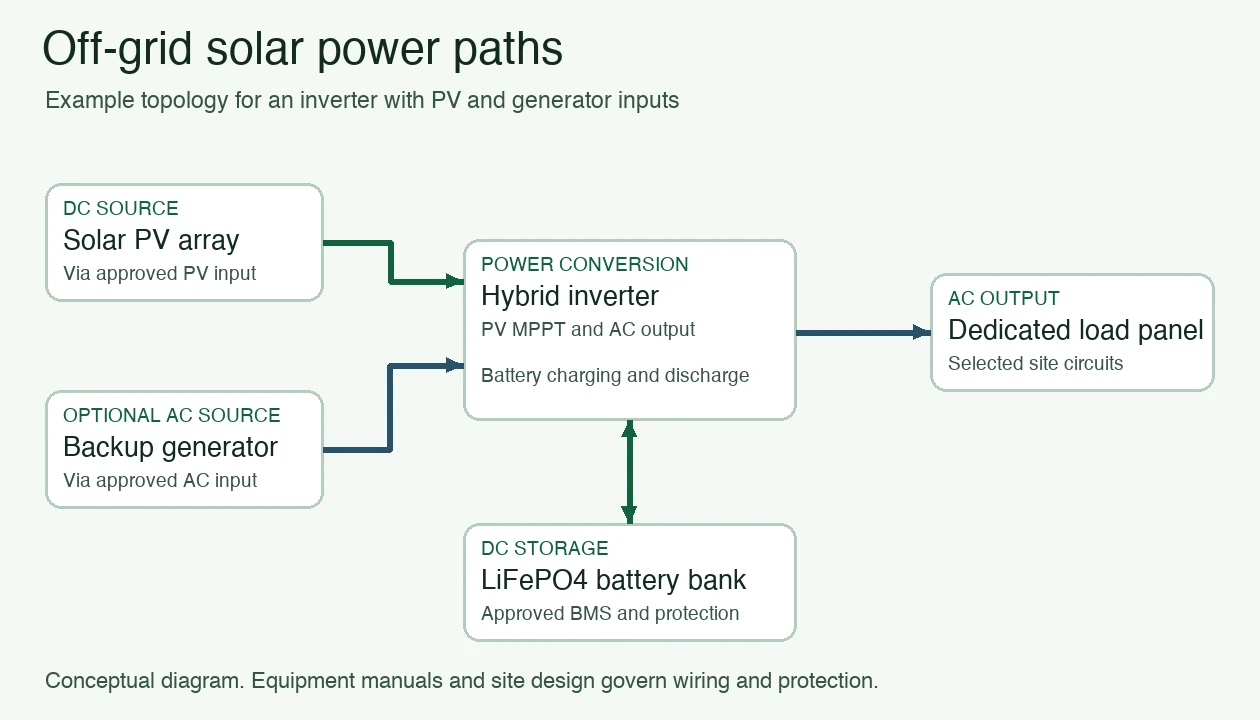
The inverter or charger links the available sources with storage and selected loads. Review each operating period before choosing the equipment.
where supported
/ chargerConversion & control
the configuration
Use the daylight. Plan the recharge.
Review how solar generation can support running loads and recharge storage. Check the seasonal solar yield and the time available to restore the required reserve.
Planning focus: loads + charging demandDecide what needs to run after sunset.
Match usable stored energy to the night-time load schedule. Include the inverter’s demand and conversion losses when estimating the operating period.
Planning focus: usable energy + load durationPlan beyond a single sunny day.
Define essential-load priorities for low-solar periods. Where a grid or generator input is available, confirm source acceptance, charging capacity and the control arrangement.
Planning focus: reserve + the next charging opportunitySize Off-grid Battery Storage from a Load Plan
Start with the circuits you need to keep running. For example, a 6 kWh daily load and 1.5 days of reserve require about 12.5 kWh of nominal battery energy at 90% inverter efficiency and an assumed 80% usable battery fraction. Check peak power, starting surge and time to recharge before choosing equipment. See the Philippines off-grid guide for the full load schedule, topology and sizing example.
| Design input | What to record | What it helps determine |
|---|---|---|
| Daily energy kWh per day | Appliance use, operating hours and the day / night split. | Storage needs and the energy that must be replenished. |
| Running power kW at the same time | Loads that run together, including seasonal demand. | Inverter output and battery discharge requirements. |
| Starting demand Power & duration | Motor, pump and compressor starting data. | Whether the equipment can support the startup event. |
| Load priority Essential & flexible use | Circuits to keep on, and loads that can be scheduled or paused. | Backup scope and a practical reserve strategy. |
Define the reserve period
Specify which loads need power and for how long without replenishment. Base the estimate on usable energy under the intended conditions.
Check the next recharge
Review the available solar, grid or generator charging window. A larger battery still needs enough energy and charging capacity to recover.
Bring the Site and
Equipment into One Plan
Share the equipment you already have, the space available and the loads you need to support. These details make a configuration review useful.
If the site still runs a lead-acid bank, see how to replace lead-acid with LiFePO4 on the same inverter.
Share Your Project Details
Match the battery and inverter
Confirm voltage range, charge and discharge limits, communication requirements and the supported model / firmware combination.
Review AC input and backup circuits
Check any existing generator or utility input alongside charging demand and running loads. Confirm isolation, transfer behavior and which circuits receive backup.
Check the installation environment
Review temperature, shelter, ventilation, moisture, clearances and service access against the selected equipment’s instructions.
Review Cold & Hot Climate ConditionsAgree the equipment and supply scope
List the battery, inverter, controls, protection and accessories required. Confirm what is included and what your installer or other suppliers will provide.
Off-grid & Weak-grid Storage Questions
Practical answers before you choose a configuration.
What is the difference between off-grid and weak-grid storage?
An off-grid site has no utility connection and needs a plan for its energy supply and recharging. A weak-grid site has a connection but may face outages, limited supply hours or unstable input. The source arrangement, reserve requirements and equipment checks depend on the actual supply conditions.
What information is needed to size an off-grid battery?
Provide daily energy use, simultaneous running power, motor starting demands, essential circuits and the required reserve period. Include seasonal changes and charging opportunities. Battery energy capacity must be reviewed alongside the inverter’s output, battery power limits and available generation.
How long can battery storage run a home without solar power?
Runtime depends on usable stored energy and the loads operating during that period. A useful estimate needs a load schedule, the intended reserve settings and an allowance for equipment demand and conversion losses. A battery’s nominal kWh rating alone does not establish a fixed number of backup hours.
Can an existing generator recharge the battery?
A generator may provide charging power through a suitable inverter / charger when the electrical input and configuration are compatible. Share the generator model, continuous rating, voltage and frequency. Review charging demand together with running loads; automatic start / stop requires separately confirmed controls and generator support.
Can the system start pumps or compressors?
Starting demand and its duration must be checked against the inverter’s overload capability, battery discharge limits and other loads running at the same time. Request the appliance’s starting data. Adding battery capacity alone does not confirm that a motor can start.
Will equipment stay on during a grid outage?
That depends on the selected backup circuits, inverter, transfer arrangement and settings. Confirm the configuration’s transfer behavior against the connected equipment’s tolerance. A battery by itself does not establish automatic transfer or uninterrupted operation for every appliance.
What Goes Into an Off Grid Solar System?
Decide what must keep running when solar output falls. Then size the array, inverter and battery as a system. A solar battery for off grid service must meet both the reserve-energy target and the highest expected discharge demand.
| Component | Selection checks |
|---|---|
| PV array | Use worst-month solar input, shading, MPPT voltage limits and time available to recover the reserve. |
| Off-grid or hybrid inverter | Match continuous kW, starting VA, DC range and available AC inputs. Compare the 6.2kW ED inverter and 13.2kW hybrid inverter for the proposed duty. |
| Off-grid battery bank | Allow for the usable state-of-charge window, inverter losses and permitted discharge current. Compare the home battery range, including LS15KW and LS20KW. |
| Generator backup | If allowed by the selected inverter, check generator voltage and frequency, charge limit, fuel access and how loads are supplied while recharging. |

On-Grid vs Hybrid vs Off-Grid
| On-grid | Hybrid | Off-grid |
|---|---|---|
| Utility is available and the system normally relies on it. | Utility is available but selected circuits may need backup. | The site has no reliable utility connection for normal operation. |
| A standard grid-tied inverter generally shuts down during an outage. | An appropriately configured backup output can feed agreed circuits. | Battery and solar cover daily demand. A generator can be a separate reserve source. |
For project enquiries, share your load list, available charging sources and installation location. ZJBESS supplies batteries and inverters for the agreed project and can introduce a local installation partner on request.
Tell Us What Your Site Needs to Power
Share your supply conditions, load schedule and existing equipment with ZJBESS.