

15kWh Stackable LiFePO4 Home Battery
For home solar and backup.
Key product details
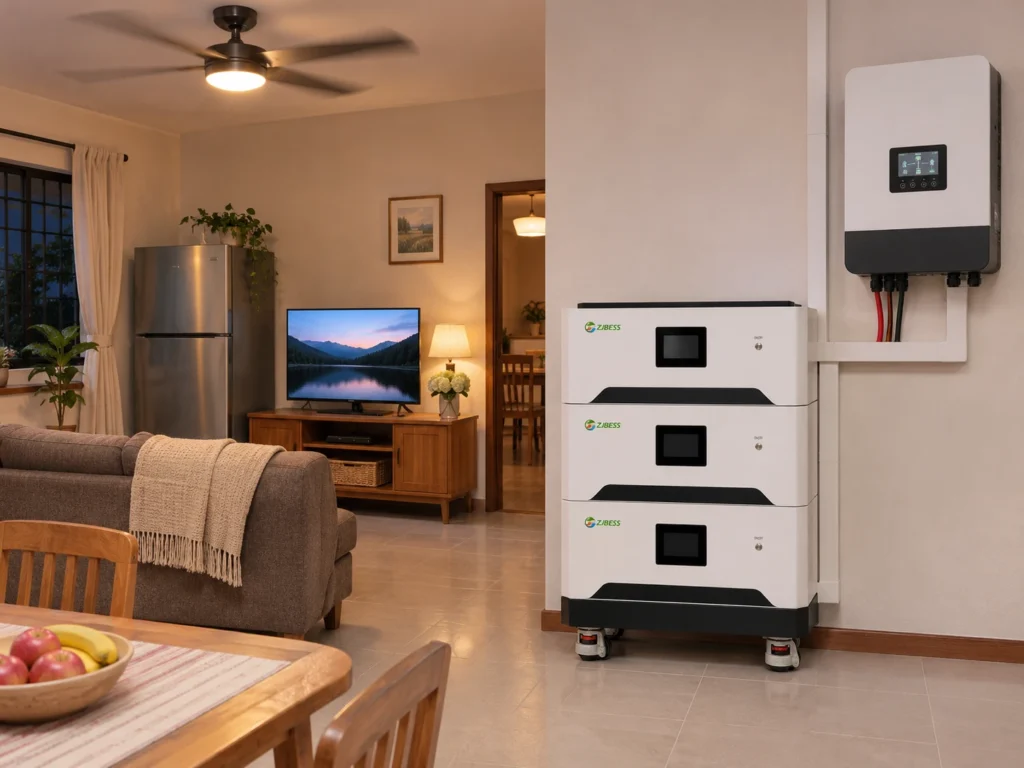
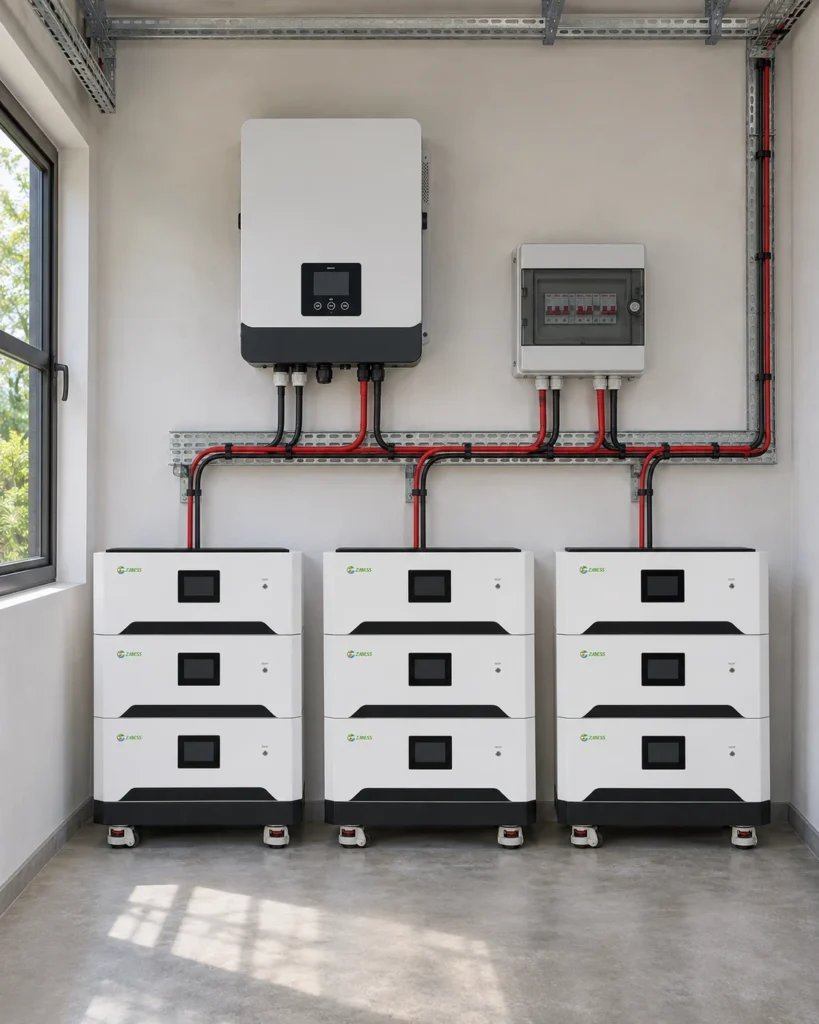
The ZJBESS DD5KW stack is a 15.36kWh, 51.2V 300Ah stackable LiFePO4 battery built from three 5.12kWh modules on a wheeled base. One stack runs a 1kW load for about 12.7 hours and carries a 48V inverter up to 8kW, and every module has its own touch screen. Built and tested in our factory in Shandong, China.
- 15.36kWh from three 5.12kWh DD5KW modules · 51.2V 300Ah
- 18 inverter protocols, selected on the 3.5-inch touch screen
- 8,000+ cycles at 25°C, 0.5C, 100% DOD · 10-year warranty
- Add modules up to 15 for 76.8kWh
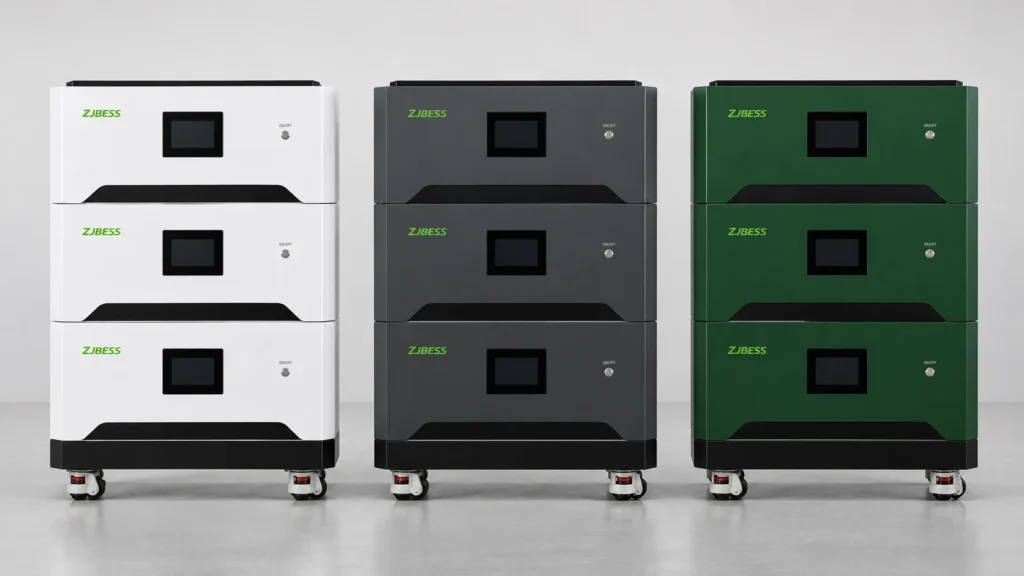
Three 5kWh modules, one 15kWh battery
The DD5KW is the stackable model in the ZJBESS home battery range. Each 5.12kWh module holds Grade A 3.2V LiFePO4 cells in a 16-series, 51.2V pack with steel banding and its own 3.5-inch touch screen. Three modules stack on a wheeled base to form a 15.36kWh, 300Ah battery with a 481 × 522mm footprint.
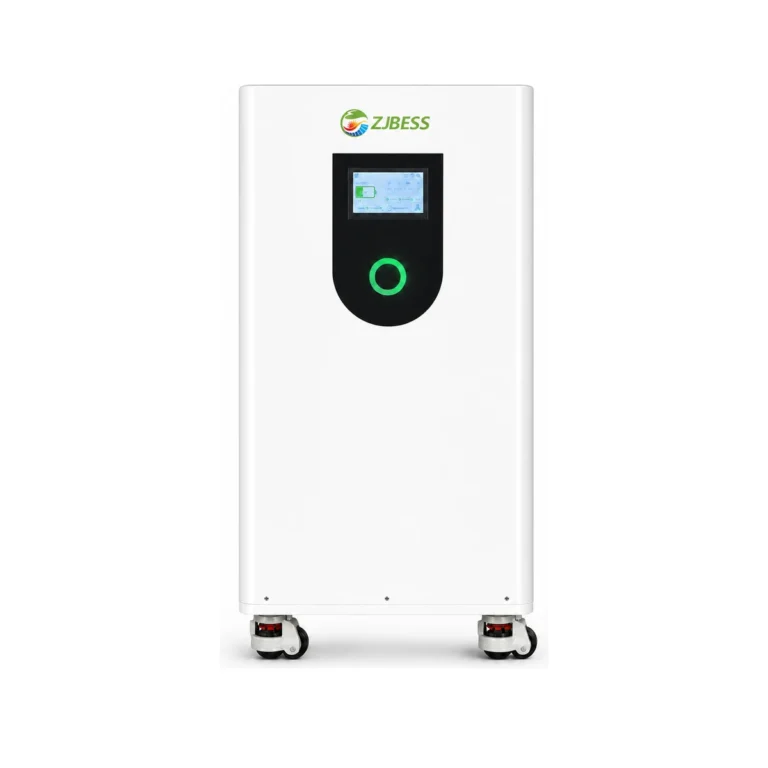
It is a battery-only product. Pair it with any 48V hybrid or off-grid inverter that uses one of the 18 built-in battery protocols, or with a ZJBESS inverter. If the customer prefers one cabinet, the 15kWh floor-standing LS15KW stores the same energy in a single enclosure.
- Carry three light modules instead of one heavy cabinet
- Fit through stairs and narrow doors where a 121kg cabinet cannot
- Start at 15kWh and add modules as loads grow
- Grow to 76.8kWh with the same module SKU
What can a 15kWh stackable battery power?
About 12.7kWh reaches the AC loads from one full three-module stack. That is enough for a full evening and night of essential loads in most homes.
| Average AC load | Typical loads | Runtime, 1 stack | Runtime, 6 modules |
|---|---|---|---|
| 300W | LED lights, router, phone charging | 42 h | 85 h |
| 500W | + fridge, TV, ceiling fans | 25 h | 51 h |
| 1,000W | + laptop, freezer, water pump cycling | 12.7 h | 25 h |
| 2,000W | + 1.5HP inverter air conditioner | 6.4 h | 12.7 h |
| 3,000W | Whole-home daytime use | 4.2 h | 8.5 h |
How many solar panels charge a 15kWh battery? About 3.8kW of PV, or 7 × 550W panels, refills one DD5KW stack in a day with 5 peak sun hours (15.36kWh ÷ 5h ÷ 0.8 system factor = 3.84kW). Add the panels needed for daytime loads on top.
Stackable: carry it in modules, stack it on site
A 126kg battery that arrives as 42kg pieces. Each module is carried in on its own and stacked on the base next to the inverter.
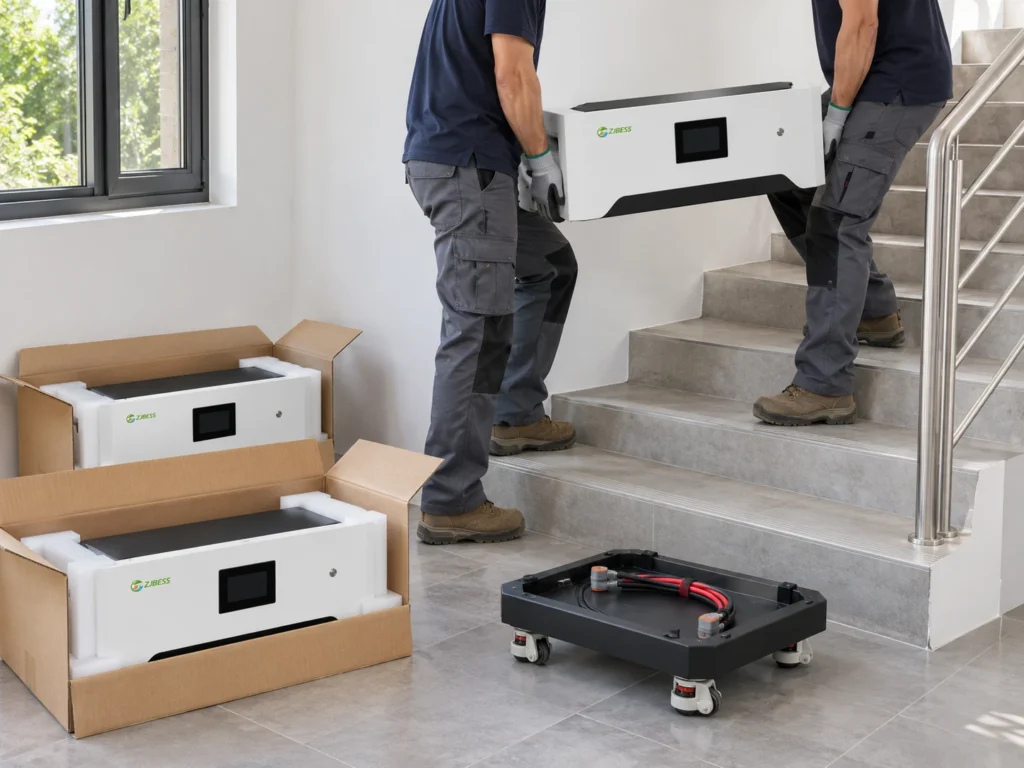
Carry in module by module
Each module averages about 42kg (126kg for three). Two people carry one up stairs or through a narrow door.

Stack on the base
Set the wheeled base beside the inverter and stack the three modules. The footprint is 481 × 522mm.

Add modules later
More DD5KW modules join the same 51.2V bus, up to 15 in total. The customer pays for capacity when they need it.
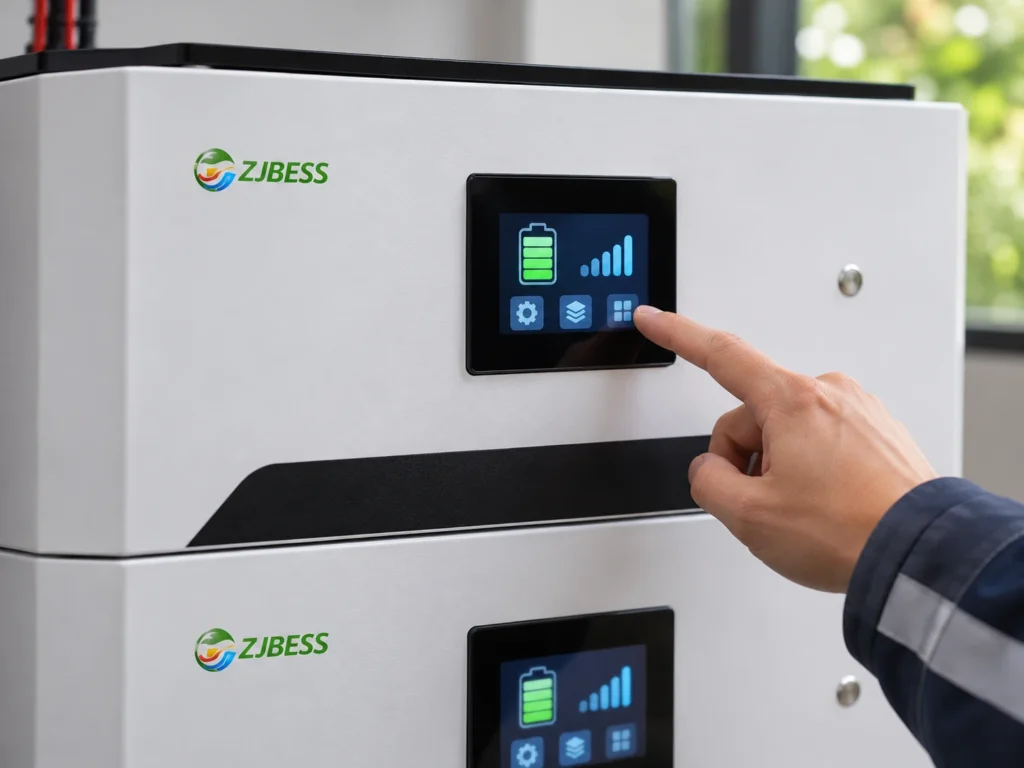
Tap. See. Control. A BMS your installers can read on site
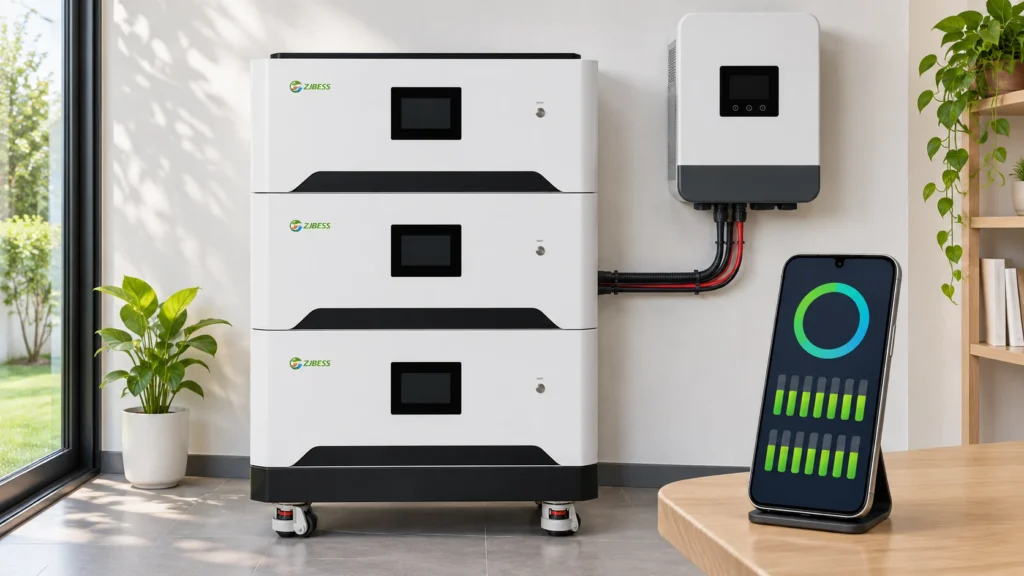
CAN or RS485 to the inverter, Bluetooth and Wi-Fi to the ZJBESS app, and a 3.5-inch touch screen where the installer picks the inverter protocol.
Protocol Direct Select
Pick the inverter brand on the touch screen once; the stack reports as one battery to the inverter.
Three screens, one battery
Each module shows its own state, so a fault is traced to one module and swapped without touching the others.
Cell-level alarms
Voltage and temperature of the 16 series cells inside every module.
Remote service
Wi-Fi monitoring of the whole stack: SOC, alarms and history from your office.
Eight protections, set at the factory
Charging stops at 58.4V
Recommended cut-off 44.8V, BMS cut-off 40V
Stack held within 200A continuous
Instant disconnect on a terminal fault
Charging blocked below 0°C
Charge and discharge stop above 60°C
Stack peak up to 11kW
Balancing and alarm per cell
Key performance advantages of the DD5KW stack
Rated at 25°C, 0.5C and 100% DOD with more than 80% capacity left. One full cycle a day is more than 21 years of cycling, so the 10-year warranty, not cell wear, sets the planning life.
For the three-module 300Ah stack. Carries an 8kW inverter at full output (181A at 48V, 92% efficiency). Recommended maximum load 8.2kW.
Up to 15 DD5KW modules on one 51.2V bus. Energy adds up module by module, voltage stays the same.
Every module has its own 3.5-inch touch screen, so the installer reads each module's state on site.
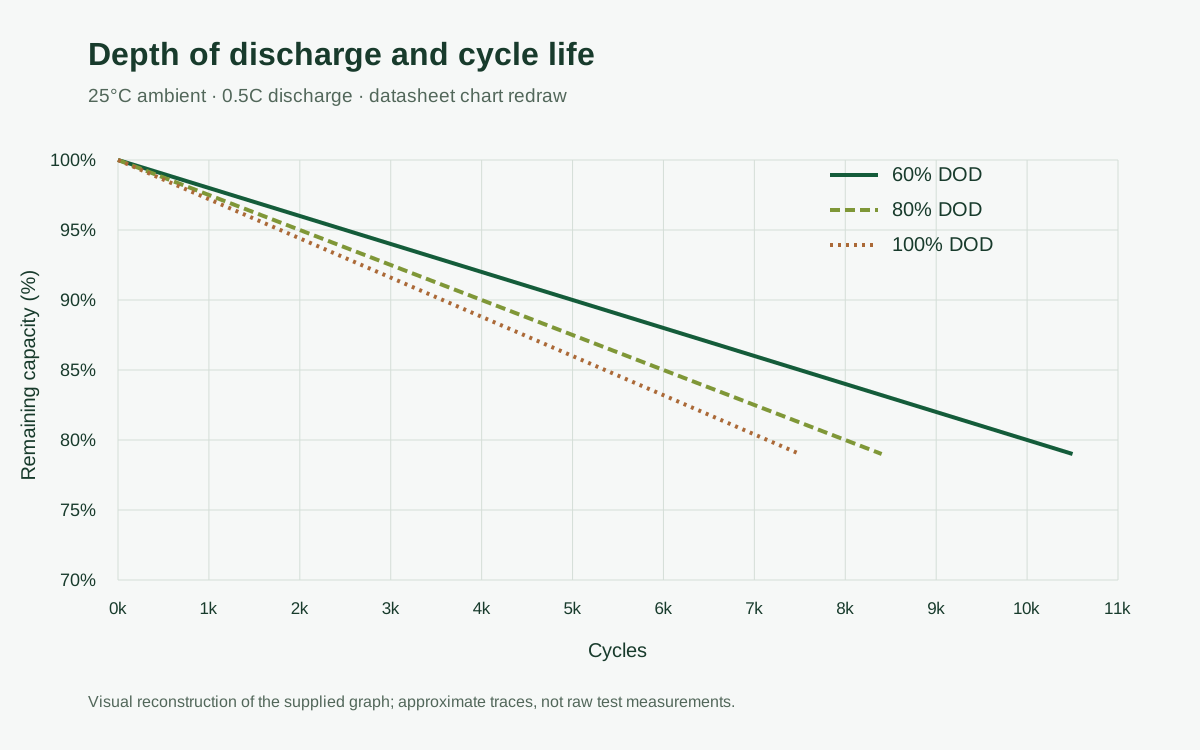
What 8,000+ cycles mean for your customer
At one full cycle a day, 8,000 cycles is more than 21 years of cycling, against 500 to 1,500 cycles for lead-acid at 50% DOD. The 10-year warranty, not cell wear, sets the planning life, and shallower daily cycles extend it further.
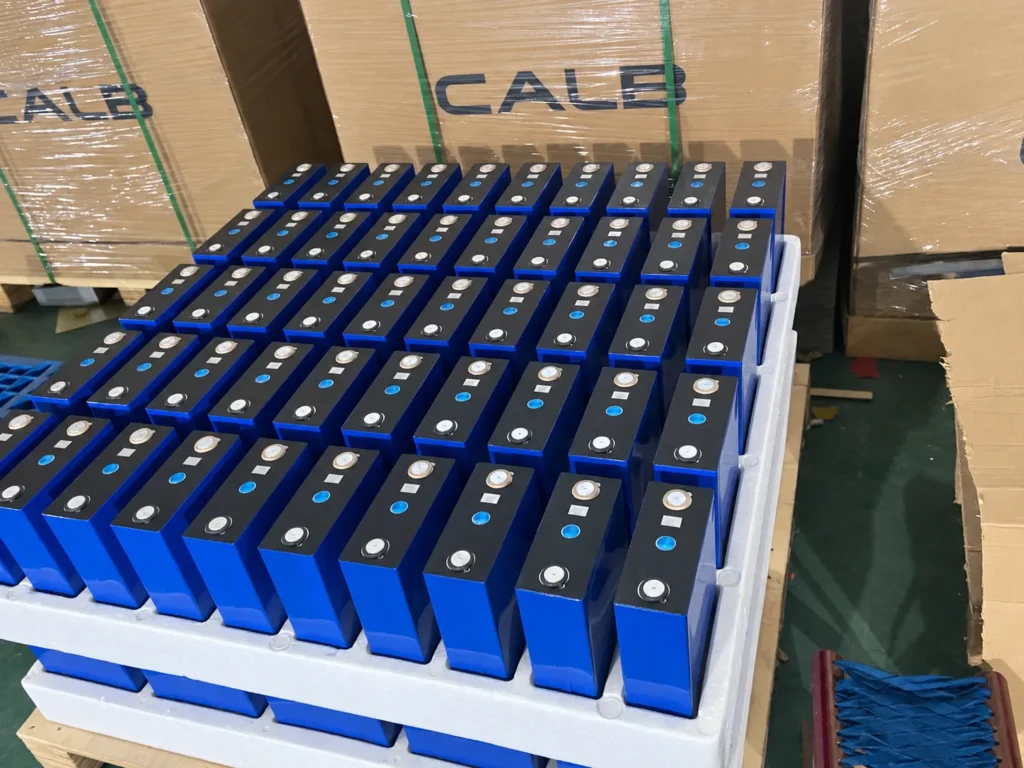
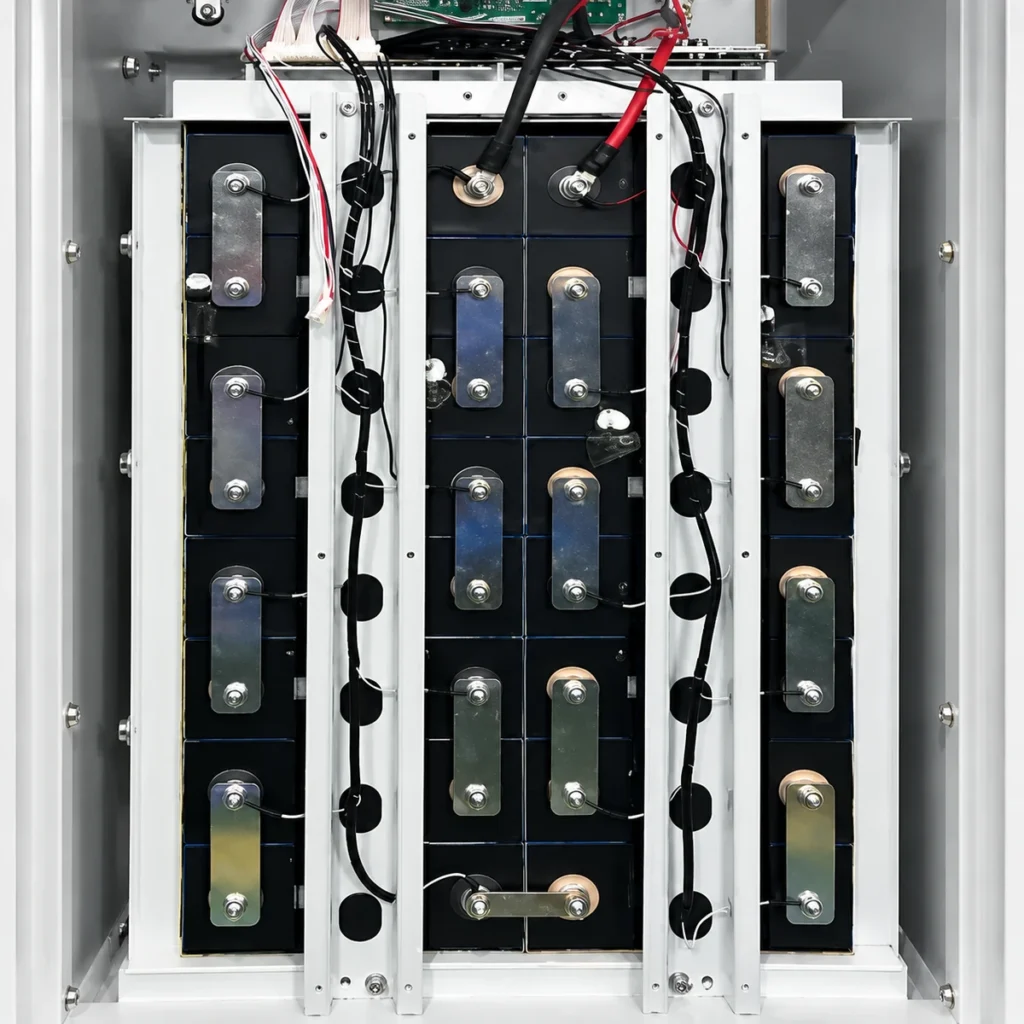
Steel-banded cells in every module
Each module carries its own steel-banded cell pack, the module process used in EV power batteries.
- Steel-banded Grade A cells. New, QR-scanned, matched cells held at constant pressure, which slows capacity fade.
- Rigid modules. Each module stays solid through sea freight, carrying and stacking.
- A screen on each module. Faults are found at module level, so service replaces one module, not the whole battery.


Which inverters work with the DD5KW stack?
Protocols for 18 inverter brands are built in, so the inverter charges by the DD5KW stack BMS limits, not a fixed voltage.
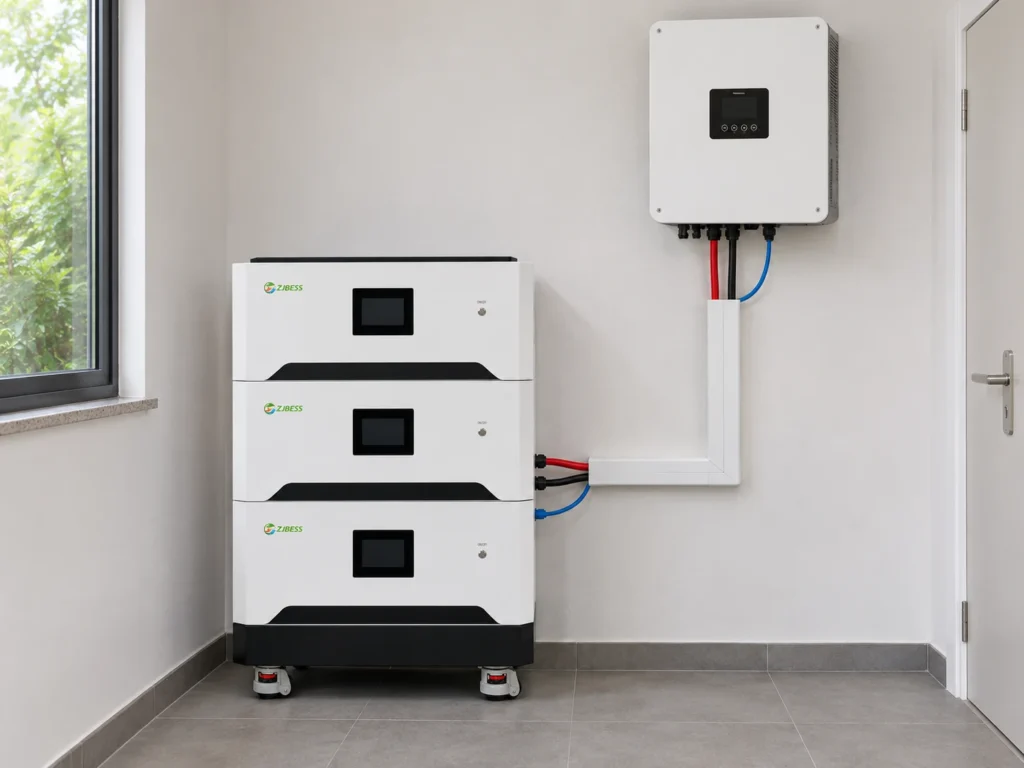
One three-module stack pairs with a 5–8kW inverter such as the ZJBESS 6kW ED; six modules suit the 13.2kW hybrid inverter.
Select the protocol
Choose the inverter brand on the touch screen of the stack.
Connect CAN or RS485
Connect the stack communication port to the inverter BMS port over CAN or RS485.
Set lithium mode
Set the inverter battery type to lithium / BMS communication.
Check the readings
Check that the inverter reads 300Ah for three modules, more if you added modules.
Pre-loaded for your market. Tell us the inverters you sell and our BMS engineers set the protocol before the DD5KW stack is crated. For a brand outside the list, send the model and firmware and we build the match.

Where the DD5KW stack is used

Upstairs homes and apartments
Where a single 121kg cabinet cannot go up the stairs, three 42kg modules can. The stack stands on 0.25m² beside the inverter.

Phased solar upgrades
Install 15kWh now and add DD5KW modules when the customer adds panels, an EV or air conditioning, up to 76.8kWh.

Load-shedding backup
Charge between outages; the hybrid inverter switches the home to battery when the grid drops. One stack runs a 500W essential load for about 25 hours.
From 15kWh to 77kWh, module by module
DD5KW modules share one 51.2V bus, up to 15 modules. Distributors stock one module SKU and build every system size from it.
| Modules | Nominal energy | At the AC loads | Typical system |
|---|---|---|---|
| 3 | 15.36kWh | 12.7kWh | Standard stack, 5–8kW inverter |
| 6 | 30.72kWh | 25.4kWh | Large home, 10–12kW inverter |
| 9 | 46.08kWh | 38.2kWh | Home with daytime AC |
| 12 | 61.44kWh | 50.9kWh | Shop, clinic, small office |
| 15 | 76.8kWh | 63.6kWh | Maximum, 76.8kWh |
DD5KW stack limits your installers should know
15.36kWh is nominal
About 12.7kWh reaches the AC loads after the discharge window and inverter losses. We size on that figure, not the nameplate.
126kg for three
The weight is the three modules only. Add the base when planning the floor.
Battery only, inverter needed
The stack stores DC energy. It needs a 48V hybrid or off-grid inverter, and one stack carries up to about 8kW.
DD5KW modules only
Expand only with DD5KW modules. Mixing other ZJBESS models or brands in one bank is not supported.
Charge above 0°C only
Each module blocks charging below 0°C. Place the stack inside the home, not in an unheated shed.
Level floor for the stack
Stand the base on a flat, solid floor so the stacked modules sit square.
How every DD5KW stack is built and tested
Every DD5KW module passes the eight stations on its own, then three matched modules are paired into one stack. Each module keeps its own serial number and records.

Incoming cell inspection
The cells for each 5.12kWh DD5KW module are scanned on arrival and checked for voltage, internal resistance and casing damage.
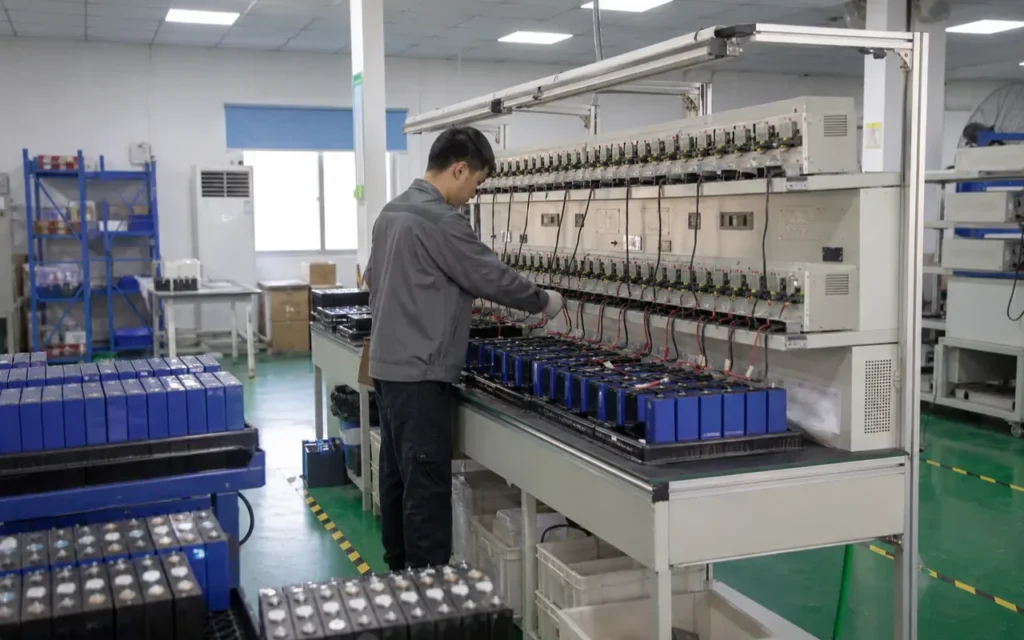
Sorting & matching
Cells are matched inside each module, and the three modules of a stack are matched to each other by capacity.
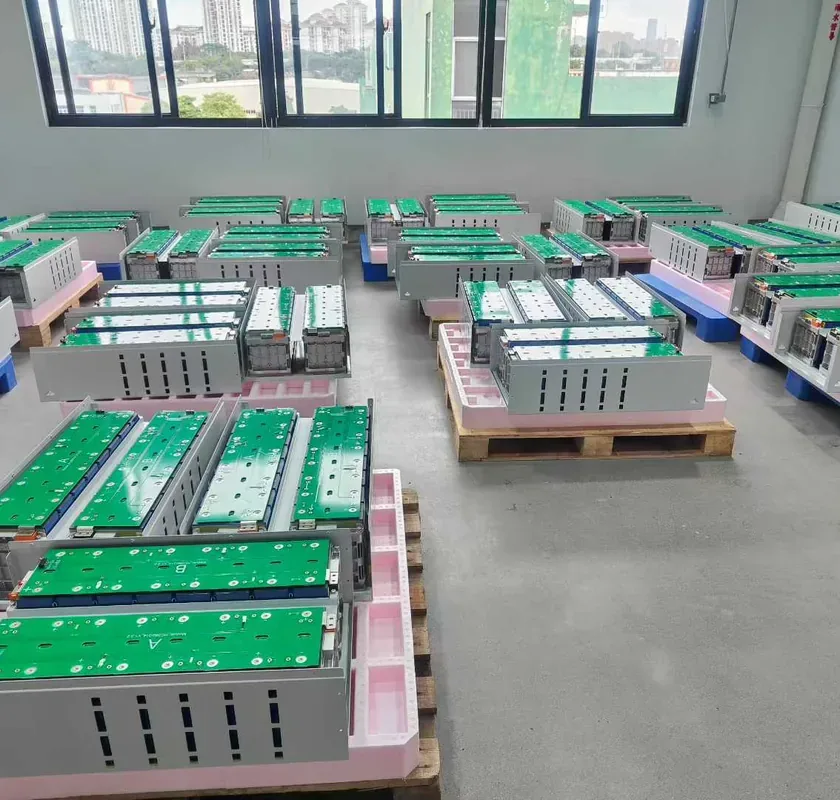
Steel-band module assembly
Each module pack is compressed and steel-banded to fit a 175mm-high module case.

BMS wiring
Every module gets its own BMS and 3.5-inch screen, wired and checked before power-up.

Module integration
Pack, BMS, screen and terminals go into the 481 × 522mm module case.

Charge–discharge aging
Each module is fully charged and discharged; capacity and aging curve are saved per serial number.
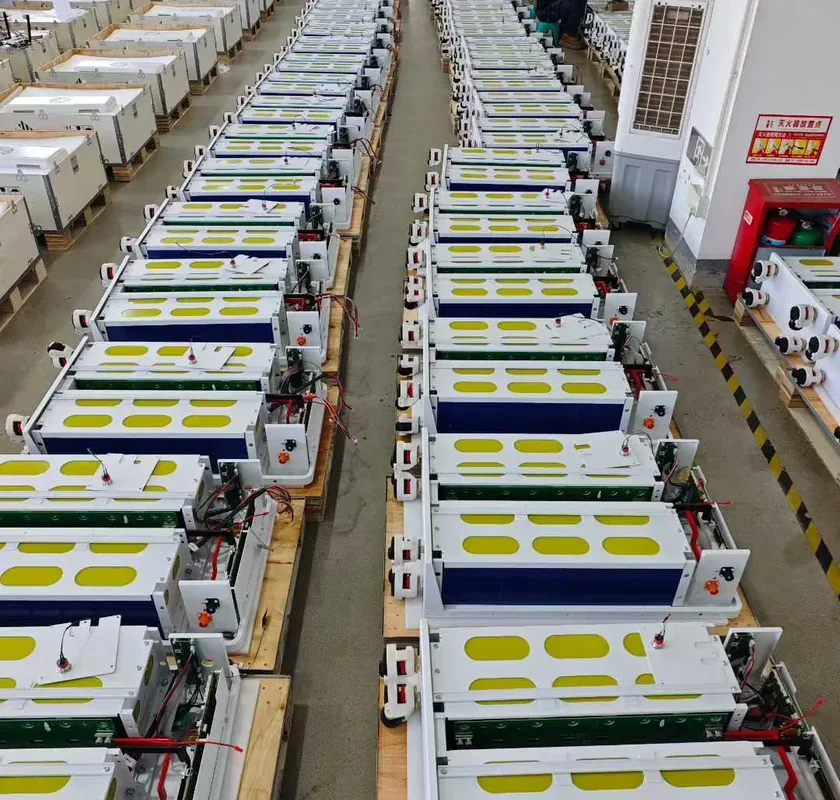
Final inspection & protocol
Module addresses and your inverter protocol are set, so a three-module stack works as one 15.36kWh battery.
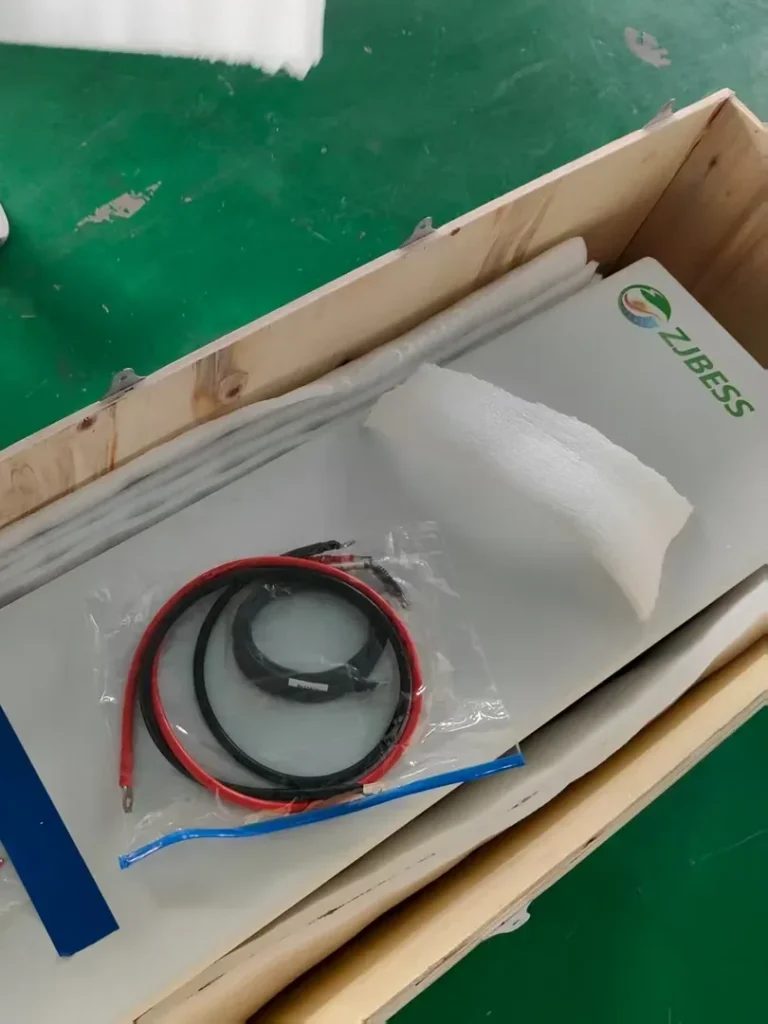
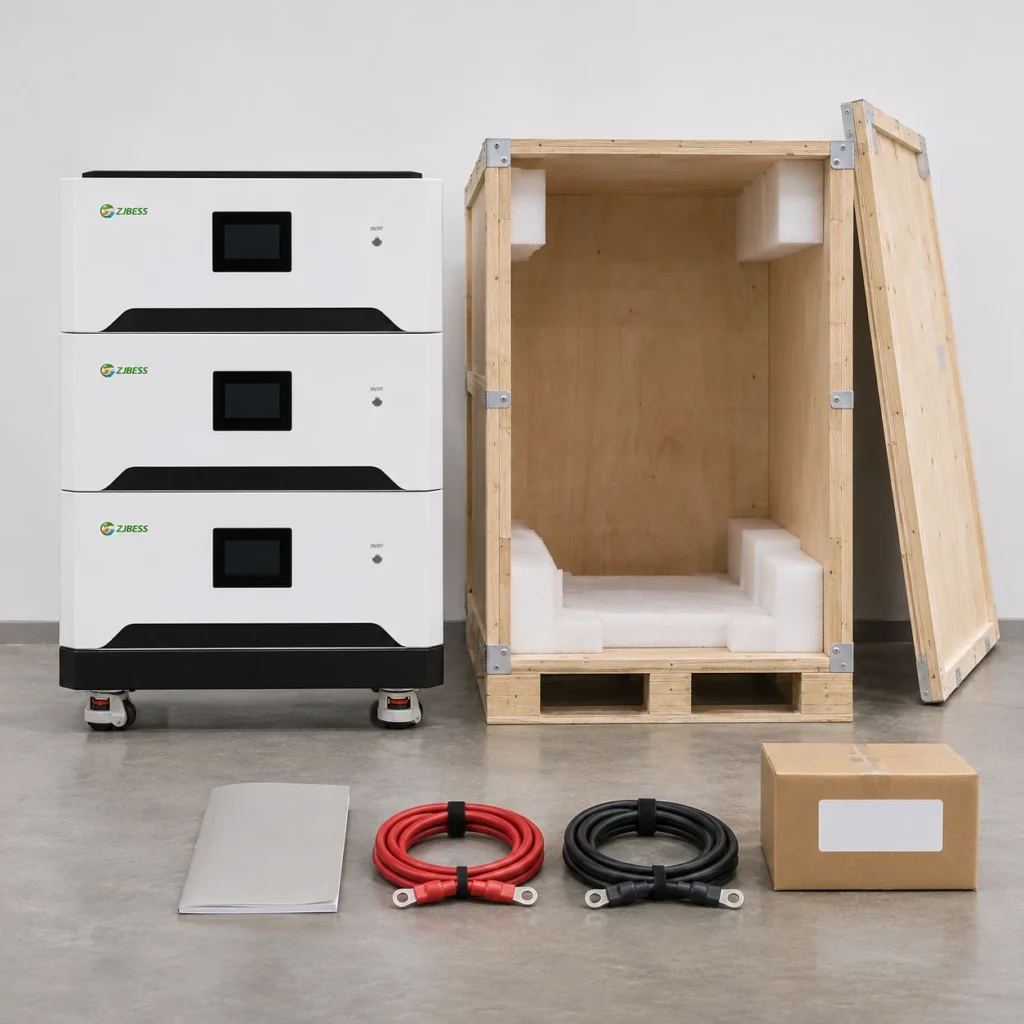
Crating & documents
Modules are packed in UN3480 crates with cables, manual and the QC pack for every module.
Distributor terms for the DD5KW stack
Our published terms for distributors, installers and EPC buyers, written into every DD5KW stack quotation.
Standard DD5KW stacks leave the factory within 15 working days of the confirmed order.
Your logo on every module front and on the boot screens from 3 stacks.
Service answers within 24 hours. A faulty module is replaced on its own; the other two stay in place.
Order one three-module stack to test with your inverters before a pallet or container order. Mixed containers with other ZJBESS models are available.
Included in the DD5KW stack quotation
- Three matched DD5KW modules per stack
- Inter-module and inverter cables, manual
- QC pack and configuration record for each module
- UN38.3 test summary and MSDS for customs
Payment and order options
- One three-module stack for your inverter test
- Extra single modules for later expansion
- Alibaba Trade Assurance or letter of credit (L/C)
DD5KW stack OEM and ODM under your brand
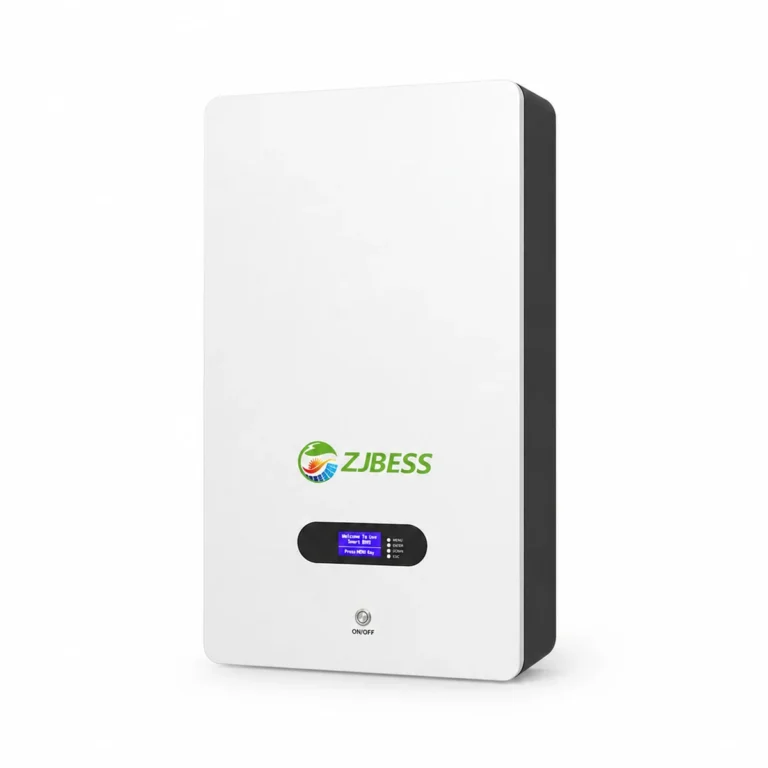
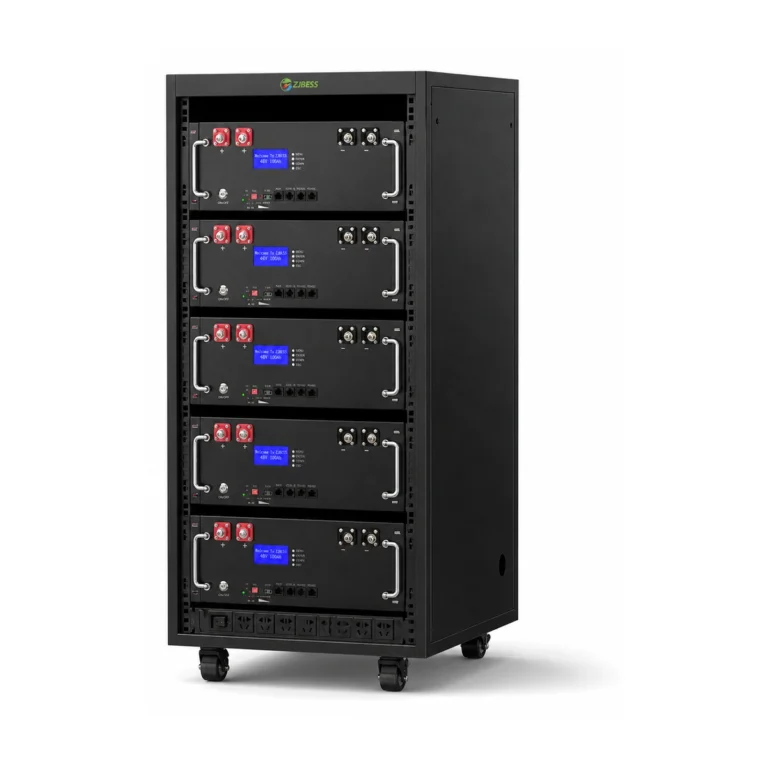
Colour, logo, boot screen, app, carton and manual change for your market; cells, BMS and tests stay the same. For a full range, pair the DD5KW stack with the floor-standing LS15KW, wall-mounted BG10KW or rack-mounted JJ5KW.
Brief
Market, inverters, stack count
Artwork
Module colour and logo proofs
Sample
One branded stack to test
Production
Same eight stations per module
Inspection
Photo, video or third-party check
Shipping
Crated, documented, tracked


ZJBESS home batteries in the field
Nigeria

Philippines

United States
DD5KW stackable battery specifications
The standard three-module stack. Every module carries the same BMS, touch screen and LiFePO4 cell platform.
| Model | DD5KW × 3 · This page15.36kWh51.2V 300AhDatasheet PDF |
|---|---|
| Battery & energy | |
| Nominal energy | 15.36kWh |
| Nominal capacity | 300Ah |
| Cell configuration | 16S LiFePO4 · 300Ah |
| Nominal voltage | 51.2V |
| Chemistry | LiFePO4, Grade A prismatic cells |
| Recommended SOC window | 0–100% |
| Internal resistance | ≤50mΩ @ 50% SOC |
| Cycle life | 8,000+ cycles (25°C, 0.5C, 100% DOD, >80% capacity) |
| Charge & discharge | |
| Charge voltage (recommended / BMS cut-off) | 57.6V / 58.4V |
| Low-voltage disconnect (recommended / BMS) | ≤44.8V / ≤40V |
| Balancing start voltage | ≥52.8V |
| Charge / continuous discharge current | ≤100A / ≤200A |
| Load power (recommended / ultimate) | ≥8.2kW / ≥11kW |
| Communication & expansion | |
| Inverter communication | CAN / RS485 / RS232 |
| Wireless | Bluetooth (app) · Wi-Fi (remote monitoring) |
| Display | 3.5-inch touch screen |
| Inverter protocols | 18 brands built in, selected on screen |
| Max. parallel | 15 modules (5 stacks of 3) |
| Max. parallel energy | 76.8kWh |
| Environment | |
| Temperature (charge / discharge / storage) | 0 to 60°C / −30 to 60°C / −30 to 60°C |
| Installation location | Indoors or under cover, out of direct sun and rain |
| Mechanical, shipping & warranty | |
| Dimensions | 481 × 522 × 175mm per module |
| Net weight | 126kg (modules only) |
| Installation | Stacked modules on a wheeled base |
| Packing | Wooden crate, UN3480 |
| Transport and EU documents | UN38.3 test summary and MSDS with the quotation; CE EMC, RoHS |
| Warranty | 10 years, free replacement of covered faults |
Certificates
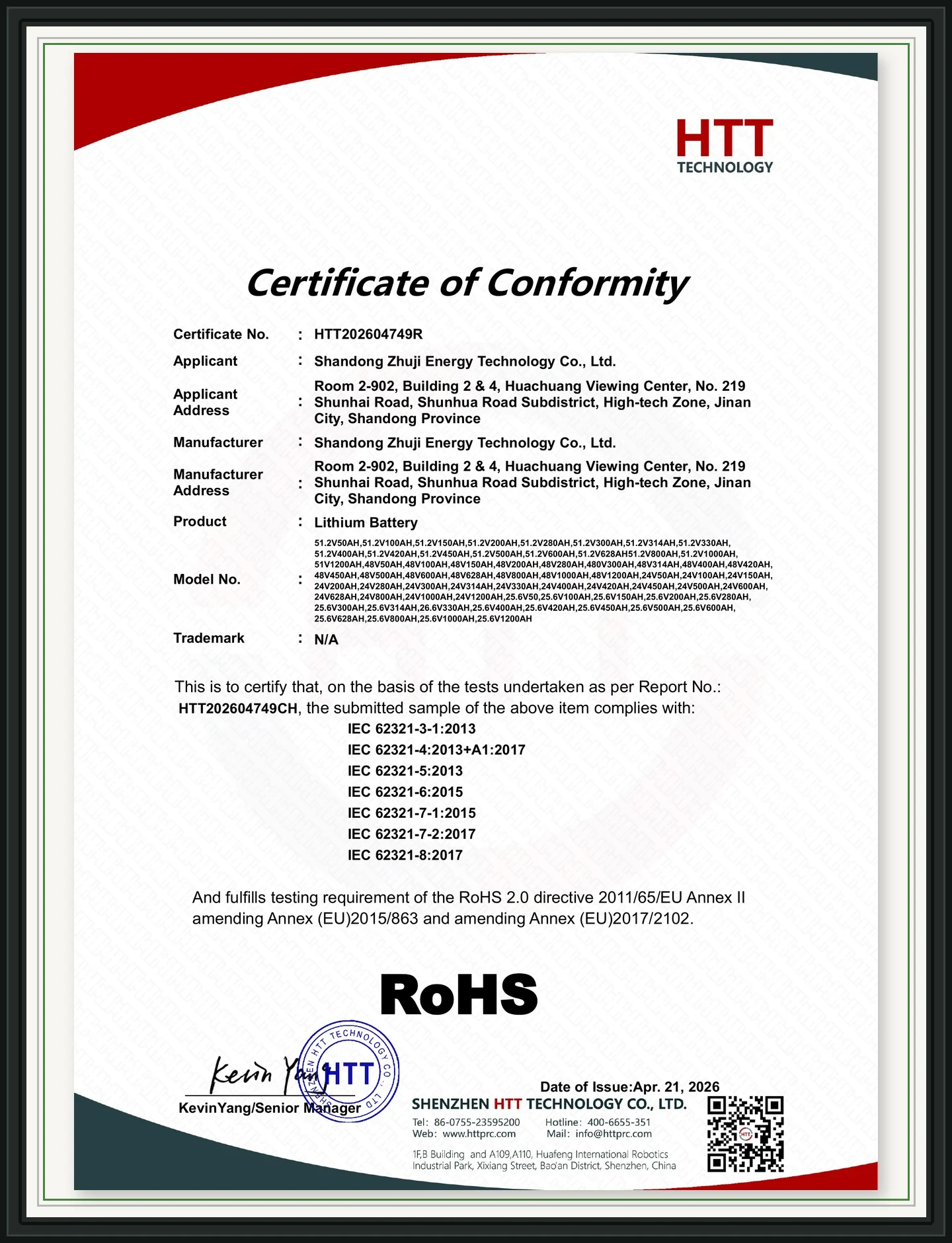
ZJBESS 51.2V LiFePO4 battery model families hold CE EMC certificate HTT202604749E and RoHS certificate HTT202604749R, issued by HTT in April 2026. The UN38.3 test summary and MSDS for the DD5KW stack come with your quotation.

DD5KW stack 15kWh battery FAQs
What distributors, installers and EPC buyers ask us before ordering.
How much does each DD5KW module weigh?
The three modules of a stack weigh 126kg together, about 42kg each. Two people carry one module up stairs or through a narrow door, so the battery reaches rooms a one-piece 121kg cabinet cannot.
How long will a 15kWh stackable battery last?
One three-module stack delivers about 12.7kWh to the AC loads: 25 hours at 500W, 12.7 hours at 1kW or 4.2 hours at 3kW. Six modules double those figures. The basis is 15.36kWh × 90% × 92%.
How many DD5KW modules can be stacked?
The standard set is three modules for 15.36kWh. Up to 15 DD5KW modules run on one 51.2V bus, for 76.8kWh. Tell us the final count and we set the addresses and supply the connection cables.
Can I start with one stack and add modules later?
Yes. Install three modules now and add DD5KW modules as loads grow. Give us the serial numbers of the installed modules so the new ones ship with a matching BMS version.
What size inverter can a DD5KW stack run?
A three-module stack runs a 48V inverter up to 8kW: about 181A at full output, inside the 200A stack rating. For a 10–12kW inverter, use six modules.
What happens if one module fails?
Its own screen and the app show which module has the alarm. Under the 10-year warranty that module is replaced; the other modules keep their place in the stack. How warranty claims work
How much floor space does the stack need?
A 481 × 522mm footprint, about 0.25m². Three modules stand about 525mm high plus the wheeled base. Leave space in front for the screens and cables.
Stackable or one floor-standing cabinet: which is better?
Stackable is easier to carry and to expand module by module. A single cabinet like the LS15KW has fewer connections. Both store 15.36kWh on the same BMS platform. Rack vs wall vs floor-standing
Which inverters work with the DD5KW stack?
18 brands are built into the BMS, including Pylontech protocol, Growatt, Deye, Victron, SMA, GoodWe and Solis. Connect the stack to the inverter over CAN or RS485. See our inverter compatibility guide.
How many solar panels charge a 15kWh stack?
About 3.8kW of PV, or seven 550W panels, with 5 peak sun hours (15.36kWh ÷ 5h ÷ 0.8 = 3.84kW). Add panels for daytime loads on top.
Can I order a DD5KW stack under my own brand?
Yes, from 3 stacks: module colour, front logo, boot screens and app. We suggest one stack first to test with your inverters. OEM / ODM
DD5KW stack documents
| Document | What it shows | How to get it |
|---|---|---|
| DD5KW × 3 datasheet | Electrical ratings, temperatures, dimensions, compatible inverters | Download PDF |
| Per-unit QC pack | Serial number, cell QR codes, IR matching report, aging curve | In every DD5KW stack crate |
| Configuration record | BMS version, inverter model and firmware, protocol and settings | With your order |
| UN38.3 test summary, MSDS, CE EMC and RoHS certificates | For customs and tenders | With your quotation |
| DD5KW stack manual and warranty card | Installation, settings, maintenance, claim process | With your quotation |
Guides for your sales team: sizing · inverter compatibility · rack vs wall vs floor-standing · sample acceptance test · 48V supplier checklist
ZJBESS Home Batteries
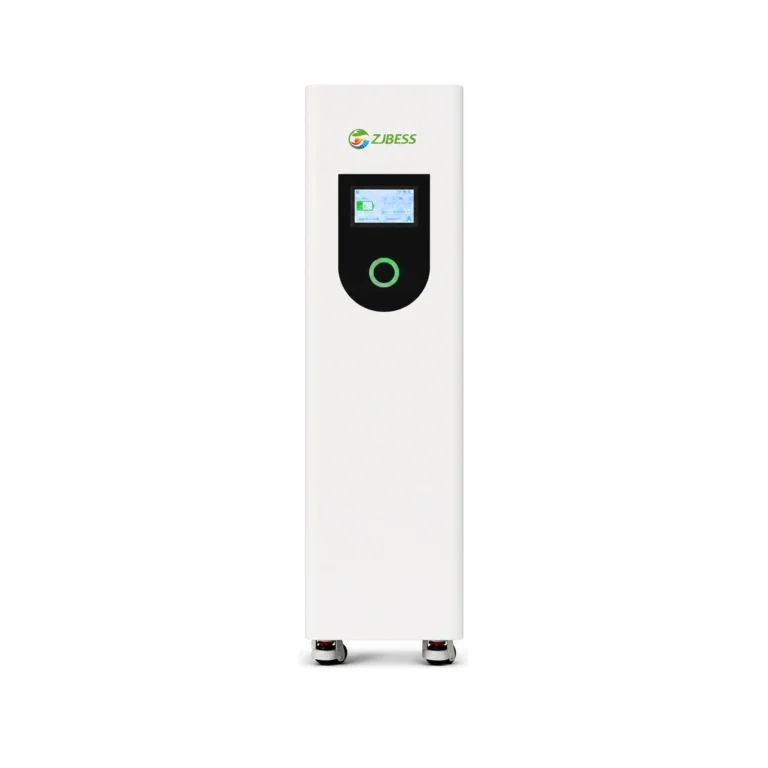
Compare other ZJBESS home battery formats when a stackable 15kWh battery is not the right physical layout.


Get a Wholesale Quote
Tell us your required battery capacity, application and inverter model. We will confirm the suitable configuration before quotation.