
A LiFePO4 battery sample acceptance test should answer a defined purchasing question about an identified unit, using an agreed method and a result that can be traced back to the readings. A video of a battery powering a load can demonstrate one function. A discharge-energy result can support a different decision. Neither, on its own, establishes that every unit in a future order will perform the same way.
For distributors, the difficult part is often interpreting two plausible reports. One measures energy at the battery terminals; another measures after the inverter. One stops under a system setting; another uses a manufacturer-defined endpoint. Both may describe what happened, while answering different questions. This guide explains how to make those differences visible and how they change an acceptance decision. The numerical records are hypothetical examples, not ZJBESS test results or operating instructions.
Define the decision before choosing the measurements
Separate receiving inspection, functional evaluation, energy measurement and production-lot acceptance. Receiving the right model with the ordered accessories resolves an identity and delivery question. Observing a connected load operate resolves a limited functional question. Measuring discharge energy requires a defined boundary, preparation, load profile and endpoint. Approving a future production lot requires evidence about units beyond the initial sample.
The agreed question determines the useful evidence. If the question is whether a proposed inverter configuration exchanges the intended control information, the relevant record includes exact equipment, firmware, operating mode and messages. A long discharge run without those details may leave that question unresolved. The battery–inverter compatibility guide addresses that configuration review. If the problem is conflicting specifications, the battery documentation checklist comes first.
For an energy question, identify the quantity and its acceptance rule before running the test. “At least the agreed DC discharge energy under method X” is different from “operate this AC load for the required period.” The first needs a measurement of energy at the specified point; the second also depends on the inverter, load and operating conditions. A result can satisfy one requirement while leaving the other open.
The supplier and responsible technical team should agree the model-specific method, limits, permitted configuration and stop conditions. Purchasing agrees the decision the report must support and the required evidence. A sample evaluation is not a reason to bypass protection, open an enclosure or invent test settings. This article concerns planning and interpretation; the applicable procedure and competent personnel govern the work itself.
Put the measurement boundary on the record
Draw the boundary before comparing two kWh values. Battery-terminal DC energy, inverter AC output energy and energy consumed by a selected load describe different locations. Components and auxiliary loads between those locations can change the totals. The meter name alone does not say which components are included.
The Sandia and PNNL performance protocol, April 2016, Sections 4.2 and 5.1, provides a useful methodological reference: describe the storage system and its included equipment, and acquire the relevant measurements together at a resolution appropriate to the application. It does not certify a ZJBESS model or provide a universal purchase acceptance limit.
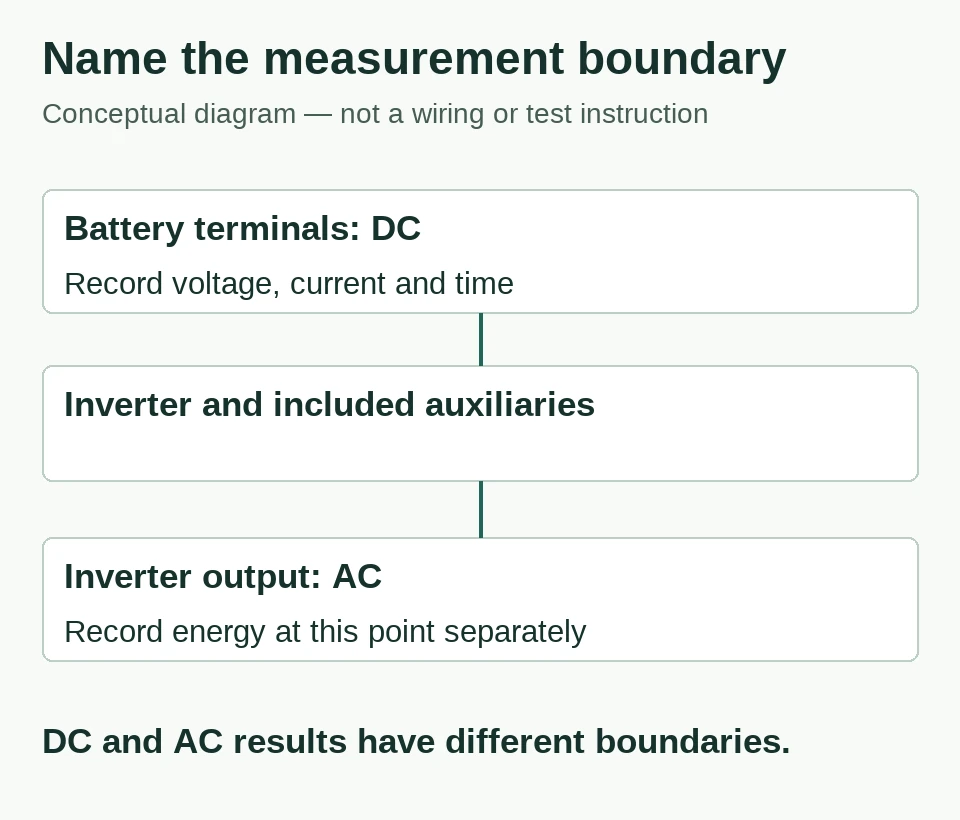
Figure 1. A battery-terminal result and an inverter-output result include different parts of the energy path. This is a measurement-boundary diagram, not a wiring instruction.
Suppose a fictional report lists 3.06 kWh delivered at the battery DC terminals and another lists 2.75 kWh at the inverter AC output. Their difference is 0.31 kWh. Dividing 2.75 by 3.06 gives about 89.9%. That ratio is meaningful as an observed boundary-to-boundary energy ratio only if the readings cover the same run and time interval, with no unaccounted energy sources and with the included loads understood. It is not automatically a battery capacity ratio or a standalone inverter efficiency specification.
If the two readings come from different runs, even that interpretation becomes uncertain: starting condition, temperature and endpoint may have changed. Subtracting them cannot allocate the difference among conversion, auxiliary use, an early stop or a changed battery condition. The first useful question is where and when each value was measured, before asking which component caused a shortfall.
Preserve the conditions that make a result comparable
A repeatable result needs more than a model name. Identify the actual sample and relevant configuration, then describe how the run began, what it experienced and why it ended. A different starting state changes the energy available to the run. A different endpoint changes how much of that energy the method counts. Neither is corrected by giving the final number more decimal places.
Use the applicable manufacturer preparation method rather than treating a displayed SOC percentage as a complete initial condition. Preserve the completion or rest condition specified by that method, the source of SOC information and relevant timestamps. For temperature, distinguish ambient air from a battery-reported channel and retain its source. The cold-weather charging guide explains why a room temperature and an internal battery-related reading need not agree.

Figure 2. A result belongs to its preparation, profile and ending condition. The diagram assigns no operating values or ZJBESS test procedure.
| Part of the record | What it must distinguish |
| Unit and configuration | Sample identity, connected equipment, relevant hardware/firmware and method revision |
| Preparation and starting state | How the run reached its initial condition, including the method-defined completion or rest condition |
| Environment and temperature | Which channel was measured, its unit and source, and changes during the run |
| Applied profile | Constant current, constant power or variable demand, with the actual recorded history |
| Endpoint and interruption | Planned end condition versus an inverter limit, lost source, alarm or protection response |
| Measurement system | Meter location, units, time basis, integration method and relevant calibration/verification record |
The load profile matters because current and power are not interchangeable. For constant power, P = V × I implies that the required current rises as voltage falls, if the equipment continues holding that power. Constant current instead allows power to change with voltage. Consequently, two runs with the same approximate average power need not expose the battery and controls to the same current history.
Keep the actual end event. “The inverter stopped” describes an observation; it does not show that the sample reached the endpoint specified in a battery capacity method. A protection event should be interpreted under the applicable procedure. The remaining work may be to resolve the configuration or interruption, rather than label the battery as having lost capacity.
Calculate Ah and Wh from the quantities actually recorded
Ampere-hours measure charge; watt-hours measure energy. For a constant-current interval, charge equals current multiplied by duration in hours. Energy also includes voltage. When voltage varies, accumulating measured voltage × current × time is different from multiplying total Ah by a nominal voltage.
Consider this deliberately simplified partial discharge record. Each interval is assumed constant, with positive current defined as discharge at the battery DC terminals. These values illustrate arithmetic only; they are not a recommended profile or a complete capacity test.
| Interval | Voltage V | Current A | Time h | Charge Ah | Energy Wh |
| First | 52 | 60 | 0.5 | 30 | 1,560 |
| Second | 50 | 60 | 0.5 | 30 | 1,500 |
| Total | Varies | 60 | 1 | 60 | 3,060 |
The charge is 60 × 0.5 + 60 × 0.5 = 60 Ah. The energy is 52 × 60 × 0.5 + 50 × 60 × 0.5 = 3,060 Wh, or 3.06 kWh. Using a fixed nominal 51.2 V would give 3,072 Wh instead. The 12 Wh difference arises from the voltage representation in this example; it does not establish an instrument error or an allowed product tolerance.

Figure 3. Equal Ah can correspond to different Wh. These are assumed interval values, not a measured discharge curve.
A real logger may integrate much more frequently than its exported rows. Preserve whether a column contains instantaneous readings, interval averages or accumulated energy. A cumulative Wh counter should normally be interpreted through its change over the relevant run, accounting for resets and the stated meter method; summing successive cumulative readings counts the same earlier energy repeatedly.
Multiplying separately averaged voltage and current also needs care when both vary. In another fictional one-hour record, voltage/current are 52 V/20 A for half an hour and 50 V/100 A for half an hour. The interval calculation gives 520 + 2,500 = 3,020 Wh. Multiplying the separately averaged 51 V and 60 A by one hour gives 3,060 Wh. That 40 Wh difference shows why preserving the relationship between simultaneous readings matters.
Make timestamps and missing data visible
A logging interval determines what an exported record can reveal. It does not, by itself, define the internal measurement rate of an instrument. A meter can integrate energy continuously while exporting infrequent totals; another file may contain only occasional snapshots. These files do not support the same reconstruction.
Imagine a hypothetical 3 kW demand lasting one minute between two snapshots that both show zero power. Its energy is 3 × 1/60 = 0.05 kWh, or 50 Wh. A reconstruction based only on the two zero readings would miss that event. An independently integrated energy register might still capture it. The example shows a limitation of the exported snapshots, not a fault in every logger with a long export interval.
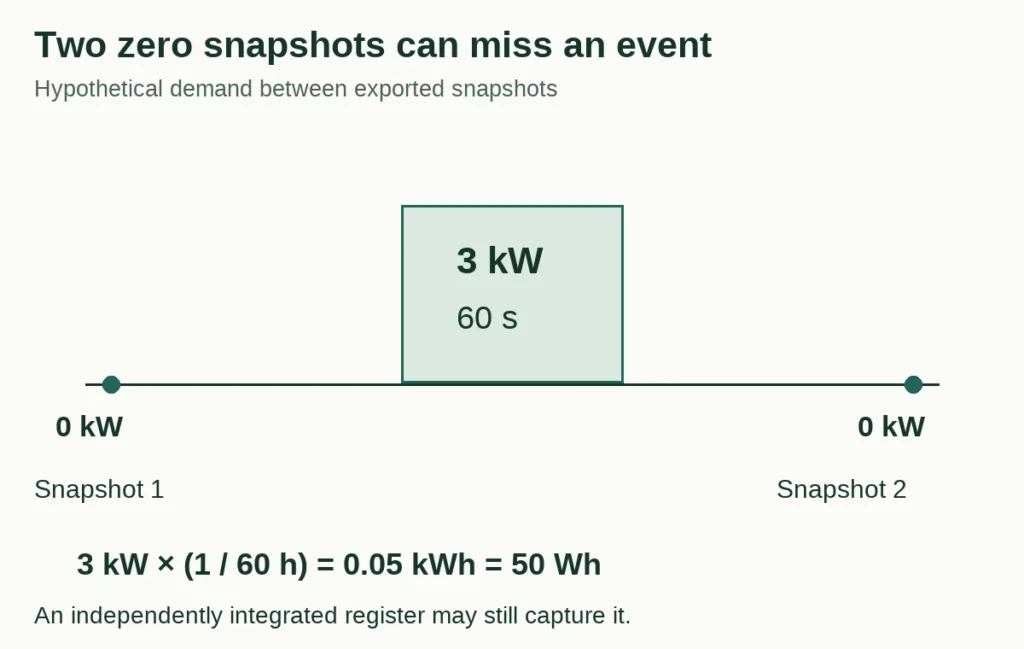
Figure 4. Endpoint snapshots can miss an event between them. The event is hypothetical and no universal sampling interval is prescribed.
Record timezone or a common elapsed-time reference, clock alignment, missing intervals, counter resets and any manual edits. If one file uses seconds and another uses minutes, the duration conversion directly changes calculated energy. If an alarm and a current change are timestamped on different clocks, their apparent order may be wrong.
A gap should remain a gap. Quietly filling it with the preceding value converts an assumption into apparent evidence. If the technical reviewer chooses an estimation method, retain the original data, identify the affected interval and explain how the assumption changes the result. Where the missing portion can change the acceptance decision, resolve the measurement before treating the total as conclusive.
Agree how uncertainty affects a result near the limit
Display resolution is not measurement accuracy. A meter showing three decimal places does not establish that the last digit is reliable, and a calibration record does not remove every source of uncertainty in the full measurement setup. The record should identify the measurement system and the uncertainty information relevant to the decision.
NIST Technical Note 1297 explains expanded uncertainty as an interval around a measurement result, with the coverage basis stated. That interval should not be described as an absolute guarantee. The acceptance decision still needs an agreed rule for how the measurement and its uncertainty are compared with a requirement.
For a fictional exercise, suppose the required minimum is 3.00 kWh for a precisely defined partial-run method. The result is 3.06 kWh with an illustrative expanded uncertainty of ±0.08 kWh, whose evaluation and coverage basis would have to be supplied by the measurement team. Its stated interval is 2.98–3.14 kWh. The central value exceeds 3.00, but part of the interval is below it.

Figure 5. An agreed decision rule changes how a near-limit result is treated. The threshold and uncertainty are illustrative, not ZJBESS capacity limits or instrument specifications.
If the parties had agreed a conservative rule requiring the lower end of the stated interval to meet the minimum, 3.06 − 0.08 = 2.98 would not meet that rule. A hypothetical 3.12 ±0.08 kWh result would have a lower end of 3.04 and would meet that particular rule, assuming the method and uncertainty statement are applicable. Other rules allocate decision risk differently and must be identified rather than silently substituted after a result arrives.
Not meeting a conservative acceptance rule is also different from proving the battery’s true value is below the specification. Report the numerical result, uncertainty statement, rule and resulting disposition separately. This keeps a purchasing decision from becoming an unsupported diagnosis.
Compare repeat runs before assigning a root cause
When two runs differ, first ask whether they are comparable. A repeat under the same defined method can reveal variation. A run after changing firmware, measurement point, profile or endpoint answers a changed question. Keep both records and identify the change explicitly.
Suppose fictional run A reports 2.75 kWh at the AC output and stops at an inverter setting. Run B reports 3.06 kWh at the battery DC terminals and stops under a battery-specific method. The difference does not isolate battery degradation. Even if B happened later, elapsed time does not remove the two method changes. A meaningful follow-up would compare the same boundary and applicable method while preserving the configuration and events.

Figure 6. Method differences can explain why results are not directly comparable without proving a particular root cause.
| Observation | Evidence that helps distinguish explanations | What it does not establish alone |
| Energy is lower on a repeat | Preparation, temperature, profile, endpoint, versions and uncertainty | Permanent capacity loss |
| Displayed SOC changes suddenly | SOC source, synchronized voltage/current history and relevant controller events | A measured change in physical stored energy of the same size |
| Output stops unexpectedly | Original alarm/event record, command state and applicable method | Which component caused the interruption |
| Another inverter behaves differently | Exact pairing, firmware, mode, measurement boundary and profile | Universal incompatibility of the battery model |
If a configuration change resolves an observation, describe what was changed and what was subsequently observed. Do not erase the first record or claim the original root cause has been proven without enough distinguishing evidence. A reviewer may accept the identified sample for one configuration while leaving a different configuration pending.
Keep a successful sample separate from production lot acceptance
A sample conclusion applies to the identified unit, configuration, conditions and question. A single energy run does not demonstrate cycle life, operation across every temperature, all inverter pairings or consistency across untested production units. A supplier-selected demonstration unit also is not automatically a random sample from the shipment being purchased.
NIST’s acceptance-sampling guidance treats lot acceptance as a decision based on a sampling plan, distinct from longer-term process quality control. Its binomial sampling example makes the large-lot approximation explicit. Those ideas explain why the sampling method and the disposition rule matter, rather than making one good sample a batch guarantee.
As a numerical illustration, assume independent random selections from a very large lot and an assumed 5% fraction that would fail a defined check. The probability that one selected unit passes is 0.95. The probability of seeing no failing units in ten such selections is 0.95 raised to the tenth power, approximately 59.9%. Seeing a pass, even several passes, can therefore occur under that assumed fraction. This is not an estimate of a ZJBESS defect rate or a recommended sample size.

Figure 7. No observed failures does not prove no failures exist. The assumed fraction and sampling model are illustrative; a finite lot or non-random selection requires different treatment.
The production agreement should therefore identify the lot, selection method, checks, acceptance/rejection rule, traceability and response to a nonconforming result. The appropriate plan depends on the characteristic, risk and purchase requirements. Increasing a number on a sample sheet without defining those elements does not create a defensible plan, and repeating a test on the same unit does not create ten independent production samples.
Retain a report that purchasing and service can use
Keep the agreed question and criteria, sample/configuration identity, method reference, preparation, measurement setup, raw files, event history, calculations, uncertainty where relevant, deviations and signed decision together. Distinguish the observed result from the acceptance disposition and any unresolved technical interpretation.
A compact conclusion might say that the identified unit met a named functional requirement in one documented configuration, while a discharge-energy decision remains pending because its endpoint was not recorded. That is more useful than marking the entire sample “pass” and leaving the limitation in an unrelated email. Resolved and pending decisions can then be carried into the order without claiming more than the evidence supports.
Retain the approved sample identity and the relevant configuration reference for future deliveries. A change in supplied hardware or firmware may require review of the affected evidence; the initial sample result does not silently transfer to every later revision. Unknown engineering fields belong with the supplier or responsible technical team, rather than being guessed by the buyer.
Request a ZJBESS sample around a defined test question
For a proposed LS15KW floor-standing battery or BG10KW wall-mounted battery, send the intended application, exact inverter model if involved, expected load or operating task, and the decision the sample needs to support. Ask ZJBESS which model-specific procedure, limits and configuration documents apply before the evaluation is agreed.
Use ZJBESS Distributor Support to request that review. The buyer can provide the commercial and project details already known. The supplier and responsible technical team should provide the engineering inputs and agree the evidence. The outcome should be a traceable purchasing decision about the proposed configuration, with remaining conditions made clear.
Discuss Your ProjectBack to Blog