
A “200Ah inverter battery” in Nigeria can mean anything from 2.4 kWh to 10.24 kWh of stored energy, which is why quotes for the same Ah figure can differ by a factor of four. Before you compare naira, ask for the battery’s voltage and chemistry, then compare the price per kWh. A 12V 200Ah lead-acid battery and a 51.2V 200Ah LiFePO4 battery are both sold as “200Ah”, yet the second stores more than four times the energy.
For reference, our factory (FOB China) prices for 51.2V LiFePO4 home batteries are US$630 for 5.12 kWh, US$900 for 10.24 kWh and US$1,030 for 15.36 kWh. At the Central Bank of Nigeria’s reference rate of ₦1,353.97 per dollar (16 November 2026), that is about ₦853,000, ₦1.22 million and ₦1.39 million before freight, clearing and installation. The sections below show how those numbers become a price in Lagos, Abuja or Port Harcourt, and how to judge them against the petrol you would otherwise burn.
How much is a 200Ah inverter battery? Start with the voltage
Ah measures charge, not energy. Multiply by the battery’s voltage to get kWh, the number that decides how long your fans, fridge and TV keep running.
| Battery as sold | Nominal voltage | Nominal energy | Typical use in Nigeria |
|---|---|---|---|
| 12V 100Ah | 12 V (lead-acid) / 12.8 V (LiFePO4) | 1.2 / 1.28 kWh | Small 12V inverter, lights and fans |
| 12V 200Ah | 12 V / 12.8 V | 2.4 / 2.56 kWh | The common “200Ah inverter battery” on a 1–1.5 kVA inverter |
| 24V 200Ah | 24 V / 25.6 V | 4.8 / 5.12 kWh | 2.5–3.5 kVA inverters |
| 48V 100Ah | 51.2 V (LiFePO4) | 5.12 kWh | Our JJ5KW rack battery |
| 48V 200Ah | 51.2 V (LiFePO4) | 10.24 kWh | Our BG10KW wall-mounted battery |

Usable energy widens the gap further. Lead-acid batteries are usually cycled to about half their capacity to keep them alive, so a 12V 200Ah tubular battery gives roughly 1.2 kWh per night. A LiFePO4 battery can be cycled much deeper: our 51.2V batteries are rated for 8,000+ cycles at 100% depth of discharge (25°C, 0.5C, more than 80% capacity remaining). Even if you plan to use only 90% of a 10.24 kWh battery, that is 9.2 kWh, about eight times the usable energy of the 12V 200Ah tubular battery. So the fair comparison is naira per usable kWh, not naira per battery. Our guide to LiFePO4 versus lead-acid for solar covers the other differences.
LiFePO4 battery price per kWh: what our factory prices show
| Model | Rating | FOB China | ≈ ₦ at ₦1,353.97/US$ | US$ per kWh | Net weight |
|---|---|---|---|---|---|
| JJ5KW rack-mounted | 51.2V 100Ah, 5.12 kWh | US$630 | ₦853,000 | 123.0 | 45 kg |
| BG10KW wall-mounted | 51.2V 200Ah, 10.24 kWh | US$900 | ₦1,218,600 | 87.9 | 86 kg |
| LS15KW floor-standing | 51.2V 300Ah, 15.36 kWh | US$1,030 | ₦1,394,600 | 67.1 | 121 kg |

The larger battery costs less per kWh because the enclosure, BMS, display and terminals are needed once whatever the capacity. The 15.36 kWh LS15KW costs 45% less per kWh than the 5.12 kWh JJ5KW. If your evening load and recharge time can use the energy, buying one larger battery is usually cheaper than buying two small ones. If they cannot, the extra kWh is money stored in a box.
The exchange rate matters as much as the factory price. On 16 November 2026 the parallel market sold dollars at about ₦1,390, 2.7% above the official reference rate. On the BG10KW that difference alone is about ₦32,400. Ask any seller which rate their naira price assumes and how long it is valid.
From FOB China to your door: what a Nigerian battery price must include
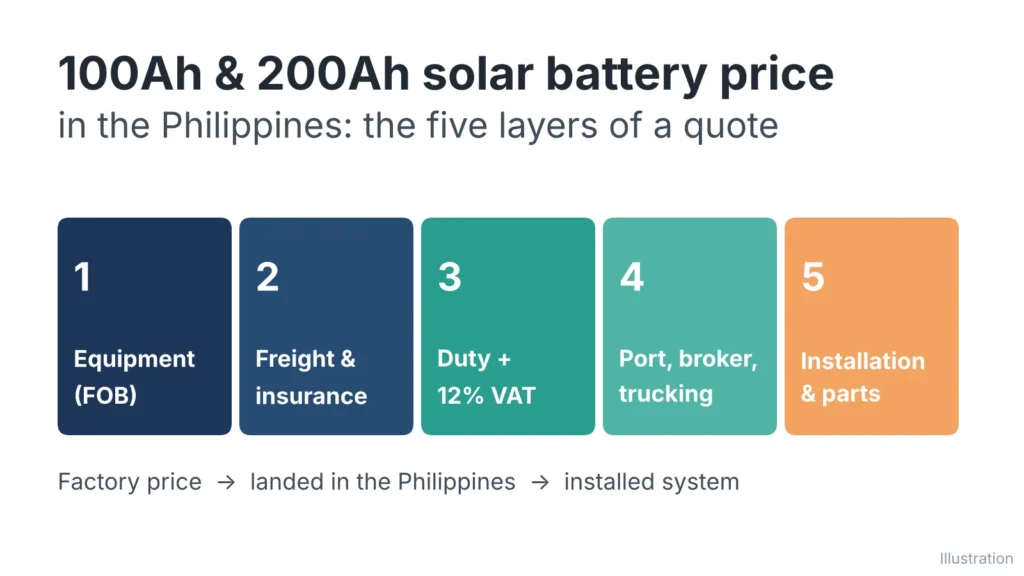
An FOB price stops when the battery is loaded at the Chinese port. A delivered price in Nigeria adds six more layers. Check that a quote either includes each one or tells you who pays for it.
| Layer | What it covers | What to ask |
|---|---|---|
| 1. Battery (FOB) | The battery, BMS, cables in the box, UN3480 wooden crate | Model, voltage, kWh, cell maker, warranty terms |
| 2. Ocean freight | Lithium batteries travel as Class 9 dangerous goods, to Apapa, Tin Can or Onne | Carrier, DG surcharge, LCL or full container, transit time |
| 3. Duty, levies, VAT | Import duty on HS 8507.60, the 0.5% ECOWAS levy, VAT treatment of solar batteries | Your licensed customs agent’s written classification and rates |
| 4. Import documents | Form M through your bank; SONCAP Product Certificate and Shipment Certificate | Who applies, who pays, how long each takes |
| 5. Clearing and haulage | Terminal charges, agent fees, trucking from the port | A written quote per shipment |
| 6. Inverter and installation | A compatible 48V inverter, cables, breakers, labour | Inverter model and battery protocol setting |

Electron Intelligence’s July 2026 landed-cost study of solar equipment in Nigeria found that the 0.5% ECOWAS levy applies even where import duty is zero, and that freight, clearing, bank charges, port handling and haulage together made up about 12% of delivered cost for solar modules. Batteries are heavier for their value and ship as dangerous goods; on our four recent orders below, freight from factory to Nigerian port alone added 10.6%–24.6% to the goods value, so treat 12% as a floor for batteries. The duty and VAT position of lithium batteries depends on how they are classified, and brokers quote different rates; get the classification and every rate in writing before you ship. Our guide to shipping LiFePO4 batteries by sea lists the documents that travel with each crate.
What freight to Nigeria cost on four of our recent orders
These are four of our recent orders to Nigeria, taken from the order records. Goods value is what the customer paid for the equipment, in naira at the rate on each order. Freight is shown in two parts: inland transport in China from our factory to the loading port, and ocean freight to the Nigerian port. Duty, clearing and delivery inside Nigeria are not included.
| Order | Goods value | China inland | Ocean freight | Freight as % of goods |
|---|---|---|---|---|
| 1 × 20 kWh floor-standing battery | ₦1,503,800 | ₦79,516 | ₦120,384 | 13.3% |
| 1 × 15 kWh battery + 1 × 12 kW single-phase inverter | ₦2,047,020 | ₦81,120 | ₦239,200 | 15.6% |
| 1 × 20 kWh battery + 1 × 6.2 kW ED off-grid inverter | ₦2,009,000 | ₦92,250 | ₦402,825 | 24.6% |
| 20 kWh + 30 kWh batteries + 1 × 13.2 kW single-phase inverter + 2 × 12 kW inverters | ₦6,544,875 | ₦164,404 | ₦526,240 | 10.6% |
On these orders, getting the goods from our factory to a Nigerian port added between 10.6% and 24.6% to their value. Three patterns explain most of that range:
- The loading port moves the ocean freight more than the cargo does. The first and third orders both carried a 20 kWh battery, yet ocean freight was ₦120,384 on one and ₦402,825 on the other; they left from different Chinese ports. Ask for the freight quote with its port and sailing date, not as one number.
- China inland transport is close to a fixed cost per order. It ran from ₦79,516 to ₦164,404, so it is 5.3% of the goods on a single battery but 2.5% on the larger order.
- Consolidating pays. The four-item order, with 50 kWh of batteries and three inverters, carried the lowest freight share at 10.6%. If you are buying an inverter or a second battery anyway, ship them together.
Battery or generator? A worked example in naira
Many Nigerian buyers are really comparing a battery with the petrol they burn every evening. Here is the arithmetic for a modest evening load. The generator fuel rate is an assumption; measure yours by filling the tank and timing how long it lasts on your normal load.
| Input | Value |
|---|---|
| Evening load | 500 W average (fans, lights, TV, a small fridge) for 6 hours = 3 kWh a night |
| Generator fuel use | 0.6 litres an hour at that light load (assumption) |
| Petrol price | ₦1,289 per litre (NNPC, Lagos, 15 November 2026) |
- Fuel per night: 0.6 × 6 = 3.6 litres × ₦1,289 = ₦4,640
- Fuel per month (30 nights): ₦139,212, or about ₦1,547 for every kWh you use
- One BG10KW at FOB, about ₦1,218,600, equals roughly 8.8 months of that fuel

The comparison is incomplete in both directions, so read it as a scale check, not a payback promise. The battery side still needs freight, clearing, an inverter and installation, and the battery must be recharged every day, from solar panels or from the grid during supply hours. The generator side leaves out oil changes, repairs, noise and the hours you run it at even lower efficiency. If your grid supply is too short to recharge the battery and you have no solar, the battery will not replace the generator; it will only shift when you run it. Our article on lithium-ion batteries for inverters shows how to check recharge time and runtime for your own loads.
Will a lithium battery work with the inverter you already have?
A battery’s price only counts if it works with your inverter. Three checks come first:
- System voltage. A 51.2V battery needs a 48V inverter. It cannot replace the batteries on a 12V or 24V inverter. If you have a 1.5 kVA 12V or 3.5 kVA 24V inverter, budget for a new 48V inverter or buy a battery built for your existing voltage.
- Charge settings or communication. Lithium batteries need the inverter set to lithium charge limits, or a working CAN/RS485 link to the BMS. A battery that only shows up on the inverter screen has not proved the inverter is following its limits. See our battery and inverter compatibility guide.
- Current. Our 51.2V batteries are rated at 100A continuous discharge (JJ5KW) and 200A (BG10KW, LS15KW). Divide your inverter’s maximum output by about 48V to see the current it can draw from the battery.
For a new 48V system, our 6.2kW ED series inverter is ¥2,300 ex-factory, about US$343 (₦464,000). For other options, our comparison of solar inverters for Nigerian homes covers the main brands.
Lead-acid still has a place. If you need only an hour or two of backup a few times a week, already own a working 12V or 24V inverter and cannot spend more now, a new tubular battery may be the cheaper decision this year. Lithium wins when you cycle the battery every day.
What we check before shipping to Nigeria
The video above was filmed by one of our customers after commissioning a ZJBESS floor-standing LiFePO4 battery with a ZJBESS inverter in Nigeria. Three problems from Nigerian distributor orders changed what we now check before shipment:
- Accessories packed separately. Cables and brackets are listed by carton so the installer can find them on site.
- Communication settings. Installers used to other brands may keep old protocol settings, so we send the battery and inverter setting sheet with the shipment.
- Loads added later. Customers often connect more appliances after handover, so we size with headroom or plan the parallel expansion at the start. Our batteries allow up to 15 units in parallel.
After installation, faults can be reported to us online 24 hours a day, and a dedicated support team handles them.
Red flags in a Nigerian solar battery quote
| Quote says | Ask | Why it matters |
|---|---|---|
| “200Ah battery” | At what voltage? How many kWh? | 12V 200Ah and 51.2V 200Ah differ by more than four times in energy |
| “Lithium” | LiFePO4 or another lithium chemistry? Which cell maker? | Chemistry changes cycle life and safety behaviour |
| “Grade A cells” | Cell model number and incoming inspection record | Anyone can write Grade A; a cell model can be checked. Our cells come from EVE and REPT |
| “6,000 cycles” | At what depth of discharge, temperature and end capacity? | A cycle figure without its test conditions cannot be compared |
| “10-year warranty” | Who handles a claim in Nigeria, how fast do they respond, and who pays freight both ways? | A warranty that needs the battery shipped back to China costs time and money. ZJBESS takes fault reports online 24 hours a day through a dedicated support team |
| A naira price | Which exchange rate, valid until when? | A 2–3% rate gap moves the price by tens of thousands of naira |
| “Delivered” | Are duty, SONCAP and clearing included? | These layers can be left out of a cheap-looking quote |
Before you sign, our guide to evaluating a LiFePO4 battery supplier from China lists the documents to request.
Get a quote you can compare
Send these with your enquiry and we will price the battery in kWh, match it to your inverter and show which layers are included:
- Your inverter’s brand, model and system voltage (12V, 24V or 48V), or that you need a new one
- The appliances you want to run and for how many hours of outage
- How you will recharge: solar panel capacity, grid hours, or both
- Delivery city and whether you want an FOB, CIF or delivered price
- Quantity, if you are a distributor or installer
From that we can tell you which of our 48V home batteries fits, how long it should run your load, and what your clearing agent will need from us.
FAQ
What is the cost of a solar battery in Nigeria in 2026?
It depends on the energy you buy. Our factory prices for 51.2V LiFePO4 batteries run from about US$67 to US$123 per kWh (₦91,000–167,000 per kWh at ₦1,353.97/US$) before freight, clearing and installation. On our recent orders to Nigeria, freight from the factory to a Nigerian port added 10.6%–24.6% to the goods value. A delivered and installed battery costs more; ask for every layer in writing so you can compare quotes on the same basis.
How much is a 100Ah lithium battery in Nigeria?
A 12.8V 100Ah lithium battery stores 1.28 kWh; a 51.2V 100Ah battery such as our JJ5KW stores 5.12 kWh and is US$630 FOB (about ₦853,000). Compare 100Ah prices only after converting both to kWh.
How long will a 10 kWh battery run my house during an outage?
Divide usable energy by your load. Using 90% of a 10.24 kWh battery gives about 9.2 kWh; at a 500 W average load that is roughly 18 hours, before inverter losses. At 1,500 W it is about 6 hours. Starting loads such as pumps and air conditioners need a separate check against the inverter and battery current limits.
Can I add another battery later?
Yes, if you plan for it. Our 51.2V batteries connect up to 15 units in parallel, but mixing batteries of different ages or revisions needs the configuration rules for those exact products. Tell us the target capacity at the start so the inverter and cables are sized for it.
Prices are FOB China factory prices for November 2026 and exclude freight, duties, clearing and installation. The generator example uses stated assumptions; it is not a measured saving or a delivered price offer.
Discuss Your ProjectBack to Blog