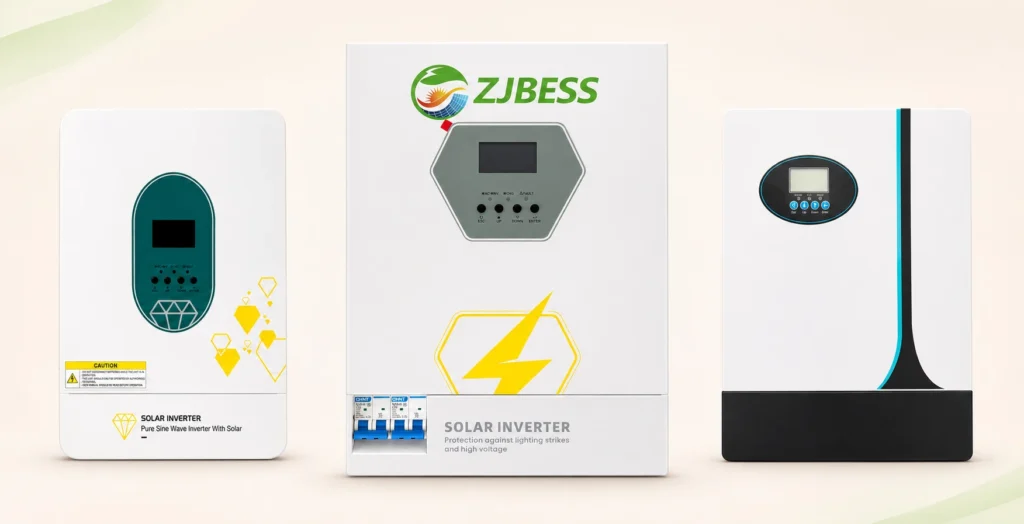


A hybrid solar inverter is one unit that does three jobs: it tracks the solar array’s maximum power point, charges and discharges a battery, and converts DC to AC that can run your loads and, where the utility allows it, feed the grid. Because one controller sees the solar, the battery, the grid and the house at the same time, it can decide every second where each watt goes. A string inverter without a battery port cannot do that, and an off-grid inverter cannot legally share the grid.
To choose one, do not start from the kW number printed on the front. Check four separate limits on the datasheet: AC output and surge, PV input per MPPT, battery voltage and current with BMS communication, and the grid side (voltage, frequency and export permission). A hybrid that passes three of these and fails the fourth will still disappoint you, usually during the first brownout.

A hybrid inverter combines an MPPT charger, a battery converter, an inverter bridge and a transfer relay on one DC bus. Simplified for explanation; not a wiring diagram.
What a Hybrid Inverter Does That a Normal Inverter Does Not
Inside the enclosure, a hybrid inverter is several converters sharing one DC bus. The MPPT charger pulls power from the PV strings at whatever voltage gives the most watts. A bidirectional DC-DC stage moves energy into or out of the battery. The main inverter bridge turns the DC bus into 230V AC, and a transfer relay decides whether the house is connected to the utility or isolated from it. Firmware sits above all of this and applies the priority you set.
That architecture is what separates it from the two inverters people usually compare it with:
| Question | Grid-tie string inverter | Off-grid inverter | Hybrid inverter |
| Battery port | No | Yes | Yes |
| Can export to the grid | Yes, with utility approval | No | Yes, if the model and the utility allow it |
| What happens in a brownout | Shuts down (anti-islanding) | Keeps running from battery and PV | Isolates backup circuits and keeps them running within its limits |
| Uses solar during a brownout | No | Yes | Yes, through the backup output |
| Typical reason to buy | Lower daytime bills only | No reliable grid at the site | Lower bills plus backup from the same equipment |
The third column is the reason hybrids sell in the Philippines: the same box that reduces the daytime bill also keeps the refrigerator and Wi-Fi running when the line goes down. If you are still deciding whether your site needs a grid-tied, hybrid or fully off-grid system, our off-grid solar system guide for the Philippines covers that choice. This article assumes you have settled on hybrid and need to pick the inverter.
The Four Operating States, and Which One Matters in a Brownout
Most hybrid inverters let you choose an output priority. The names differ by brand (SBU, SUB, solar-first, utility-first), but the physical states are the same four:
- Daytime surplus. PV covers the loads, the extra charges the battery, and anything left over is exported or curtailed, depending on your export setting.
- Evening. PV is gone, so the battery discharges into the loads until it reaches the reserve you set, then the grid takes over.
- Brownout. The transfer relay opens, the inverter forms its own 230V supply for the backup circuits, and PV keeps charging the battery if the sun is up.
- Grid charging. The inverter charges the battery from the utility, which is useful before a scheduled rotational outage or a typhoon warning.
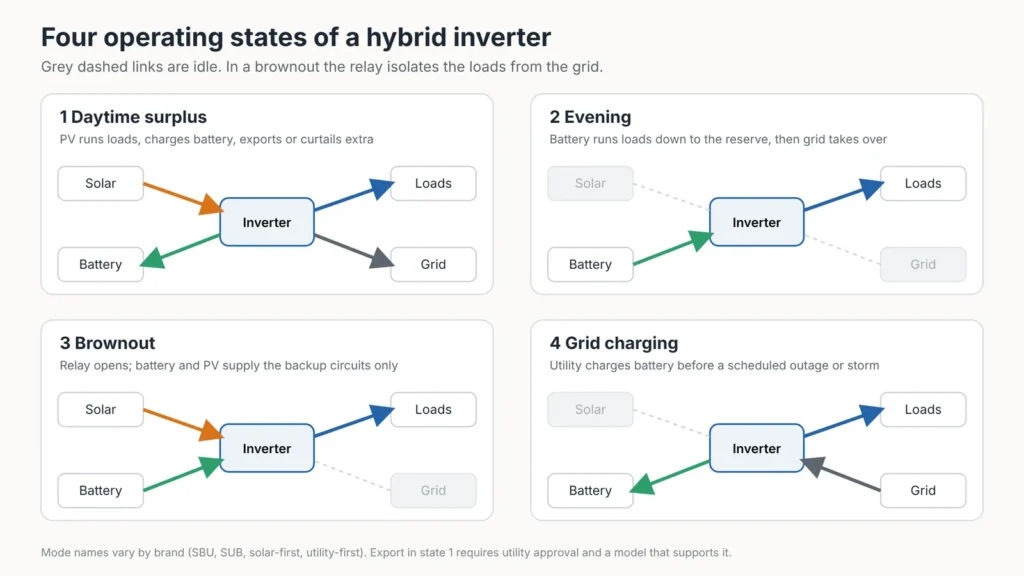
The same inverter moves between four power-flow states. In a brownout, the relay isolates the backup circuits from the grid.
State 3 is where buyers get surprised. Two numbers decide whether your loads ride through it: how much power the backup output can carry, and how long the changeover takes.
Transfer time: not every hybrid behaves like a UPS
When the grid drops, the relay has to open and the inverter has to take over the load. During that gap, a desktop PC or a router may reboot even though the lights barely flicker.
Our own datasheets show why you should ask for this number in writing. The ZJBESS ED series solar inverter publishes a transfer time of up to 10 milliseconds in UPS mode and up to 20 milliseconds in inverter mode. For the MAX-II 13.2kW hybrid, a verified transfer-time figure has not been published yet, so we do not market it as UPS-grade backup. That is the right way to read any hybrid datasheet: if the transfer time is missing, treat the unit as a backup source for ordinary loads, not as a replacement for an online UPS on a server, a medical device or a POS terminal.

Published maximum transfer times for the ZJBESS ED series compared with an online UPS. The MAX-II 13.2kW transfer time is not yet published.
How to Choose: Read the Datasheet as Four Separate Limits
A hybrid inverter’s headline rating is its continuous AC output. The other three limits are printed further down the datasheet and are just as binding. We will use the published data for the ZJBESS MAX-II 13.2kW single-phase hybrid inverter as the worked example because each limit shows up clearly on it.
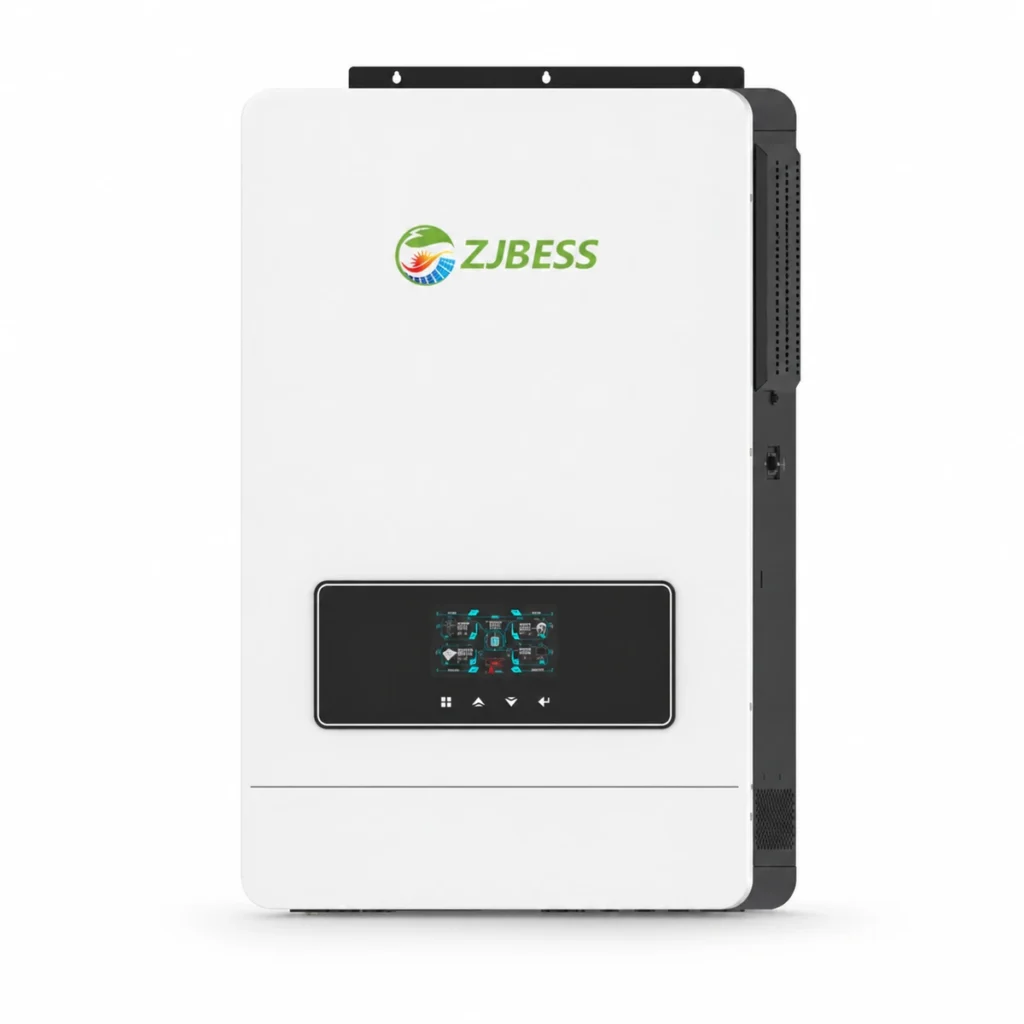
| Limit | MAX-II-13.2KW published value | What it controls |
| AC output | 13,200W / 13,200VA, pure sine wave; 220/230/240VAC | Which loads can run at the same time |
| PV input | 8,000W + 8,000W across two MPPTs; MPPT range 90–450VDC; 500VDC maximum; start-up 90VDC | How many panels per string and per tracker |
| Battery | 48VDC nominal; 160A maximum solar charging; 140A maximum AC charging; 160A maximum total charging | Which batteries and how many in parallel |
| Grid | Grid output 195–253VAC; 57.3A nominal grid output current; AC input 90–280VAC or 170–280VAC; 98% maximum DC-AC efficiency | Connection to the utility and export |
1. AC output: size for simultaneous load and starting surge
Inverter power is sized from the loads that run at the same time, not from your monthly kWh. A household that uses 400 kWh a month can still need a 6kW-class inverter if the aircon, pump and rice cooker overlap at dinner time.
Here is a typical evening backup list for a Metro Manila home. The wattages are planning assumptions; use the nameplates of your own appliances.
| Load | Running power (assumed) | Starting demand (assumed) |
| Two 1.0HP inverter split aircons | 1,800W | Soft start, no large surge |
| Refrigerator | 150W | about 900W for under a second |
| 0.5HP water pump | 600W | about 1,800W (3× running) |
| Lights, fans, TV, router | 400W | negligible |
| Rice cooker | 700W | negligible |
| Total | 3,650W | 5,600W if the pump and fridge start together |

Assumed evening backup list: 3,650W running together and a 5,600W peak when the pump and refrigerator start at once.
Read the result against three inverter classes:
- A 3kW, 24V inverter fails on continuous load alone: 3,650W is above 3,000W, and the user would have to shed the rice cooker or one aircon every evening.
- A 6kW-class, 48V inverter carries the 3,650W with about 2,550W to spare, and the 5,600W worst-case start stays below its rated output. As a reference for how surge is specified, the ED 6.2kW datasheet lists 12,400VA peak power and battery-mode overload support of 105–150% for up to 11 seconds, 150–200% for up to 2 seconds, and above 200% for about 400 milliseconds.
- A 13.2kW unit is justified when the list grows: a third aircon, an electric oven, a small workshop, or a plan to run most of the house rather than a backup panel.
Two cautions. Motor loads have a power factor below 1, so their VA draw is higher than their wattage. And the battery has to deliver the same surge, which brings us to limit 3.
PV input: MPPT count, voltage window and oversizing
The PV side has its own limits, and they are voltage limits as much as power limits. The MAX-II accepts up to 8,000W on each of its two MPPT inputs, tracks between 90 and 450VDC, and must never see more than 500VDC. Two independent trackers mean you can put an east-facing string and a west-facing string on separate inputs without one dragging the other down.
String design is where the 500V ceiling matters. Panel voltage rises as temperature falls, so the worst case is a clear, cool morning.
Example string check (assumed module, not a recommendation): a 550W module with Voc 49.5V, Vmp 41.6V, Voc temperature coefficient −0.27%/°C and Vmp coefficient −0.35%/°C. Design minimum cell temperature 10°C, hot-roof cell temperature 70°C.
- Cold Voc per module = 49.5 × (1 + 0.0027 × 15) = 51.5V
- 9 modules: 9 × 51.5 = 463.5V, below 500V. Pass.
- 10 modules: 10 × 51.5 = 515.0V, above 500V. Fail. This can damage the input.
- Hot Vmp for 9 modules = 9 × 41.6 × (1 − 0.0035 × 45) = 315.4V, inside the 90–450V MPPT window. Pass.

With the example 550W module, nine in series stays under 500V on a 10°C morning; ten in series does not.
One string of 9 modules is 4,950W, so a 9-module string on each MPPT gives 9.9kWp, a DC-to-AC ratio of 0.75. To fill the full 8,000W per input you would parallel strings on the same tracker, and that adds current. The MAX-II product page does not list a per-MPPT input current limit, so ask for that figure before you parallel two strings of panels with 14A short-circuit current. (For comparison, the ED 6.2kW publishes 18A on its single MPPT.)
Why can a 13.2kW inverter take 16kW of panels? Because PV rarely produces its nameplate output, oversizing raises energy in the morning, the late afternoon and on cloudy days. At midday the inverter clips anything it cannot use or store. That is a design choice, not free power.
3. Battery side: voltage, current and BMS communication
A “48V” label on the inverter and on the battery is the start of the compatibility check, not the end. Three things have to match.
Current. Power on the battery side is voltage times current, and a 48V system needs a lot of current. At the full 13.2kW AC output, a 51.2V nominal battery and the published 94% battery-mode efficiency, the inverter draws about 274A DC. When the battery sags to 46V near the end of discharge, the same output needs about 305A. A 6.2kW inverter in the same conditions needs about 129A, rising to about 143A at 46V.
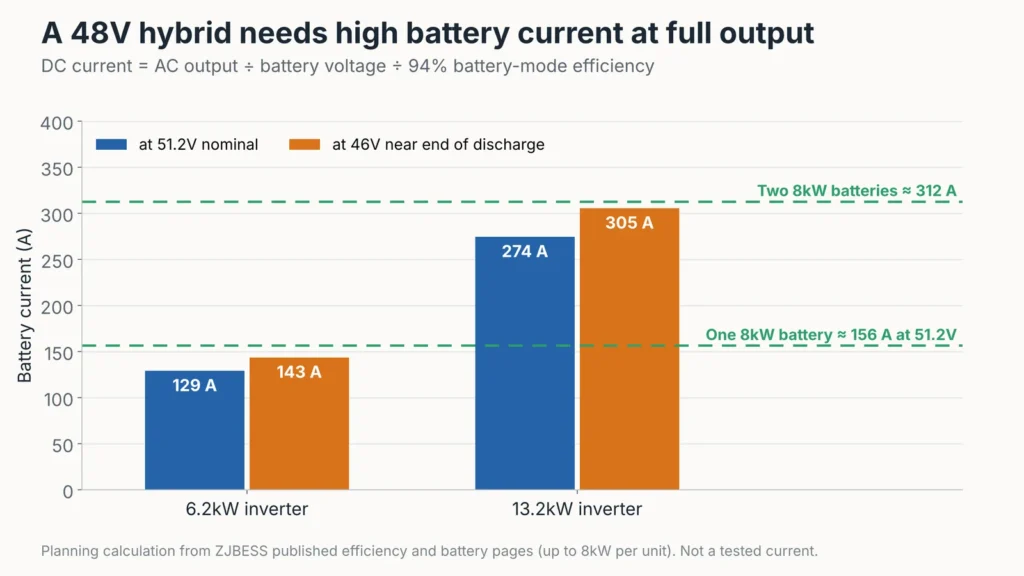
Full-output battery current at 51.2V and 46V, compared with one and two 8kW batteries. Planning calculation, not a tested current.
Compare that with what the battery can deliver. Our home battery pages publish up to 8kW per unit, about 156A at 51.2V. So a single battery cannot carry a 13.2kW inverter at full load. Two matched units in parallel are the starting point for a full-output discussion, and the parallel battery guide explains current sharing and protection. If the BMS current limit is lower than the inverter’s draw, the BMS trips when the pump starts, and the house goes dark with a “full” battery.
Charging. The MAX-II publishes 160A maximum solar charging, 140A maximum AC charging and 160A maximum total. These do not add up to 300A. Set the charge current to the lower of the inverter limit and the battery’s permitted charge current at its actual temperature.
Communication. The inverter needs to read the battery’s state of charge and current limits over a BMS link (the MAX-II offers RS232, RS485 and BMS ports, plus Wi-Fi monitoring). Matching port types is not enough; the protocol and the inverter firmware version must be on the battery maker’s compatibility list. Our LiFePO4 battery and inverter compatibility guide walks through that check, and the lithium battery for inverter guide covers capacity and runtime.
Low voltage or high voltage? Many residential hybrids, including the ones above, are low-voltage (48V) designs. High-voltage hybrids run batteries at a few hundred volts, so current and cable size are much lower, but the battery must be from the matched high-voltage family. Choose the battery architecture first; it narrows the inverter list immediately.
4. Grid side: voltage, 60Hz, wiring and export permission
The Philippine grid supplies 230V at 60Hz. Check both numbers on the datasheet. The MAX-II page lists 220, 230 and 240VAC output options but does not state frequency, so confirm in writing that the unit you order is set and certified for 60Hz operation. A 50Hz-only setting will not synchronise.
Then check how your service is wired. In some Philippine service areas, the 230V arrives between two line conductors rather than between a line and a neutral. Many hybrid inverters switch their neutral–earth bond when they isolate the backup circuits, so your installer needs to confirm the service arrangement against the inverter manual before wiring the backup panel.
Weak rural lines are another reason to read the AC input range. The MAX-II lists two AC input ranges: 90–280VAC and 170–280VAC. The wide setting keeps the inverter on the grid when the voltage sags in the evening. The narrow setting transfers to battery earlier, which protects voltage-sensitive equipment but cycles the battery more.
Finally, export permission. Under the Philippine Net-Metering Rules (ERC Resolution No. 09, Series of 2013, amended by Resolution No. 06, Series of 2019), renewable systems up to 100kW can qualify, with or without battery storage, according to the DOE net-metering primer. In 2026, the DOE, DILG and DPWH also set local permit timelines of three working days for electrical permits and seven working days for the Certificate of Final Electrical Inspection, as reported by Power Philippines. None of this makes a particular inverter approved. Your distribution utility decides which inverter certifications it accepts, so get that list before you buy. If you do not plan to apply for net metering, ask how the hybrid limits export to zero (usually a CT clamp or a meter on the incoming line) and confirm that accessory is in the quote.
Matching Inverter Class to the Site
With the four limits in hand, the choice usually falls into one of three bands:
| Site profile | Inverter class to evaluate | Why |
| Small home, essential loads only (lights, fans, fridge, router, one TV), under about 2kW at once | 3kW class, often 24V | Low cost, but check that 24V batteries and charge current suit the load; poor fit if you expect to add aircon |
| Typical home with one or two aircons and a pump, one roof plane | 6kW class, 48V, single MPPT | Covers about 3–4kW simultaneous load with surge margin; one tracker is fine for a single orientation |
| Large home, guesthouse or small shop; two roof orientations; whole-house backup | 11–13.2kW class, 48V, dual MPPT | Higher continuous output and two trackers; needs two or more batteries for full-output current |

Start from simultaneous load, then roof orientations and expansion plans. These bands are starting points, not rules.
Plan expansion before you buy. Our ED 6.2kW does not support parallel operation, while the ED 11kW variant does. If you might need more power in two years, choose a model that parallels now rather than replacing the inverter later.
Worked example: a Quezon City home during a 4-hour brownout
Take the load list above. During an evening brownout, the family keeps one aircon (900W), the fridge (about 60W averaged over its compressor cycle), lights, fans and router (300W), and runs the pump for half an hour (600W).
- Energy needed at the AC side: 0.9 × 4 + 0.06 × 4 + 0.3 × 4 + 0.6 × 0.5 = 5.34kWh
- Nominal battery needed, at 90% conversion efficiency and 80% usable capacity: 5.34 ÷ 0.9 ÷ 0.8 = 7.4kWh
A 10.24kWh battery such as the ZJBESS BG10KW leaves margin for a longer outage or an older battery. A 6kW-class 48V hybrid draws about 129A at full output, so the battery’s continuous discharge rating needs to cover that for the full evening load list, not just the brownout list. For more detail on capacity, see the home battery sizing guide.
Quotation Red Flags When Buying a Hybrid Inverter
Most misreadings on hybrid inverter quotes come from treating one datasheet line as more than it says. These are the ones to check before you sign:
| What the quote or listing says | What to ask | Why it matters |
| “UPS function” with no transfer time | The transfer time in ms, and in which mode | Without a number you cannot judge whether a PC or router will reboot |
| “300A charging” | Separate solar, AC and total charge limits | Solar and AC limits are often not additive; the total may be 160A |
| “16kW inverter” | AC rated output vs maximum PV input | 16kW of PV input on a 13.2kW AC unit is oversizing, not output |
| “Compatible with any 48V lithium battery” | The battery maker’s compatibility list and firmware version | A voltage match does not prove the BMS protocol works |
| “Grid-tie ready” | Grid certification your utility accepts, 60Hz setting, export-limit method | Technical grid-tie ability is not approval to export |
| “Expandable” | Whether the inverter itself supports parallel operation | Battery expansion and inverter expansion are different things |
Hybrid Inverter FAQ
Can a hybrid inverter work without a battery?
Many can. The MAX-II supports battery-free operation in suitable solar and grid-connected configurations. Without a battery, though, it cannot supply power after sunset or keep loads stable through a brownout or a passing cloud. If backup is the reason you are buying a hybrid, plan the battery from the start, even if you install it later.
Is a hybrid inverter worth it if I do not apply for net metering?
It can be, provided you set it to zero export and size PV for daytime self-consumption plus battery charging. The value then comes from cutting daytime grid purchases and from backup, not from export credits.
Can I add a battery to my existing grid-tie system?
Not through the grid-tie inverter’s DC side; it has no battery port. The options are to replace it with a hybrid or to add a separate battery inverter on the AC side. Which is cheaper depends on the age of the existing inverter and on whether your utility approval covers the change.
Send Us Your Load List and Panel Datasheet
To review a hybrid inverter configuration, we need five things: your simultaneous load list with any motor or compressor loads, the solar module datasheet and roof orientations, the battery model you plan to use (or the backup hours you want), your service voltage and whether a neutral is present, and whether you intend to apply for net metering. With those, we can check all four limits for the MAX-II 13.2kW hybrid inverter or the ED series before quoting. Send your project details.
The appliance wattages, module values and household loads in the examples above are planning assumptions, not measurements; the inverter values come from ZJBESS published product data as of November 2026.
Discuss Your ProjectBack to Blog