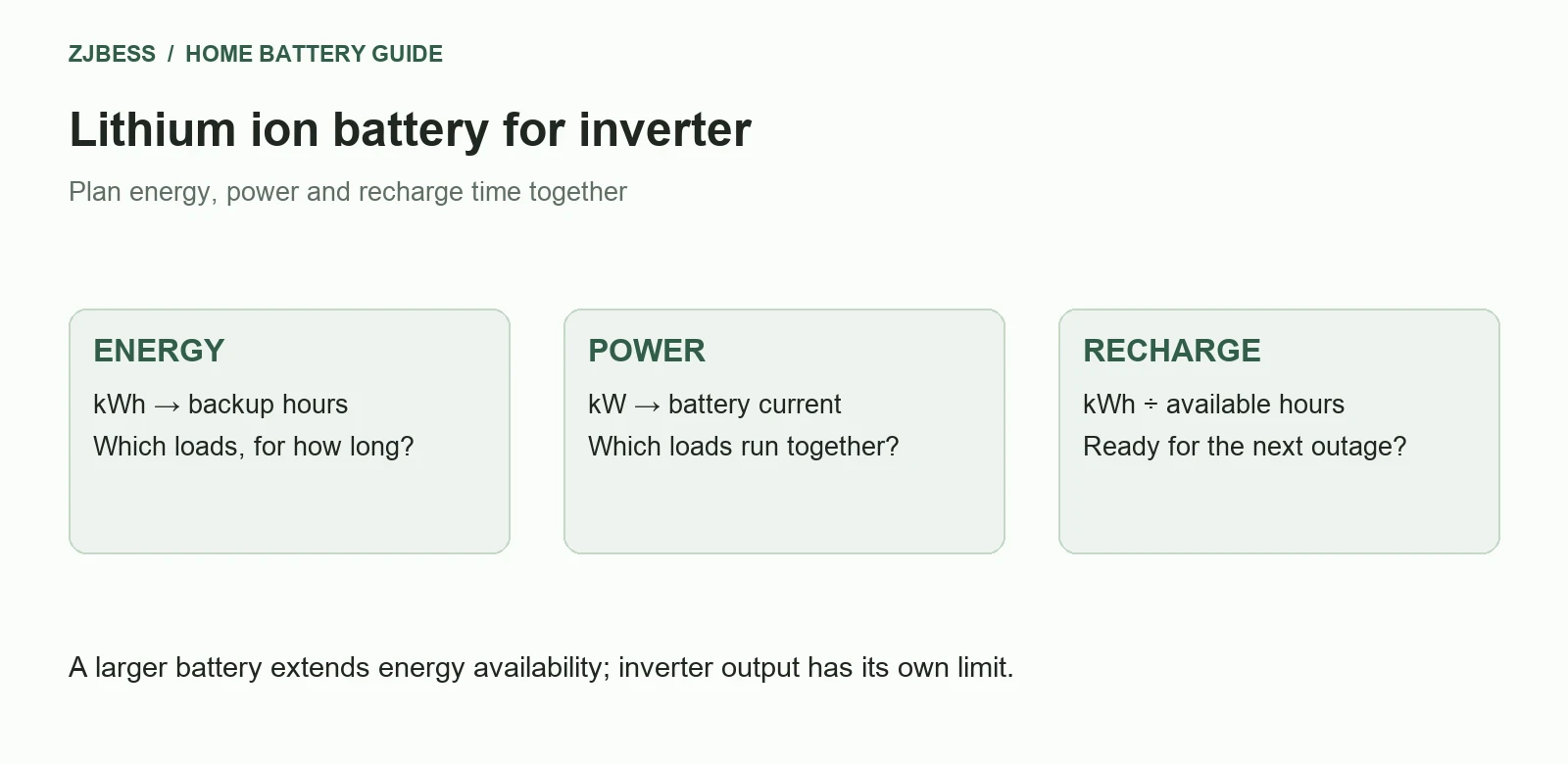
A lithium ion battery for an inverter stores electrical energy as DC; the inverter converts that DC into AC for household loads. LiFePO4 is a lithium-ion chemistry used in home storage. A suitable system needs enough usable energy for the intended outage, enough battery current for the load, and an inverter approved for that battery’s voltage, charging limits and control method.
For installers and distributors selecting a 48V-class home system, start with two separate questions: which appliances must run together, and how many hours must they run? A larger battery can extend backup time, but it cannot raise the inverter’s output rating. This guide turns those questions into a load brief and a battery shortlist.
How a lithium battery and inverter supply a home
During discharge, stored chemical energy supplies DC electricity to the inverter. The inverter produces the AC required by the backed-up circuits. Charging reverses the storage process through a compatible charger: grid electricity requires AC-to-DC conversion, while solar charging requires suitable power conversion and charge control. The battery does not supply household AC directly.
A battery management system monitors cell conditions and controls or requests limits on charging and discharging. How those limits reach the inverter depends on the equipment: supported digital communication, separate control signals or an approved configuration. The Victron system design and BMS selection guide illustrates these different control arrangements for its own batteries; it does not establish compatibility for a ZJBESS pairing.

Solar panels and a battery also do not automatically provide outage backup. The inverter must support the intended backup mode and the installation must supply the designated circuits correctly. A grid-connected system that runs well with utility support still needs a separate check of battery-only operation.
Choose an inverter for a lithium ion battery
Use the inverter’s battery input specification, rather than its PV input range. A 51.2V battery may belong to the 48V system class, but the full operating voltage range, startup requirements and approved charging settings must fit. A 12V or 24V battery input cannot accept a 51.2V pack simply because both products say “lithium”. High-voltage storage is a separate equipment choice.
Next compare continuous AC output in watts, motor starting demands and the battery-side current limit. A kVA label alone does not state the continuous real power available in every operating condition. Ask whether the advertised output requires grid or PV assistance, or is available from the battery alone.
Finally, confirm the exact inverter model and firmware, battery revision, communication profile and approved cable. CAN or RS485 on both nameplates does not prove that the devices exchange the same battery messages. Use the existing LiFePO4 battery inverter compatibility guide for the detailed pairing record and commissioning evidence.
Size the battery in kWh before comparing Ah
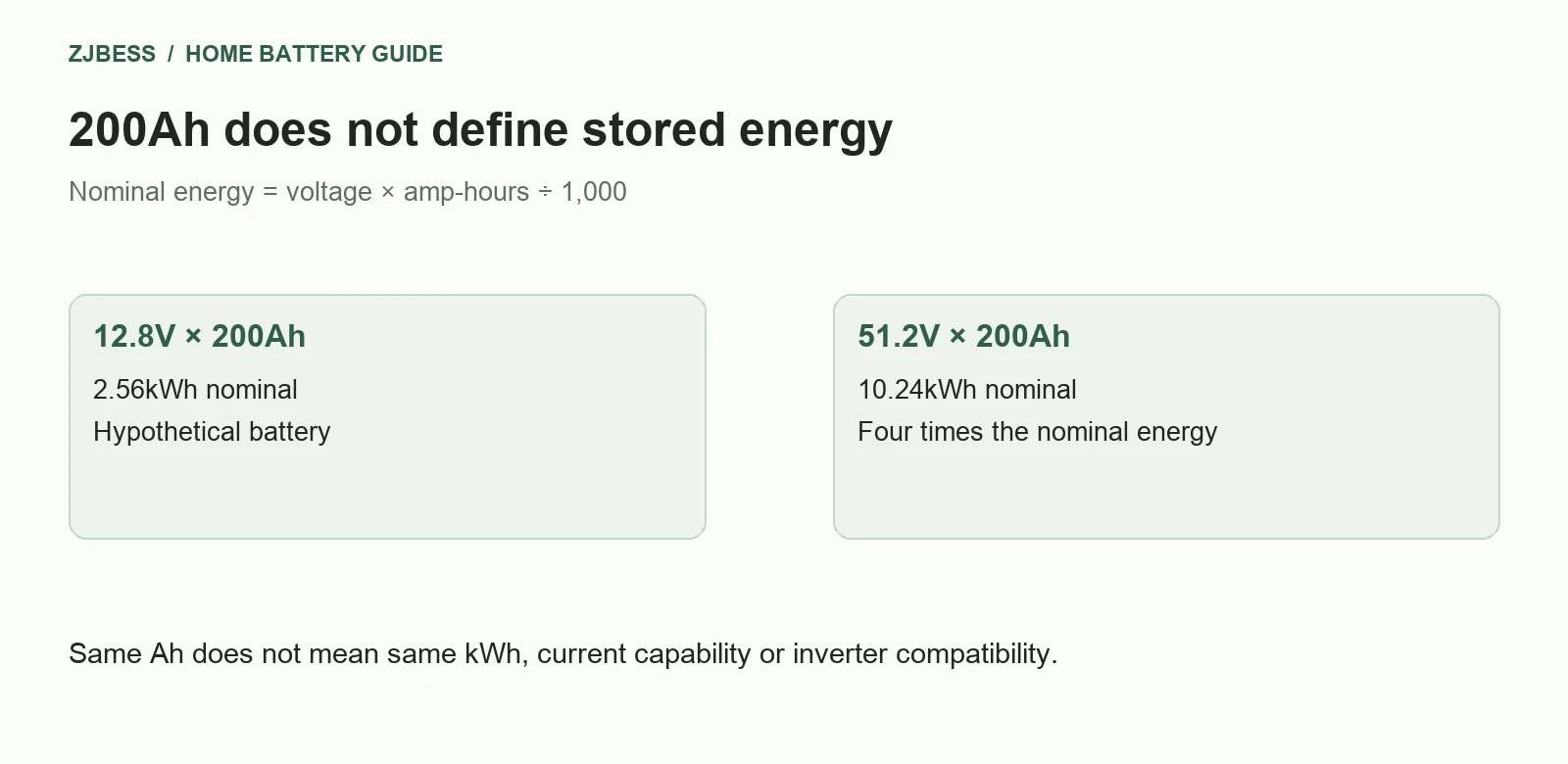
Amp-hours describe charge capacity. To estimate nominal stored energy, multiply amp-hours by nominal voltage and divide by 1,000. Two 200Ah batteries at different voltages do not contain the same energy. The Ah label also does not tell you the permitted continuous discharge current.
Nominal energy in kWh = nominal voltage × Ah ÷ 1,000. A hypothetical 12.8V 200Ah battery holds 2.56kWh nominal; a hypothetical 51.2V 200Ah battery holds 10.24kWh nominal. These are arithmetic examples, not interchangeable products for the same inverter.
Build an outage load list using running power and expected operating time. In the following assumed example, a refrigerator averages 100W over the outage, two fans draw 120W together, lights draw 60W, a router draws 15W and a television draws 100W. The total average is 395W. Four hours require 1.58kWh at the AC loads. The refrigerator’s start must be checked separately; its averaged energy does not describe its starting demand.
If the planned usable battery fraction is an assumed 80% and inverter efficiency is an assumed 92%, the nominal energy requirement is 1.58 ÷ (0.80 × 0.92) ≈ 2.15kWh before additional allowances. Those assumptions are not ZJBESS operating settings. A designer still needs to allow for inverter self-consumption, temperature, aging and the selected reserve policy.
Adding an air conditioner with an assumed 1,000W average draw for the same four hours adds 4kWh at the loads. The resulting nominal requirement becomes 5.58 ÷ (0.80 × 0.92) ≈ 7.58kWh before those allowances. This is why a load list changes the shortlist more than a generic “200Ah is enough” claim. Actual air-conditioner energy varies with equipment, weather and use.
Estimate backup time from usable energy
For a constant average load, estimated runtime equals nominal battery energy multiplied by the planned usable fraction and inverter efficiency, divided by average AC load in kW. Use measured load energy where available. The calculation below assumes a full initial charge, no simultaneous solar or grid contribution, 80% usable energy and 92% inverter efficiency.
| Nominal battery energy | Estimated AC energy | At 0.5kW average | At 1.5kW average |
|---|---|---|---|
| 5.12kWh | 3.77kWh | 7.54 hours | 2.51 hours |
| 10.24kWh | 7.54kWh | 15.07 hours | 5.02 hours |
| 15.36kWh | 11.30kWh | 22.61 hours | 7.54 hours |

These results compare energy only. They do not establish that a particular battery can deliver the load, nor include standby consumption separately. An inverter’s efficiency changes with operating conditions. For reserve policy and a fuller load schedule, continue with the home battery sizing guide.
Check battery current independently of runtime
A system can have enough kWh and still shut down when loads start. For an initial power screen, battery current is approximately AC load power divided by working DC voltage and inverter efficiency.
At an assumed 48V working voltage and 92% conversion efficiency, a 5,000W AC load needs approximately 113A. At an assumed 44V it needs approximately 124A. These voltages are calculation inputs, not recommended settings or permission to operate a selected battery at 44V. The approved voltage window governs the design.

A hypothetical 100A continuous battery limit would already be below that 5kW demand, even if the battery stored enough energy for several hours. Compare the allowed current at the relevant temperature and state of charge, plus peak current and duration for starts. Cables, protection and the inverter also impose limits; use the manufacturer’s approved system design.
Can the battery recharge before the next outage?
Backup planning also needs a charging window. Replacing 8kWh of battery-side energy in two hours requires an average 4kW delivered into the battery. At a simplified constant 51.2V that corresponds to about 78A. In practice, current, voltage, available input power and charging acceptance vary, so this is a first screen rather than a promised recharge time.
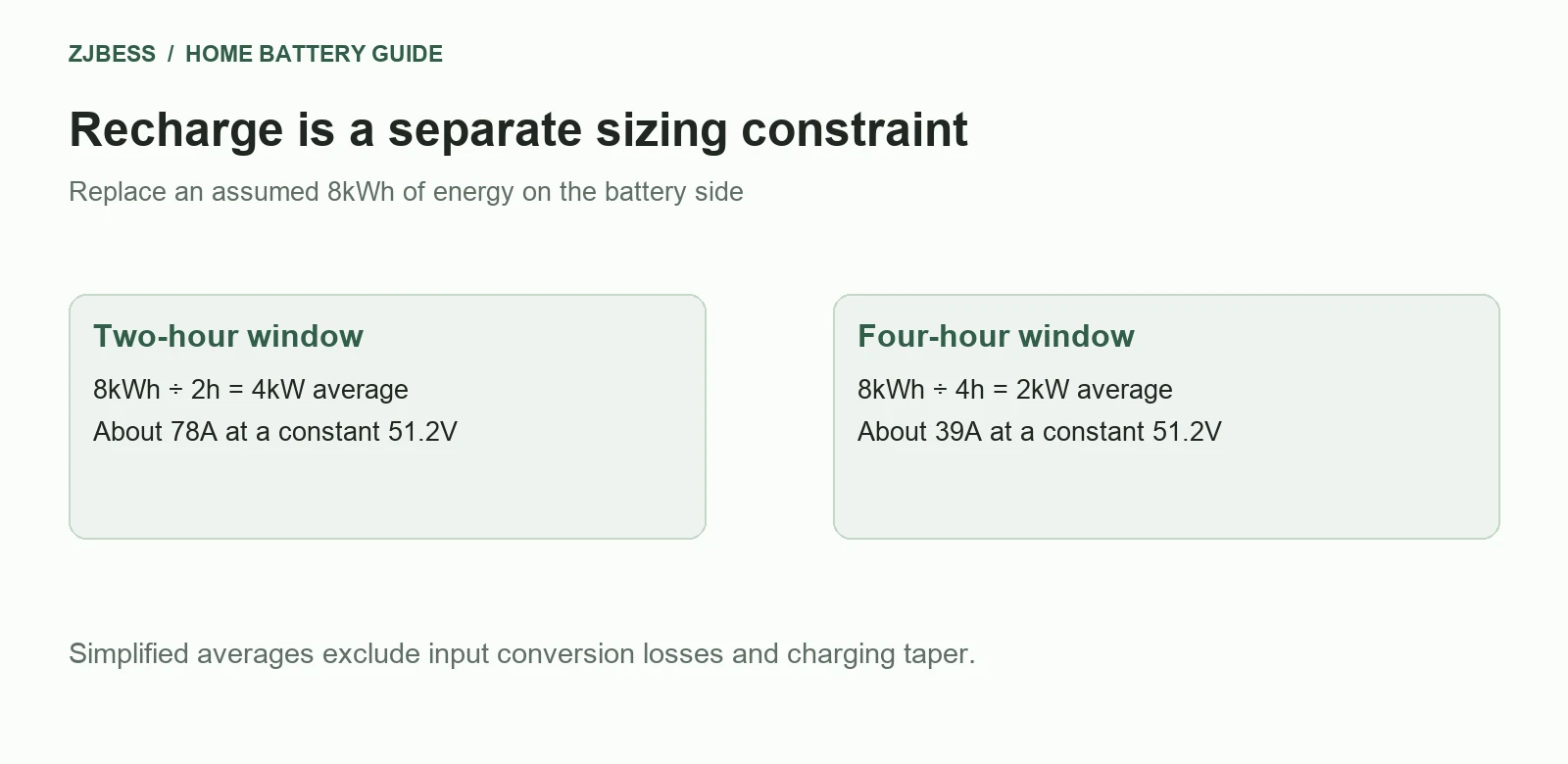
Solar must cover daytime loads as well as charging. Grid charging may be constrained by the AC input allowance, schedule or local supply. Where multiple sources can charge simultaneously, compare their combined battery-side charging current with the approved total limit; do not add PV and AC input readings as though they were already battery output currents.
For a site with short grid-availability windows, a larger pack may extend one outage while taking too long to refill for the next. Solve the load, energy and recharge constraints together. Specify the required backup service over repeated outages, not only the first discharge from a full battery.
Separate service life from a ten year claim
There is no universal ten-year service life for every lithium inverter battery. Calendar aging and cycling both affect capacity, while temperature, operating limits and the energy demanded from the system determine when reduced capacity becomes a practical problem. A cycle count needs its test temperature, discharge depth, rate and end-of-life capacity criterion.
For example, if a hypothetical 10.24kWh pack retains 80% of its original energy, the same assumed 80% usable fraction and 92% conversion efficiency provide about 6.03kWh AC rather than 7.54kWh. At a 1.5kW average load, calculated backup falls from 5.02 to 4.02 hours. This is a sensitivity example, not a prediction of when a ZJBESS battery reaches 80% capacity.

Warranty duration is a separate commercial term. Read the applicable written capacity, throughput, operating and claim conditions rather than turning a warranty into a runtime promise. The lithium solar battery lifespan guide explains service years, capacity fade and replacement planning.
Maintenance remains necessary at the system level: review alarms and operating history, keep the specified clearances and enclosure conditions, and arrange the inspections required by the equipment manuals. LiFePO4 equipment does not require the watering associated with flooded lead-acid batteries, but that does not remove electrical inspection or monitoring requirements. For cold sites, distinguish charging from discharge limits; the Victron Lithium NG operating manual demonstrates that these windows and current reductions are model-specific. Do not transfer its settings to another battery.
Turn the calculations into a ZJBESS shortlist
Use the ZJBESS home battery range to compare physical formats after defining the electrical requirement. The BG10KW wall-mounted battery is publicly listed at 51.2V and 200Ah, giving 10.24kWh nominal by calculation. That energy figure alone does not approve an inverter pairing or guarantee the runtime in the examples above.
A wall-mounted format needs an appropriate supporting structure and installation access. A rack or floor-standing arrangement needs suitable floor space, servicing clearance and a plan for the permitted expansion configuration. Extra matching modules can increase energy in an approved parallel bank; they do not increase the inverter’s rated AC output. Obtain the current model specification and configuration record before quoting.
Contact ZJBESS about a battery and inverter configuration with the inverter’s full model and firmware, essential running loads and motor starts, backup hours, available charging window, installation temperature and destination market. Those details let the supplier review energy, current and integration requirements against a specific configuration.
Questions buyers ask before ordering
Can I use a lithium battery with my existing inverter?
Only if that exact combination supports the battery’s operating voltage, charge profile, current limits and required control method. An inverter previously used with lead-acid needs a documented review before reuse. See the lead-acid replacement guide for that separate retrofit decision.
Does a 200Ah battery deliver 200A continuously?
No. The Ah rating describes capacity; the continuous current rating is a separate specification with operating conditions. Nominal voltage is also needed to compare stored energy.
Is a li battery for inverter use automatically a solar battery?
The shortened phrase describes a lithium battery used with an inverter, not a complete solar system. Solar charging still needs compatible charging equipment, settings and sufficient generation. Confirm the full battery chemistry and model rather than relying on “Li” in a listing.
Will a bigger battery run more appliances at once?
It can improve energy availability and, in an approved configuration, may improve battery current capability. The simultaneous load remains constrained by the inverter, battery bank and installation. Check starting and continuous power separately from backup hours.
Discuss Your ProjectBack to Blog