

Lithium-ion solar batteries have an average lifespan of around 10–15 years, according to the Australian Government’s Solar Consumer Guide. Treat that range as a planning reference, not a promise for every battery. A battery may remain operational while storing too little energy to cover the outage or overnight load it was bought for.
For a homeowner, installer or distributor, the more useful question is: will this battery still supply the required kWh and kW as it ages? This guide answers that with a 10 kWh example, a calculation for capacity margin, three operating profiles and a warranty-throughput comparison. It also adds what changes in a hot, humid climate such as the Philippines, using our own 48V battery datasheet and factory QC records as reference points.
Why phone battery life is the wrong reference for solar storage
A search for “lithium ion battery lifespan” can bring together phones, electric vehicles and stationary storage. Their battery chemistry, temperature history, charging strategy and replacement requirements differ. A phone replacement interval should not become a solar battery service-life estimate. For solar storage, identify the exact battery chemistry, complete battery model and intended duty before comparing years or cycles. This article concerns stationary solar storage, with LFP examples where identified.
What does solar battery lifespan actually mean?
Three different dates can matter. The battery reaches a stated capacity threshold, the written warranty expires, or the system stops meeting the customer’s required backup duration. Those dates need not coincide.
| Term | What it tells you | What it does not establish |
|---|---|---|
| Cycle life | A cycling result or rating under a defined test method and endpoint | A guaranteed number of years at the installation |
| Calendar ageing | Degradation as time passes, including periods without cycling | A fixed annual loss rate shared by all lithium batteries |
| Warranty period | The duration of specified contractual coverage, subject to its terms | Unchanged capacity, unrestricted operation or an automatic replacement date |
| Useful service life | The period during which the system meets the agreed energy, power and other operating requirements | A universal 70% or 80% capacity cutoff for every application |
LiFePO4, also called LFP, is one lithium-ion chemistry. Its name alone does not specify the complete battery’s endurance. A cell result and a finished battery result describe different objects; the BMS, inverter limits and thermal conditions also belong in the assessment. For reading laboratory claims, use our separate LiFePO4 cycle-life guide. Here, the focus is the energy that remains useful at the customer’s loads.
Why 6000 cycles does not automatically mean 16 years
Suppose a supplier quotes 6,000 test cycles. At one matching cycle per day, the arithmetic is 6,000 ÷ 365 = 16.4 years. At two matching cycles per day, it is 6,000 ÷ 730 = 8.2 years. These are times to accumulate a count, not predicted service lives. Neither division accounts for calendar ageing or establishes that field operation matches the test.
A solar system also does not necessarily complete one full cycle every day. Consider three hypothetical uses of the same 10 kWh fixed energy reference:
| Operating profile | Discharged battery energy | Annual energy | Equivalent full cycles per year |
|---|---|---|---|
| Occasional backup | 5 kWh on 100 days | 500 kWh | 50 |
| Daily solar shifting | 8 kWh each day | 2,920 kWh | 292 |
| Two daily discharge windows | 8 kWh twice each day | 5,840 kWh | 584 |
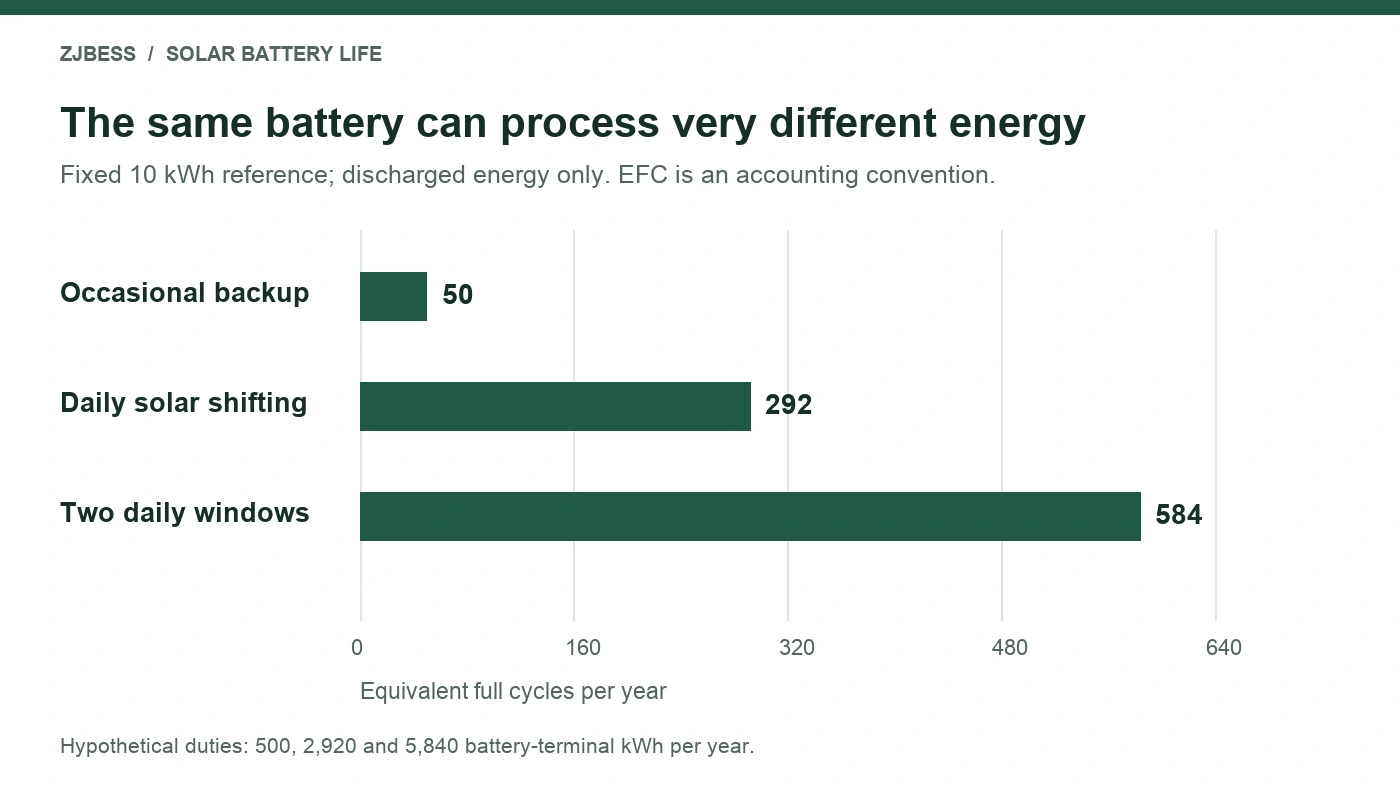
The accounting rule here is EFC = discharged battery-terminal kWh ÷ 10 kWh, with a fixed denominator. Charging energy is not added again. A manufacturer’s BMS counter or warranty may use a different definition. Do not compare these EFC totals directly with a laboratory cycle count unless the counting methods match.
The backup unit accumulates few cycles but still ages while standing ready. The twice-daily unit processes much more energy, so its current, temperature and throughput limits deserve particular attention. NREL’s lifetime-model research identifies temperature history, operating window and charge/discharge rate as influences on degradation. A cycle-count division leaves those inputs out.
How capacity loss changes backup runtime
Use a constant-load calculation to translate a retained-energy percentage into something a customer can assess:
AC runtime in hours = initial battery energy × retained-energy fraction × usable discharge fraction × discharge-path efficiency ÷ average AC load.
For this example, assume 10 kWh initial battery-terminal energy, an 80% usable discharge fraction, 94% battery-to-AC discharge efficiency and a constant 1.2 kW load. There is no solar or grid input during the outage. The efficiency is a one-way assumption; substituting round-trip efficiency would mix charging losses into a discharge-only calculation. Ignore standby and auxiliary consumption for this simplified example.
| Retained energy | Energy delivered to AC loads | Runtime at 1.2 kW | Six-hour requirement |
|---|---|---|---|
| 100% | 10 × 1.00 × 0.80 × 0.94 = 7.52 kWh | 6.27 hours | Met, with little margin |
| 80% | 10 × 0.80 × 0.80 × 0.94 = 6.02 kWh | 5.01 hours | Not met |
| 70% | 10 × 0.70 × 0.80 × 0.94 = 5.26 kWh | 4.39 hours | Not met |
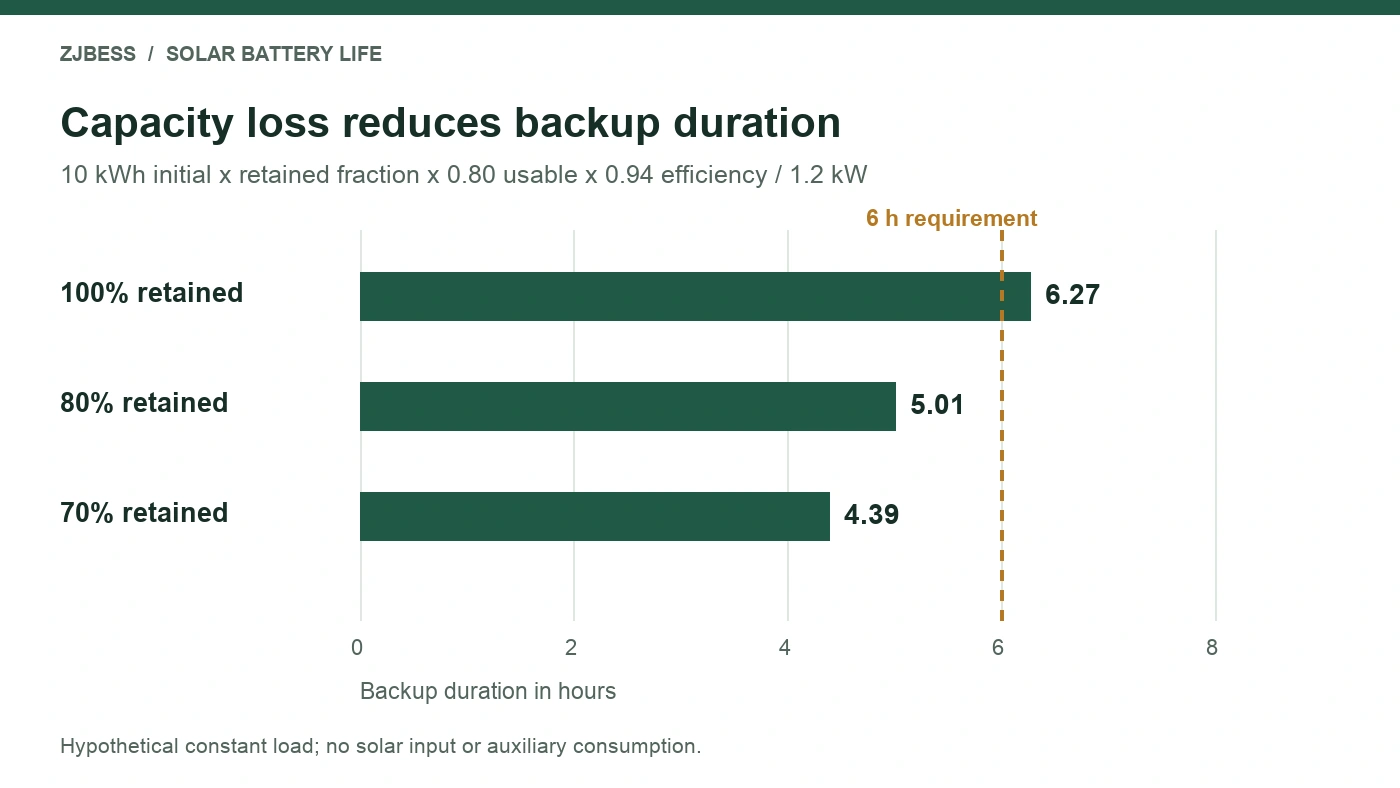
The 80% retained-energy row does not mean the battery has failed. It means this example system can no longer deliver six hours at 1.2 kW under the stated assumptions. It could still meet four hours at the same load, provided its power capability and other operating conditions remain acceptable.
Load growth can produce the same complaint. Even when new, the example battery supplies only 7.52 ÷ 1.8 = 4.18 hours if average load increases from 1.2 to 1.8 kW. A shorter runtime alone cannot distinguish ageing from additional appliances, a lower starting SOC or a changed reserve setting.
Size for the energy needed later in service
A battery that barely covers the load when new has little room for capacity loss. Suppose a customer needs 8 kWh at the AC loads during an outage and wants that requirement met at an assumed future retained-energy level of 80%. Keep the previous 80% usable fraction and 94% discharge efficiency.
Required initial energy = 8 ÷ (0.80 retained × 0.80 usable × 0.94 efficiency) = 13.30 kWh.
Ignoring future loss gives 8 ÷ (0.80 × 0.94) = 10.64 kWh. Designing around the assumed 80% retained level therefore requires 25% more initial energy in this calculation.
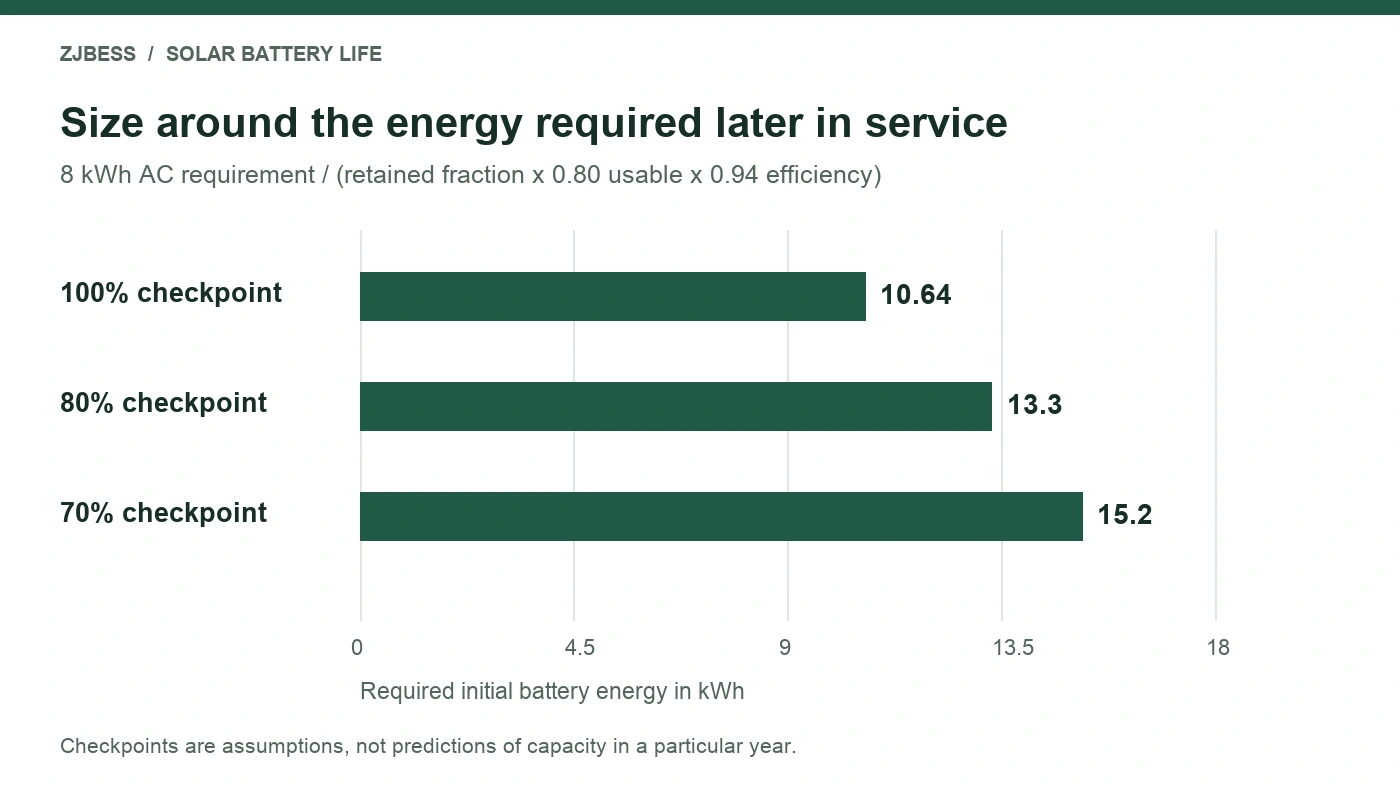
At a 70% retained level, the same calculation gives 15.20 kWh. Neither percentage predicts which year that condition will occur. They are design checkpoints to discuss against the actual model’s evidence and warranty.
These figures also assume the battery is fully available at the beginning of the event. If an outage begins after an evening discharge, the remaining SOC window can be much smaller. Agree the minimum starting reserve and the load duration before selecting a size. Our home battery sizing guide develops the load schedule; the ZJBESS home battery range is the place to compare actual configurations. Match the result to current model documents rather than rounding down to the nearest label size.
Extra kWh cannot solve every shortage. A high-power load may exceed the inverter or battery discharge limit even when ample stored energy remains. For a hypothetical 5 kW AC demand, 48 V under-load battery voltage and 94% inverter efficiency, battery current is approximately 5,000 ÷ (48 × 0.94) = 111 A. That is a calculation, not an approved current setting. Check continuous and surge limits separately for the selected equipment.
Which operating conditions change lifespan?
Heat and time spent at high state of charge
A battery in a hot enclosure experiences a different history from one in a temperature-controlled room. Calendar-ageing research on a specific commercial LFP/graphite cell followed 17 storage conditions over 29 months, examining temperature and SOC. The published study supports assessing both variables; it does not establish a universal “years lost per degree” rule or a ZJBESS degradation curve.
For a hypothetical site whose battery logs repeatedly reach 40°C, a cycle-life test conducted at 25°C is not a matching exposure. Keep the actual temperature history, including duration and load at high temperature. Ask for the model’s permitted conditions and any relevant performance evidence. Do not convert the 15°C difference into a lifespan reduction without a validated model.
Keeping a large backup reserve can be necessary where outages are frequent. It also changes the time spent at different SOC levels. Choose the reserve around the outage requirement and the manufacturer’s charging and balancing instructions. A blanket instruction to “never charge above 80%” can conflict with the product’s balancing or SOC-calibration requirements.
Depth of discharge and energy per cycle
A 20–80% SOC window is 60% DoD, not 80% DoD. On the hypothetical 10 kWh battery when new, that window offers 6 kWh at the battery boundary, or 5.64 kWh at AC with the assumed 94% discharge efficiency. A 10–90% SOC window spans 80% and offers 8 kWh at the battery boundary, or 7.52 kWh at AC. The narrower window provides 1.88 kWh less AC energy in this example.
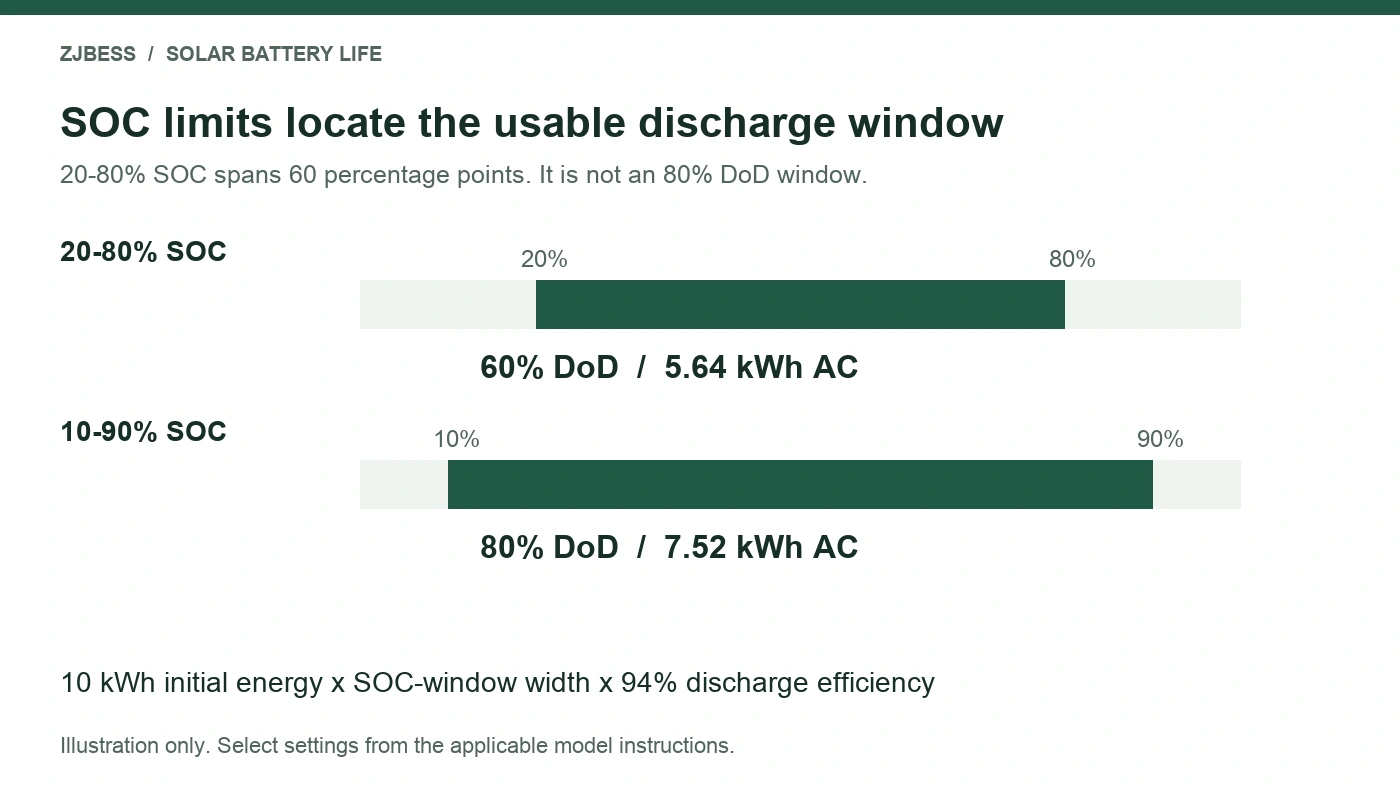
That tradeoff matters during an outage. If essential loads need 7 kWh, the narrower window cannot meet the requirement even with a new battery. A longevity strategy must preserve the required backup service. Choose the window from the model’s instructions and the actual load, rather than copying a generic percentage. Likewise, charge-voltage advice for another lithium chemistry must not be applied to an LFP cell or pack.
Shallower cycles may increase the number of cycles, but the energy moved during each cycle also falls. A concrete manufacturer example is the Victron Lithium NG 51.2 V 100 Ah specification: it lists 2,500 cycles at 80% DoD, 3,000 at 70% and 5,000 at 50%, with capacity at least 80% of nominal.
For a rough comparison using a fixed initial-energy reference, 2,500 × 0.80 = 2,000 full-depth equivalents, while 5,000 × 0.50 = 2,500. The cycle count doubles; this simple throughput proxy rises by 25%. It ignores declining capacity and is not measured lifetime energy. Those ratings apply to that Victron model, not to all LFP batteries. Its specified charge-temperature range is +5°C to +50°C, illustrating why a generic 0°C rule cannot replace a model’s manual.
Charging rate and the available charging window
A system that must put back 8 kWh of battery energy in two hours needs an average net battery charge power of 4 kW, before allowing for tapering or interruptions. If the permitted battery charge power is only 2 kW, at least four hours are needed on this simplified basis. Increasing a charger setting beyond the battery’s permitted current does not solve that design mismatch. It may simply cause limiting or protective shutdown.
Review the battery, inverter and available solar or generator input together. A system that cannot replenish the planned reserve may appear to have “lost capacity” when it actually begins each outage partly charged.
Planning 48V battery life and runtime in hot climates such as the Philippines
Most of the Philippines is warm all year. PAGASA puts the national mean annual temperature at 26.6°C, with May the warmest month at a 28.3°C mean and the hot, dry period running from March to May. Average relative humidity ranges from about 71% in March to 85% in September. Those are outdoor averages. A battery in a closed garage, under a roof deck or on a sun-facing wall runs warmer than the weather report.
The outage and the heat often arrive together
Grid stress in the Philippines tends to peak when it is hottest. On 13 May 2026, NGCP placed the Luzon and Visayas grids on red alert from 3 p.m. to 8 p.m., the first red alert of the year, after hot weather pushed demand close to available capacity. For a home battery, that timing matters: the battery may be asked to cover the evening load straight after a hot afternoon of charging, when its own temperature is near the day’s high. Plan the backup requirement for that condition, not for a cool morning test.
What our own 48V datasheet does and does not tell you
We rate the ZJBESS BG10KW 10kWh wall-mounted battery (51.2V, 200Ah, 16S LiFePO4) at 10,000 cycles at 25°C and 100% DOD. That 25°C is the test condition, not a typical Philippine battery room. The same datasheet allows charging from 0 to 60°C and discharge from −30 to 60°C. Read the two numbers separately: the operating range says where the battery is permitted to work; the cycle rating says what happened under one controlled temperature. A battery that spends its afternoons at 35–40°C is outside the condition behind the cycle figure, so do not divide 10,000 by 365 and quote 27 years to a customer in Cebu or Pampanga.
The enclosure rating is a separate question. The BG10KW is IP65, which covers dust and water jets. It does not make direct afternoon sun on a west-facing wall acceptable, and our installation notes say so. In a hot climate, location usually does more for battery temperature than any setting change: shade, airflow and distance from the roof and other heat sources. Our climate and hot-weather storage page lists the site checks we ask installers to review.
Current, cables and heat on a 48V system
A 48V system moves large currents. At an 8 kW inverter output with about 92% inverter efficiency, the BG10KW supplies roughly 181 A at 48 V. Current heats cables, lugs and breakers as well as cells, and that heat adds to a warm room. Check that cable size and termination torque follow the inverter and battery manuals, and look at terminal temperatures during the first high-load evening, not only at commissioning.
Use the factory QC record as your baseline
Every BG10KW leaves our Shandong factory with a QC pack filed under its serial number: original cell QR codes, the internal-resistance matching report, the full charge–discharge aging curve and the inverter configuration record. Keep that pack with the commissioning record described below. When a customer later reports shorter runtime, the delivered capacity at the factory is the reference point that separates real ageing from a hotter room, a higher reserve or new appliances. See how each unit is checked on our quality control page.
How to extend solar battery life without losing required backup
Start with the mismatch the system actually has. If charging reaches its permitted temperature limit during the hottest part of the day, have the installer review location, ventilation or the approved thermal arrangement. If a 20–80% SOC policy leaves only 5.64 kWh for a 7 kWh outage requirement, reduce nonessential loads or assess a larger approved battery configuration; the smaller window is not adequate by itself.
If repeated short outages leave the battery partly charged, compare the energy that needs replacing with the permitted charge power and available charging time. Review BMS communication and charge limits for the actual inverter model. If balance-related alarms recur, follow the manufacturer’s assessment and balancing procedure rather than continually changing the charge ceiling. For extended shutdown, use the model’s storage SOC, recharge interval and isolation instructions; connected auxiliary loads can change how quickly the battery discharges.
Keep a commissioning baseline of starting SOC, reserve settings, battery temperature, delivered energy and the load schedule. Repeating a comparable review when runtime changes gives the installer evidence to separate ageing from configuration or load changes. Firmware changes should follow the manufacturer’s instructions for the installed pairing.
Read warranty years alongside retained capacity and throughput
A ten-year warranty does not necessarily mean ten years at the original capacity. For a documented example, Tesla’s US Powerwall warranty, revision 2.6, effective 6 May 2026, specifies 70% energy retention at ten years. Listed solar self-consumption, time-based control and backup uses have unlimited cycles; other applications, or combinations including them, have a 37.8 MWh aggregate-throughput limit measured at the battery AC output. Coverage also has other terms and exclusions.
The application category matters. Do not automatically assign the throughput cap to every daily-cycling installation. Equally, do not read “unlimited cycles” as unlimited retained capacity. These are US Powerwall terms, not Australian, UK or ZJBESS terms.
Now compare a separate, invented warranty: ten years or 36 MWh of AC discharge throughput, whichever occurs first. Assume constant daily discharge for the calculation:
| Daily AC discharge | Annual AC discharge | Time to 36 MWh | Earlier limit |
|---|---|---|---|
| 8 kWh | 2,920 kWh | 12.3 years | 10-year time limit |
| 16 kWh | 5,840 kWh | 6.2 years | Throughput limit |

For a real quotation, put the time limit, energy limit, permitted applications, capacity-retention criterion and measurement method in separate fields. Also identify the remedy and responsibility for freight and site labour. This prevents a distributor from promising a service that the manufacturer’s written terms do not provide. Our battery quote comparison guide helps align offers on the same basis.
Does shorter runtime mean the battery needs replacing?
Start with comparable operating records. A first-month runtime of six hours and a later runtime of four hours mean little if the starting SOC, temperature, reserve or appliances changed. The following distinctions help narrow the review without declaring a cause prematurely.
| Observed change | Useful evidence | What it helps distinguish |
|---|---|---|
| Less energy across the whole discharge | Comparable starting SOC, ending limit, load and temperature; measured battery and AC energy | Possible capacity reduction versus altered usable window or losses |
| Shutdown when a pump or compressor starts | Event time, peak load, battery current, voltage, SOC and BMS/inverter alarms | Power or surge limitation versus an energy shortage |
| Low reserve at the start of the outage | Previous charging energy, charge limits, solar production and charging-window duration | Incomplete recharge versus reduced storage capability |
| Reduced charging on cold mornings | Battery temperature and permitted charging conditions | Temperature protection versus permanent capacity loss |

If capacity is disputed, ask qualified personnel to use the applicable assessment method. Runtime observation is useful evidence, but it is not a controlled capacity test. Do not bypass protection to obtain a longer run. Replacement planning should follow the technical finding, required backup performance and applicable terms.
Questions buyers ask about lithium solar battery life
How long does a 48V lithium battery last in the Philippines?
There is no single number. The general 10–15-year planning range is a reasonable starting point, but in the Philippines the deciding factors are battery temperature, the daily energy cycled and how often brownouts call on the reserve. A battery kept indoors and shaded, sized so it still covers the evening load at 80% retained energy, will meet its purpose longer than one installed on a sun-facing wall and cycled to its limits every day. Ask for the cycle rating’s test temperature and compare it with your site’s afternoon conditions.
Can a lithium solar battery last 20 years?
A 20-year claim needs model-specific evidence for the intended duty and a definition of what performance remains at year 20. A large cycle rating alone does not supply that evidence. Use the 10–15-year general planning range cautiously and assess any longer claim against its stated conditions.
Does 80% state of health mean the battery must be replaced?
No universal replacement rule follows from that number. In the example above, 80% retained energy supplies about five hours at 1.2 kW. That falls short of six hours but still exceeds four. First establish what the reported health percentage measures and whether power and other operating requirements are also met.
Can another battery be added after several years?
Only if the manufacturer permits that combination and defines the integration procedure. New and aged batteries can differ in capacity, firmware and current sharing. Additional energy also requires compatible controls, adequate charging capacity and an approved arrangement. Expansion is not automatically a way to restore the original system’s performance.
Plan the required backup performance before comparing models
For a ZJBESS enquiry, send the destination, inverter model, essential-load kW and kWh, required backup hours, expected discharge frequency and installation temperature conditions through the ZJBESS contact page. State whether the requirement must still be met at an agreed retained-energy checkpoint. Request the relevant model specification, usable-energy basis, integration limits and written warranty for that destination. These details make it possible to discuss an actual configuration rather than choosing by a headline cycle count.Calculations in this guide are worked examples, not ZJBESS test results or operating instructions; follow the manual of the model you install.
Discuss Your ProjectBack to Blog

