
Most LiFePO4 battery supplier failures that reach a distributor’s desk look the same: the sample passed, the first shipment looked fine, and then something in the third container was different from the datasheet. By that point you have already sold the product, committed to a service territory, and built a reputation around it.
The 10 items below are grouped into three stages that mirror a real procurement process. Stage 1 covers paper verification — what you can check before the sample arrives. Stage 2 covers sample testing — what to measure when the product arrives. Stage 3 covers ongoing supply assurance — what happens after the first order.
Overview: 10 items in three stages
| # | Item | Stage | Pass criteria (minimum) |
|---|---|---|---|
| 1 | Business registration match | Paper | Manufacturer name matches invoice, licence and warranty |
| 2 | Cell grade documented | Paper | Cell model number + IQC report provided |
| 3 | UN38.3 scope correct | Paper | Model, cell config and test lab all match ordered product |
| 4 | Market certifications scoped | Paper | DoC and test report cover the specific model you are ordering |
| 5 | Sample capacity ≥95% rated | Sample | 0.2C discharge test at 25°C before batch approval |
| 6 | BMS cutoffs verified | Sample | Firmware version documented; under-voltage test passed on the unit |
| 7 | Inverter compatibility tested | Sample | Register map or test record for your top inverter brands |
| 8 | Change notification policy | Ongoing | Formal ECN process or versioned datasheet with revision history |
| 9 | Warranty mechanism clear | Ongoing | Step-by-step claims process; shipping terms defined |
| 10 | EOL records traceable | Ongoing | Serial number links to cells, BMS firmware version and EOL test record |
Any item scored fail before the first order is a risk you carry into every subsequent order. Items 3, 5 and 9 — UN38.3 scope, sample capacity and warranty mechanism — are the three that most commonly cause problems in practice, because they are the ones where a gap between documentation and reality tends to surface at the worst possible time.
Stage 1 — Paper verification
Items 1–4: what you can verify before you request a sample.
1 Business registration and legal entity match
Ask for the business licence (营业执照) and confirm that the company name on the licence matches the name on the invoice, the datasheet header and the certification documents. In China, a trading company can legally sell products manufactured by a third-party factory without disclosing the relationship. This is not inherently a problem, but you need to know which entity is manufacturing, which is selling, and which name is on the warranty.
2 Cell supplier and cell grade
The cell is the single largest cost component in a LiFePO4 pack and the dominant factor in cycle life. “CATL cells” covers everything from Grade A new production to Grade B cosmetically rejected cells to Grade C cells reclaimed from other applications. Ask for the cell model number, not just the brand, and cross-check it against the publicly available cell manufacturer’s product catalogue.
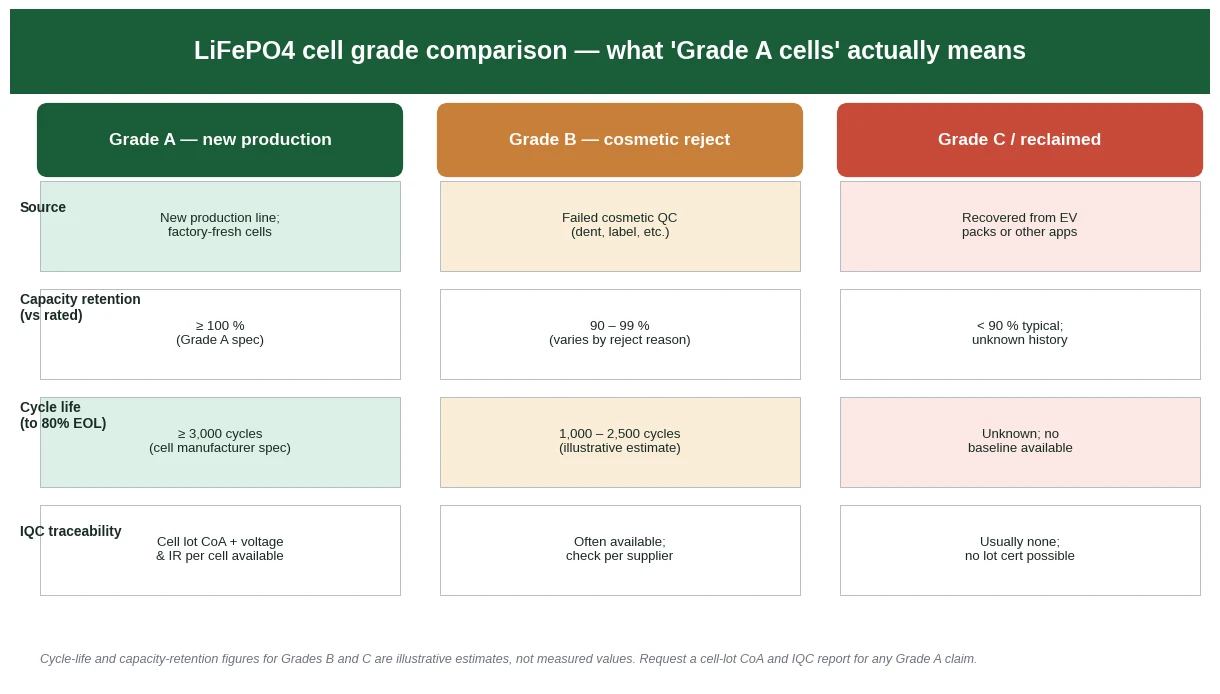
What to ask: “What is the exact cell model number? Is this Grade A new production? Can you provide an IQC report from your incoming quality control team showing the cells were tested against their specification before assembly?”
3 UN38.3 test report: check the model, not just the pass result
UN38.3 is the transport safety standard required by IATA, IMDG and most national customs authorities for lithium battery shipments. Almost every supplier can produce a UN38.3 certificate. The question is whether the certificate applies to the specific model and configuration you are buying.
UN38.3 testing is conducted on a specific cell type, cell configuration and BMS version. A certificate for a 100Ah pack does not automatically cover a 200Ah pack assembled from the same cells. When you receive the report, check four fields:
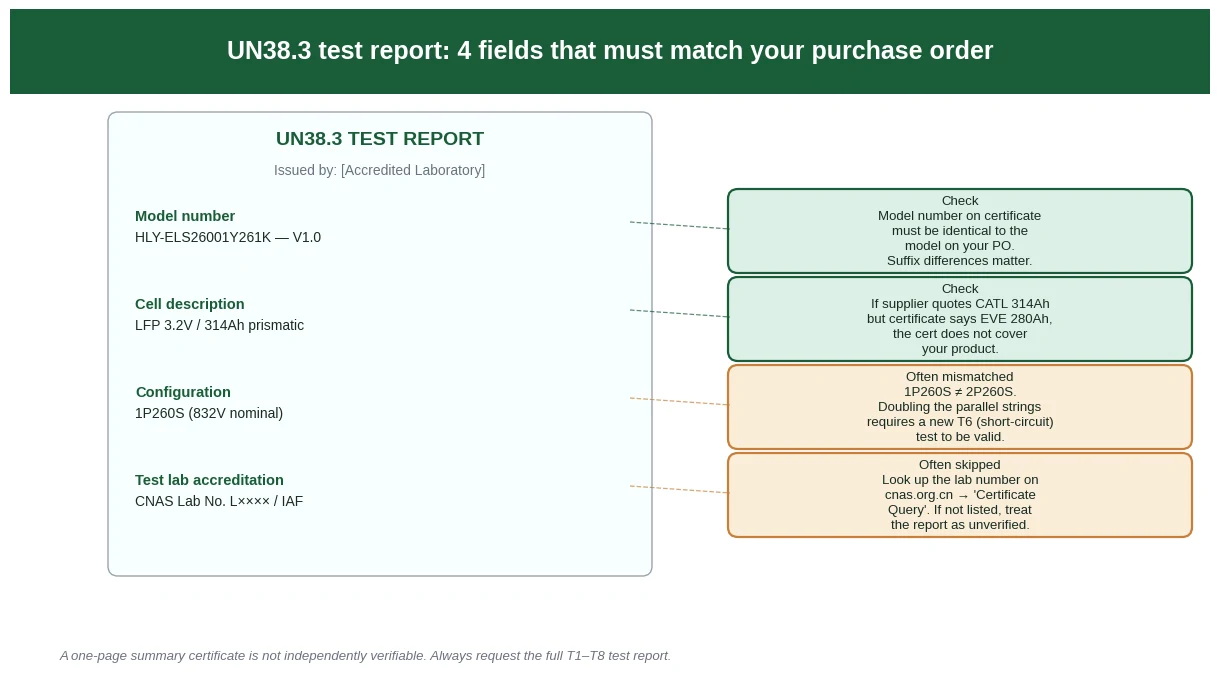
Four fields to verify on the UN38.3 report:
- Model number on the certificate — must match the model on your purchase order exactly, including variant suffix. HLY-ELS26001Y261K-V1.0 and HLY-ELS26001Y261K-V2.0 are different models.
- Cell description — must match the cell type the supplier says is in the pack. If a supplier quotes CATL 314Ah but the certificate says EVE 280Ah, the certificate does not cover the product.
- Configuration — number of cells in series and parallel must match the product’s electrical specification. 1P260S is not covered by a 2P260S certificate; the parallel doubling changes the T6 short-circuit test current.
- Test laboratory accreditation — the lab must be CNAS-accredited or recognised by IAF. In China: SGS, TUV, Intertek, Bureau Veritas and a number of CNAS local labs. Look up the lab’s CNAS number at cnas.org.cn → Certificate Query.
For a full explanation of what each UN38.3 test covers, see our UN38.3 battery test summary guide.
4 IEC 62619 and CE: scope matters
IEC 62619 is the international safety standard for secondary lithium cells and batteries used in industrial applications. CE marking for the European market requires a Declaration of Conformity (DoC) referencing the applicable directives — at minimum the Low Voltage Directive 2014/35/EU, with IEC 62619 as the harmonised standard for battery safety. When a supplier says “CE certified,” ask which directives, which notified body issued the DoC, and whether the DoC covers the specific model in your order.
Stage 2 — Sample testing
Items 5–7: what to measure when the product arrives, before batch approval.
5 Capacity test: measure the delivered energy, not the label
The nominal capacity on a datasheet — for example, 10.24kWh / 200Ah for the ZJBESS BG10KW — is measured at 0.2C discharge rate, 25°C ambient, and discharge to the minimum BMS cutoff voltage. The label is what a Grade A new cell pack should deliver under those conditions. Run the test before you approve a batch.
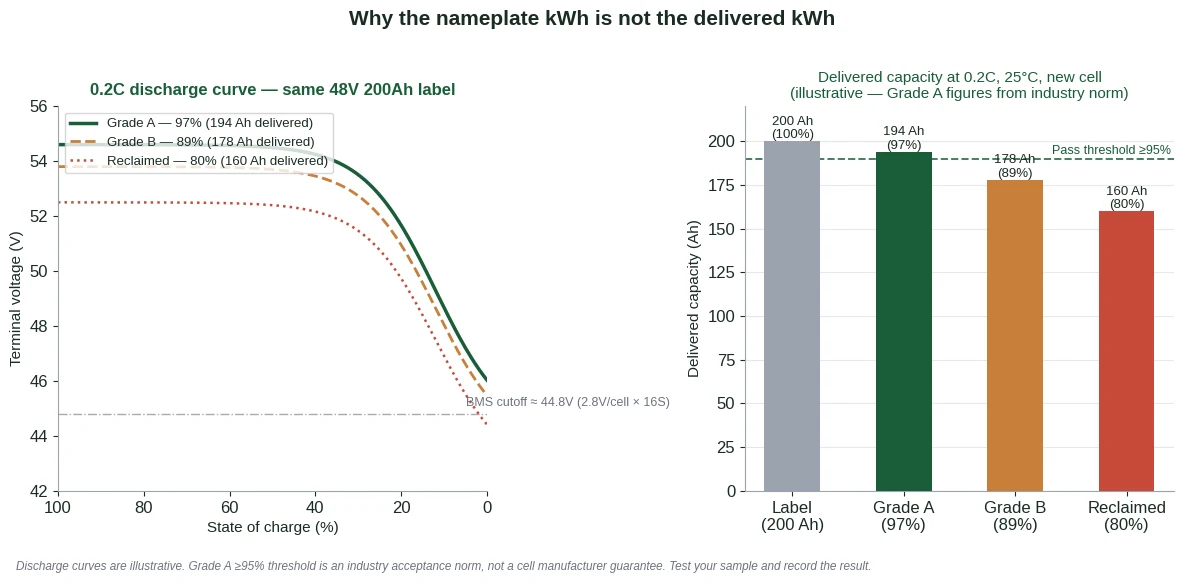
Five-step capacity test procedure:
- Charge to 100% SOC using the manufacturer’s recommended profile (voltage and current limits from the datasheet).
- Rest 30 minutes at 25°C ambient.
- Discharge at 0.2C (e.g. 40A for a 200Ah pack) to the BMS low-voltage cutoff.
- Record total Ah delivered. For a new Grade A pack: target ≥95% of rated Ah. Below 90% fails the batch.
- Repeat at 0.5C. A well-designed pack retains ≥90% of its 0.2C capacity at 0.5C.
Document the test with timestamps, voltage and current logging, and ambient temperature. This record becomes your baseline for warranty claims if capacity degrades faster than specified.
Record where the energy was measured. Amp-hours count charge; delivered energy also depends on voltage. If a log shows 1.5 h at 50 V and 40 A followed by 1.0 h at 48 V and 30 A, the pack delivered 90 Ah and (50 × 40 × 1.5 + 48 × 30 × 1.0) ÷ 1,000 = 4.44 kWh at its DC terminals. Multiplying the same 90 Ah by a nominal 51.2 V would give 4.608 kWh, which is a nominal calculation, not a measurement. An AC meter after the inverter reads lower again because of conversion losses. Compare only results taken at the same point. These numbers are illustrative, not a ZJBESS test result.
For the full acceptance test procedure, including how to record results for a warranty baseline, see our LiFePO4 sample acceptance test guide.
6 BMS protection: verify the cutoffs actually work
The BMS prevents a LiFePO4 pack from damage by over-voltage, under-voltage, over-current, over-temperature and short circuit. The datasheet lists protection thresholds. These numbers only matter if the BMS actually disconnects the pack at those values.
Three tests are practical for a distributor to perform without specialised equipment:
Under-voltage protection test (safe, no lab equipment needed):
Run the pack to 0% SOC on the inverter display, then continue a small discharge load (a lamp or resistive load). The BMS should disconnect within a few minutes. After disconnection, measure terminal voltage with a DC voltmeter. For a 48V 16S LiFePO4 pack: the voltage should be above the minimum safe cell voltage, which is typically ≥2.8V per cell, or ≥44.8V for a 16S pack. If the terminal voltage at BMS cutoff is below 44.0V (2.75V/cell), the cutoff is set too low for safe cell operation.
Temperature protection check:
During a cold period, verify the BMS refuses to charge when cell temperature is below the charge cutoff (typically 0°C for LiFePO4). The app or display should show a temperature fault — not silently refuse to charge with no indication. A silent refusal means the installer cannot diagnose why the battery is not accepting charge.
Short-circuit protection: Do not test this without proper lab safety equipment. Request the T6 short-circuit test results from the UN38.3 report as documentary evidence.
7 Inverter compatibility: test with the inverters your customers actually use
LiFePO4 battery compatibility with inverters operates on two levels. The first is basic electrical compatibility: the battery’s voltage range must fall within the inverter’s DC input range, and the charge voltage and current limits must be programmable on the inverter. The second level is communication compatibility: for inverters that support lithium battery communication, the BMS must send the correct CAN or RS485 protocol to allow closed-loop charge management.
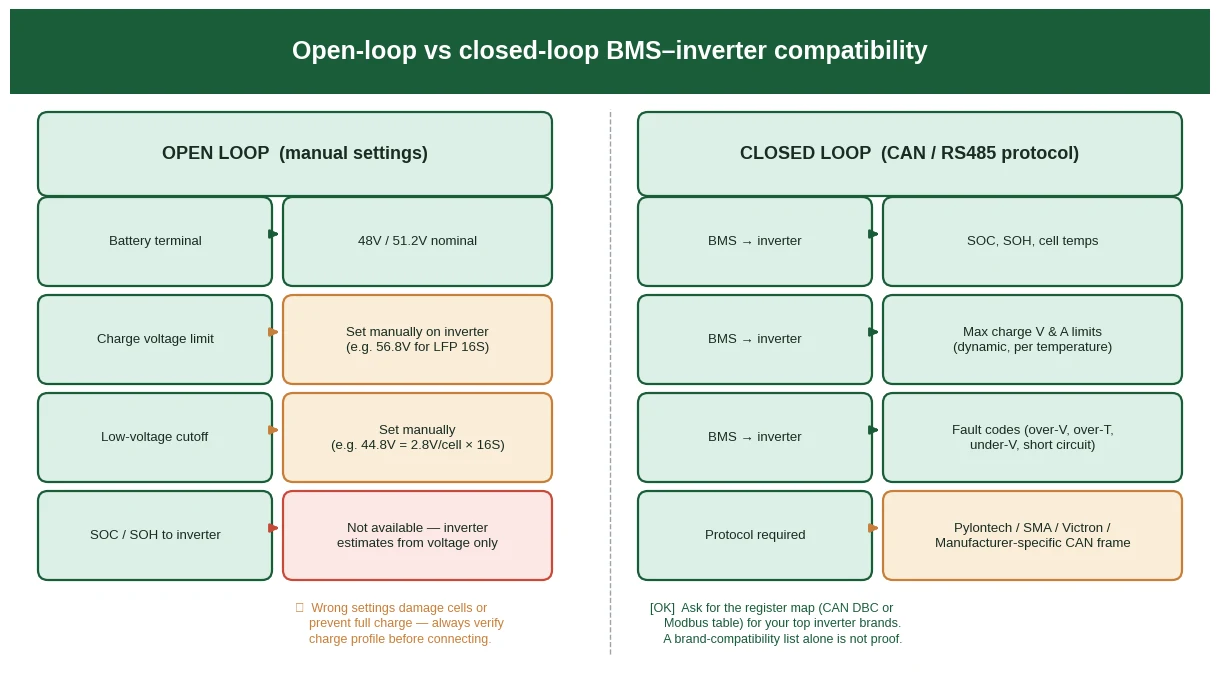
What to ask for closed-loop compatibility: “Which inverters has this BMS been tested with for CAN or RS485 closed-loop communication? For the top two or three brands in my market, can you send the communication protocol document or register map showing the protocol type, baud rate and frame format?”
A brand-name compatibility list is not evidence of a tested integration. A register map or CAN DBC file that the inverter manufacturer’s technical team has reviewed is evidence.
A battery appearing on the inverter screen proves a data link, not control. The evidence worth keeping connects three things on one time axis: the limit the BMS requested, how the inverter interpreted it and the current that actually flowed. Test the operating mode you will sell, too. A demonstration with the grid connected lets the grid cover any shortfall; battery-only backup makes the battery and inverter carry the load within their own limits. ZJBESS has run factory compatibility tests and has received compatibility confirmation from customers after delivery. For a new order, check that the record covers your battery, the full inverter model, firmware, protocol, cable and operating mode.
For the full compatibility methodology and a list of confirmed protocol types by inverter brand, see our LiFePO4 battery inverter compatibility guide.
Stage 3 — Ongoing supply assurance
Items 8–10: what happens after the first order.
8 Production consistency: ask for a change notification policy
Battery pack production is not static. Cell suppliers upgrade cell generations (for example, from 100Ah to 105Ah nominal capacity for the same physical cell size), BMS firmware updates to fix faults, and thermal management designs get revised between production runs. Each change can affect performance, safety certifications and inverter compatibility — without necessarily changing the product model number on the datasheet.
What to ask: “Do you have a formal Engineering Change Notice (ECN) process? If the cell model, BMS firmware version, or any safety-relevant component changes, will you notify us in writing before shipping the new revision? Will the datasheet version number be updated?”
A change does not mean every test has to be repeated. Follow the dependency: re-check only the conclusions that relied on the part that changed.
| Change in a reorder | What it can affect | Evidence before making the same promise |
|---|---|---|
| Connector or supplied cable | Whether existing stock and cables still fit | Interface definition and accessory revision |
| BMS or firmware | Whether the inverter pairing still follows limits and reports correctly | Change description plus communication or control evidence |
| Mounting or enclosure | Installation and service access | Revised product and installation documents |
| Cell model or cell supplier | Capacity, cycle life and transport-document coverage | New cell datasheet, IQC record and confirmation that the UN38.3 report still covers the product |
An empty rack slot or a spare parallel port is physical space, not approval to mix revisions. The configuration rules for the actual products decide what may be combined.
9 Warranty mechanism: what actually happens when a unit fails
Warranty terms on a datasheet describe a duration. They do not describe the mechanism. For a distributor with customers in Nigeria, the Philippines or South Africa, a warranty that requires shipping a defective unit to Shenzhen and waiting 6–8 weeks is not functionally equivalent to a warranty with component-level replacement available from local stock.
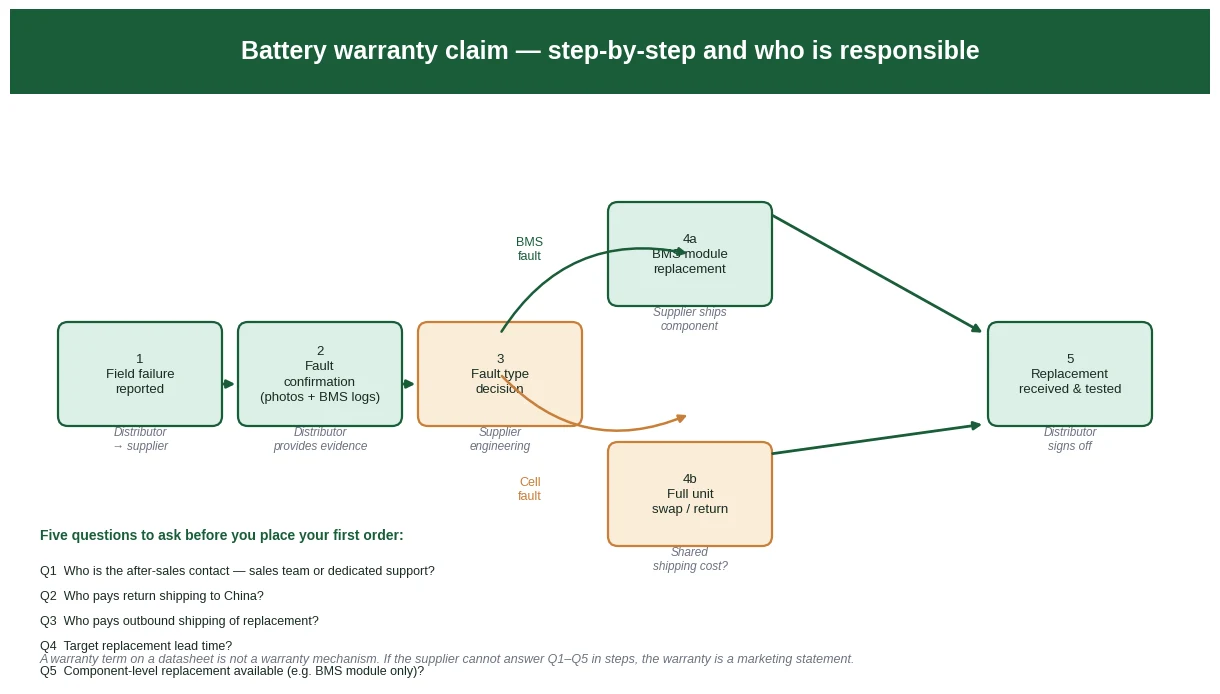
Five questions to ask before placing the first order:
- Who is the after-sales contact — the sales team or a dedicated after-sales team?
- Who pays for return shipping to China and outbound shipping of the replacement?
- What is the target replacement lead time?
- Is component-level replacement available — for example, a replacement BMS module rather than a full unit swap?
- What documentation is required to open a claim (photos, BMS fault logs, serial number)?
How ZJBESS handles a claim: we respond within 24 hours and, except during special periods or for complex problems, give a handling conclusion within three days. Spare parts are prepared at the factory in advance, and replacement before return is assessed case by case. The LS15KW carries a ten-year warranty with free replacement under its product policy. Free replacement defines the remedy; return freight, local labour and lifting work are allocated in the agreed terms, so settle them before the first order rather than after the first fault.
For the full list of warranty terms to clarify before your first order, see our home battery warranty claims guide.
10 Factory audit and pre-shipment inspection: EOL records as the baseline
An End-of-Line (EOL) test is a charge-discharge test run on every finished pack at the factory before shipment. It is the minimum documentary evidence that the unit you are receiving met its rated capacity on the day it left the factory. Without EOL records, you have no documented baseline for a capacity warranty claim.
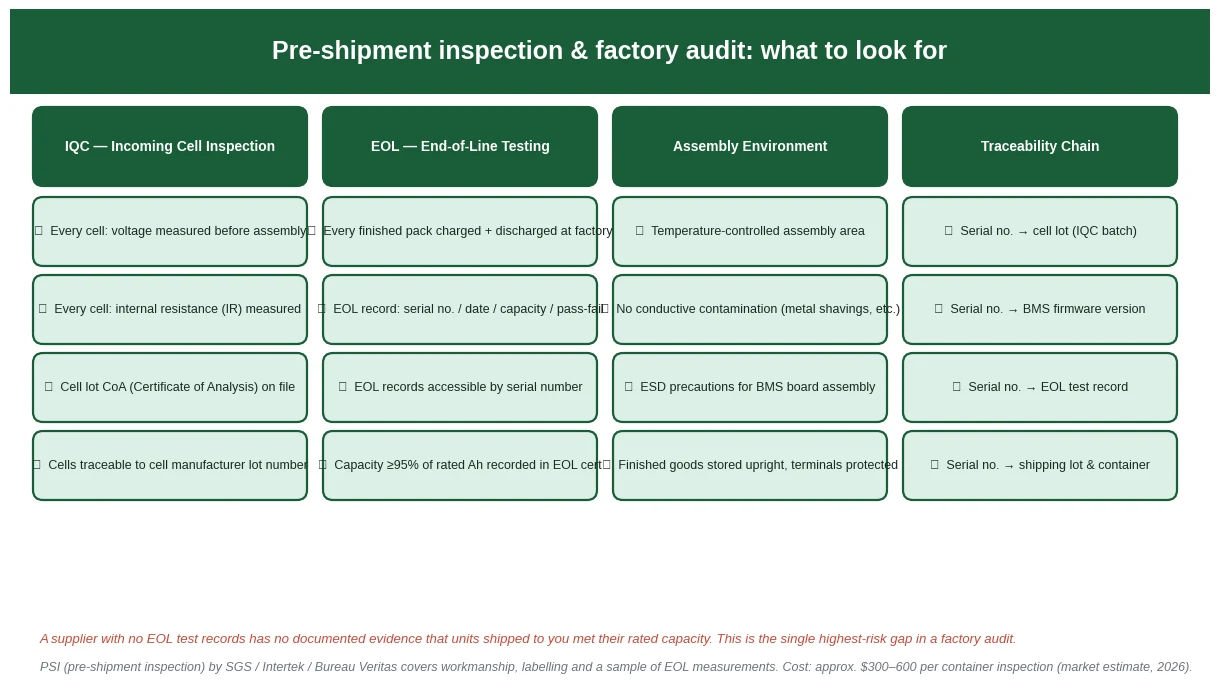
What EOL records should contain (minimum):
- Pack serial number
- Test date
- Capacity measured at 0.2C (Ah and % of rated)
- Pass or fail against the rated specification
- BMS firmware version at the time of test
Pre-shipment inspection (PSI): If a physical audit is not feasible before the first order, a PSI by SGS, Intertek or Bureau Veritas covers workmanship, labelling, carton marking (required for lithium battery sea freight) and a sample of electrical measurements on finished goods before they leave the factory. Market estimate for a container inspection: approximately US$300–600 (2026). For orders above approximately US$50,000, the inspection cost is well under 1% of the order value.
What to include in your initial RFQ
The 10 items above are designed to be completed at the RFQ stage — most of the information should be available before you order a sample. By the time you receive samples for capacity testing (Item 5) and BMS verification (Item 6), you should have already narrowed to one or two suppliers based on Items 1–4.
Documents to request before the quote stage:
- Business licence (manufacturer and trading company if different)
- Cell model number and IQC report template for the production batch
- UN38.3 full test report for the specific model — not the summary certificate alone
- CE Declaration of Conformity with standard reference (IEC 62619 for the LVD)
- Datasheet with version number and revision date
- Warranty claims procedure document
Suppliers who cannot provide these promptly at the RFQ stage are unlikely to provide them when you need them after a problem. The speed of the response is itself a data point.
Ask for lead times as two dates, not one. For standard models, ZJBESS dispatches within 15 working days of the agreed starting point, and transport is scheduled separately. That is a dispatch date, not an arrival or installation date, so confirm the starting milestone and planned dispatch before you commit a date to your own customer.
Our battery documentation checklist lists every document we provide with a ZJBESS order and what each one covers. For the UN38.3 test reports, the full T1–T8 results for each cell configuration are available on request alongside the summary certificates on the product pages. For inverter compatibility, the confirmed protocol types by brand are listed on the compatibility page with the protocol type (CAN / RS485 / Bluetooth) for each.
If you are ready to start the evaluation process, the most efficient starting point is sending us your target order quantity, cell configuration, top inverter brands in your market, and the certifications your import authority requires. Start your distributor review here →
Frequently asked questions
What is the most important document to request from a LiFePO4 supplier?
The UN38.3 full test report (T1–T8) is the single most important document because it is independently verified by an accredited laboratory and covers the specific model and cell configuration you are buying. It is also the document most commonly provided in an incomplete or mismatched form — where the certificate covers a different model, different cell count, or a cell type other than what is actually shipped. If a supplier cannot provide the full test report for your specific model, that is the highest-priority gap to resolve before ordering.
How do I verify a UN38.3 or IEC 62619 test report is genuine?
Contact the test laboratory directly using the contact information on the laboratory’s official website — not the contact information printed on the report. Most accredited labs (SGS, TUV, Intertek, Bureau Veritas) have a certificate verification portal or will confirm a report number by email. In China, CNAS maintains a public database at cnas.org.cn. A report from a laboratory that does not appear in the CNAS database should be treated as unverified until confirmed independently.
Is a factory visit necessary before the first order?
Not always. A pre-shipment inspection (PSI) by a third-party inspector such as SGS or Intertek is a low-cost alternative that covers most first-order risks. A PSI for a container of batteries typically costs approximately US$300–600 (market estimate, 2026) and checks workmanship, labelling, carton marking (required for lithium battery sea freight) and a sample of electrical measurements on finished goods. For orders above approximately US$50,000, the inspection cost is well under 1% of the order value. For recurring supply relationships, an annual factory audit is a reasonable schedule.
What happens if the supplier changes cells without telling me?
If the supplier has no ECN process, you are likely to discover a cell change through a customer complaint — a batch with lower capacity retention, different voltage behaviour, or a BMS that behaves differently with a new cell’s internal resistance profile. The practical protection is a versioned datasheet with a dated revision history, a purchase order that specifies the cell model number (not just “CATL 200Ah”), and an IQC report with the cell serial number batch for each shipment. These create a documented baseline that makes a cell substitution visible at incoming inspection.
What certifications do I need for importing LiFePO4 batteries into the EU?
For a 48V LiFePO4 home battery system, the minimum requirements are CE marking (Low Voltage Directive 2014/35/EU, with IEC 62619 as the harmonised safety standard) and UN38.3 for transport. The EU Battery Regulation (Regulation 2023/1542) introduces additional requirements for batteries above 2kWh, including battery passport and carbon footprint declaration requirements that are phased in from 2026 onwards. Verify current requirements with a local compliance consultant for your specific product category and market entry date.
How do I evaluate a supplier for C&I-scale BESS rather than home batteries?
The 10 items above apply to C&I systems as well, but the stakes are higher. For a 100kWh+ outdoor BESS, EMS capability, grid code compliance documentation (IEC 62477 for the PCS, local grid interconnection standards), and a site-specific single-line diagram review replace some of the home-battery-specific checks. The warranty mechanism question (Item 9) is especially important for C&I: a failed BMS module in a 261kWh cabinet on a commercial site has a different urgency than a failed module in a home battery. Ask specifically about on-site service response time, not just replacement shipping time. Our 261kWh C&I BESS product page includes the full C&I document package as a reference.
How many suppliers should I evaluate in parallel?
Running the 10-item checklist on two or three suppliers in parallel is a reasonable approach. The checklist is designed to be completed at the RFQ stage — most of the information should be available before you order a sample. The documentation checks in Stage 1 typically eliminate two out of three suppliers before the sample stage, so full sample testing on five suppliers simultaneously is rarely the most efficient use of your time.