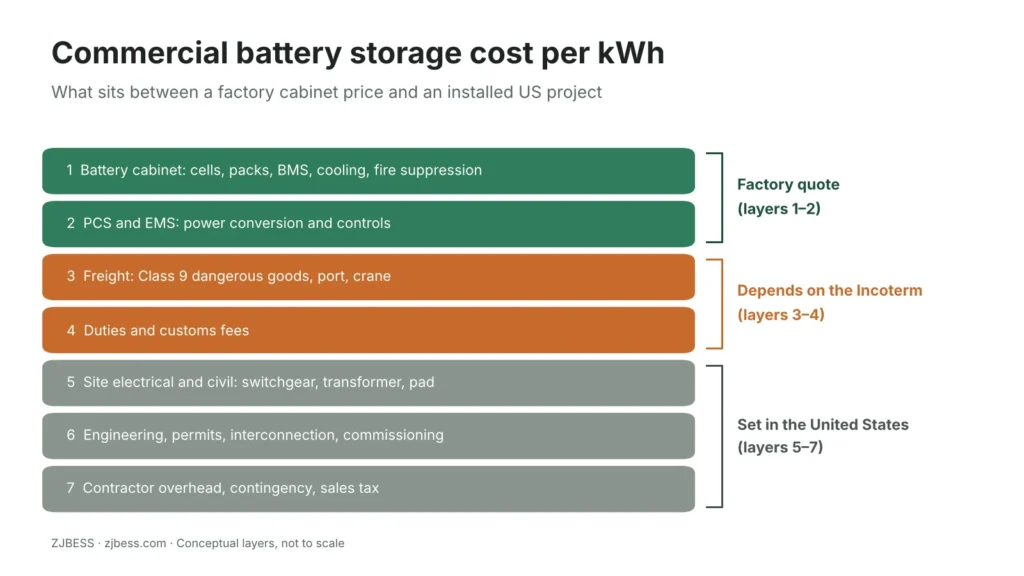

A solar battery or hybrid inverter price in the Philippines is the sum of five layers: the equipment price at the factory, the cost of shipping it to a Philippine port, customs duty and 12% import VAT, port and broker charges with inland delivery, and finally installation and the parts around the equipment. Two quotes for “a 10 kWh battery” can differ by tens of thousands of pesos simply because they stop at different layers.
As a reference for the first layer, our published FOB prices (updated 6 November 2026) are US$630 for the 5.12 kWh JJ5KW rack battery, US$900 for the 10.24 kWh BG10KW wall-mounted battery and US$1,030 for the 15.36 kWh LS15KW floor-standing battery. At about ₱63.5 to the dollar, that is roughly ₱40,000, ₱57,150 and ₱65,400 before anything is shipped. This guide shows what gets added on top, and which questions turn a single headline number into a quote you can compare.
100Ah or 200Ah? Read the voltage before the price
A “100Ah solar battery” price means little until you know the voltage, because amp-hours alone do not tell you how much energy the battery stores. Energy in kWh is voltage × amp-hours ÷ 1,000:
| Battery as advertised | Nominal voltage | Capacity | Stored energy | Example |
|---|---|---|---|---|
| 12V 100Ah LiFePO4 | 12.8 V | 100 Ah | 1.28 kWh | Common for small DIY and inverter kits |
| 48V 100Ah LiFePO4 | 51.2 V | 100 Ah | 5.12 kWh | ZJBESS JJ5KW rack module, US$630 FOB |
| 48V 200Ah LiFePO4 | 51.2 V | 200 Ah | 10.24 kWh | ZJBESS BG10KW wall-mounted, US$900 FOB |
A 48V 100Ah battery stores four times the energy of a 12V 100Ah battery, and one 48V 200Ah unit holds as much as eight 12V 100Ah batteries. So a 12V 100Ah price that looks cheap per unit is often the most expensive option per kWh once you have bought enough of them to run a home, and you still have to wire them in series. Compare offers in price per kWh at the same voltage, then check that the voltage matches your inverter: many home hybrid inverters, including our MAX-II 13.2kW, run on a 48V battery bus.
The five layers inside a solar battery quote

| Layer | What it covers | Who sets it | What to ask |
|---|---|---|---|
| 1. Equipment (FOB) | Battery or inverter, cables and manual packed at a named Chinese port | The manufacturer | Exact model, nominal and usable kWh, what is in the crate |
| 2. Freight and insurance | Sea freight to Manila, Cebu or Davao, cargo insurance, dangerous-goods handling | Your forwarder or the seller (if CIF) | Full or shared container, carrier acceptance of UN3480 cargo, transit time |
| 3. Duty and VAT | Customs duty for the tariff code, plus 12% VAT on the landed value | Bureau of Customs rules | Tariff code used, whether a preferential rate applies, how VAT was calculated |
| 4. Port, broker and inland | Arrastre, wharfage, brokerage, documentation, trucking to site or warehouse | Port operator, broker, trucker | Which of these the quote includes, and to which address |
| 5. Installation and parts | Breakers, DC cables, busbars, mounting, PV structure, labour, permits, commissioning | The installer | Itemised parts list, cable sizes, who files any utility application |
A distributor’s shelf price already contains layers 1 to 4 plus a margin for stock, warranty handling and credit. An installer’s system price adds layer 5. A factory FOB price contains only layer 1. None of these is wrong; they answer different questions.
Layer 1: what an FOB battery price covers
FOB (Free On Board) means the seller’s responsibility ends when the goods are loaded at the named port of shipment. Everything after that, from ocean freight onward, is the buyer’s cost unless the quote says otherwise.
| Model | Format | Voltage and capacity | Nominal energy | FOB per unit | FOB per kWh |
|---|---|---|---|---|---|
| JJ5KW | Rack module | 51.2 V, 100 Ah | 5.12 kWh | US$630 | US$123 |
| BG10KW | Wall-mounted | 51.2 V, 200 Ah | 10.24 kWh | US$900 | US$88 |
| LS15KW | Floor-standing | 51.2 V, 300 Ah | 15.36 kWh | US$1,030 | US$67 |
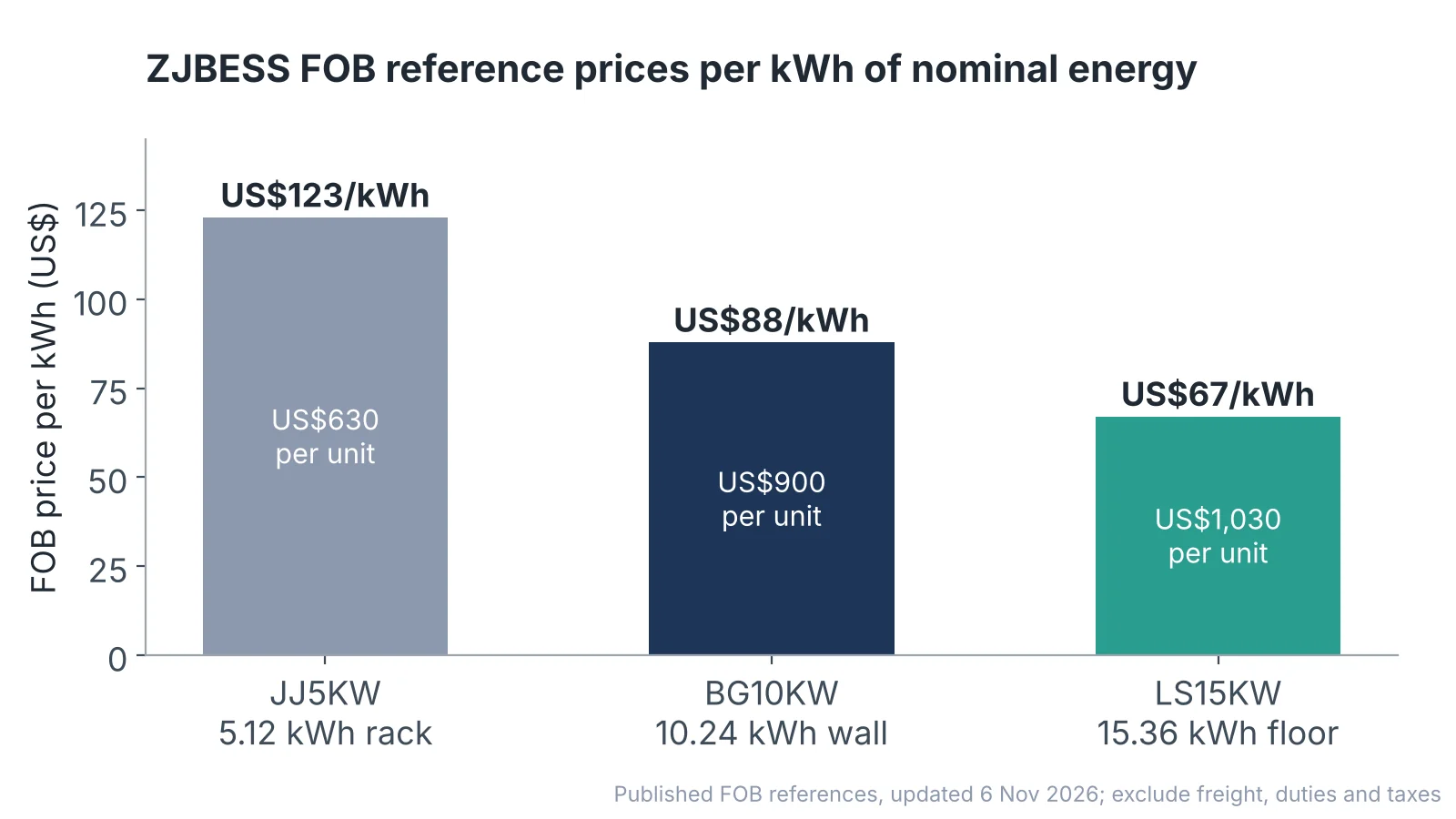
Price per kWh falls as the battery gets larger because the enclosure, BMS, display, crate and testing are needed once per unit, whatever its capacity. That makes “price per kWh” useful only when the format suits the site: a rack module that can grow in 5 kWh steps, or a single 15 kWh cabinet that needs floor space and weighs 121 kg.
What our FOB quotation includes for these batteries is written into each product’s distributor terms: the battery with your inverter protocol pre-loaded, power and communication cables, the installation manual, a per-unit QC pack and configuration record, a UN3480 wooden crate, and the UN38.3 test summary and MSDS that customs and the carrier will ask for. Standard orders leave the factory within 15 working days of the confirmed order. When you compare suppliers, check that their FOB figure covers the same items; a cheaper battery that needs a separate communication cable or BMS configuration is not cheaper at the site.
Layer 2: shipping lithium batteries to the Philippines
Lithium-ion batteries shipped on their own travel as UN3480, Class 9 dangerous goods. That affects price in two ways. Not every carrier or consolidator accepts them, and those that do add dangerous-goods documentation and handling charges. Shared-container (LCL) shipments can carry minimum charges that weigh heavily on one or two units.
Here is what that looks like in practice. These are the international freight charges on three recent ZJBESS battery shipments to the Philippines, as invoiced. Each was a small shipment, not a full container, and none includes delivery from the Philippine port to the customer’s address.
| Shipment | International freight | Per unit (at ₱63.5 per US$) |
|---|---|---|
| 1 × LS15KW 15 kWh floor-standing battery | ₱6,253 | ≈ US$98 (₱6,253) |
| 2 × LS20KW 20 kWh floor-standing batteries | ₱9,872 | ≈ US$78 (₱4,936) |
| 5 × LS20KW 20 kWh floor-standing batteries | US$614 | ≈ US$123 (₱7,798) |
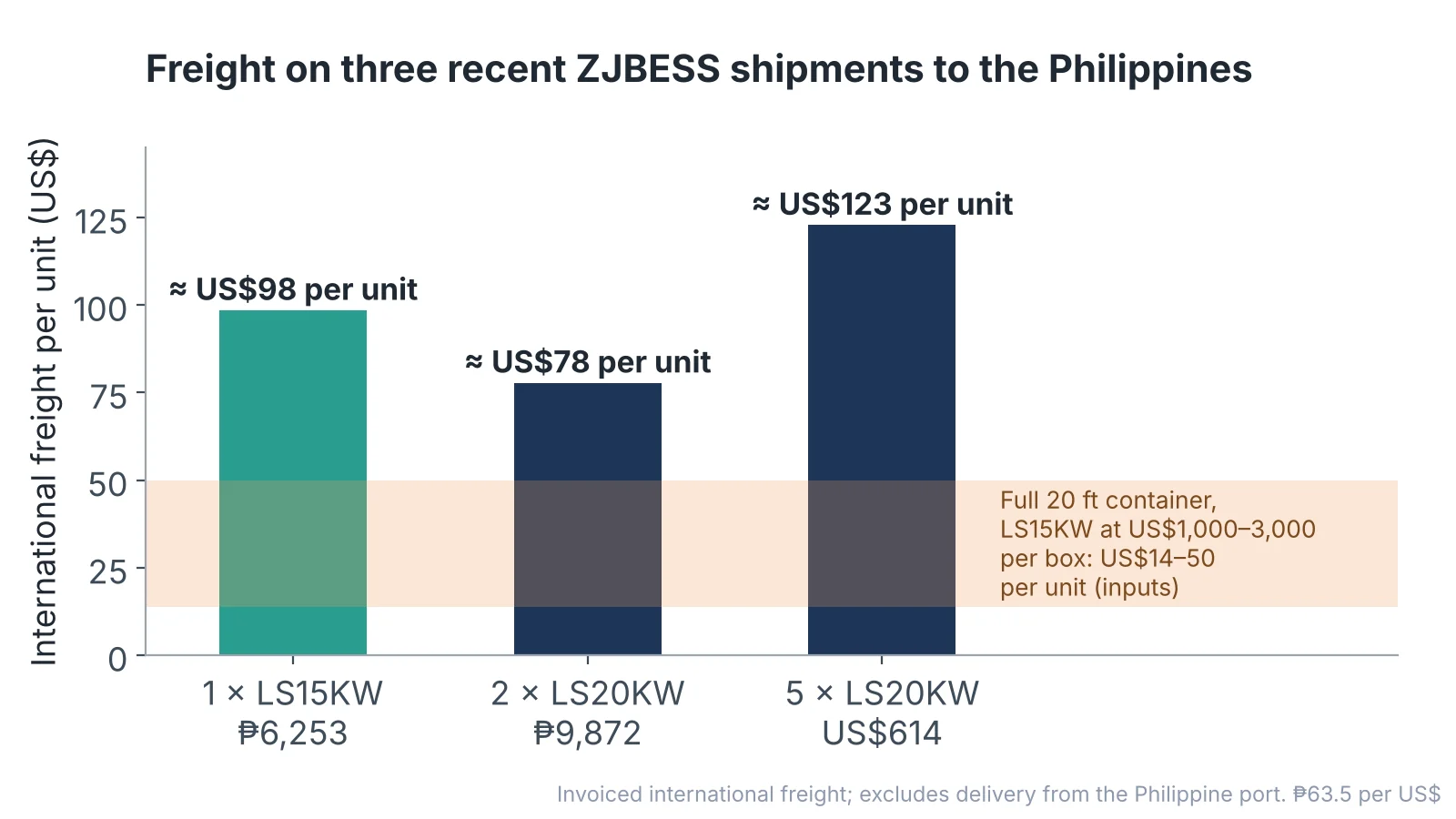
Two things stand out. Freight on a small shipment ran at roughly US$80–120 per battery; for the single 15 kWh unit it was about 10% of the LS15KW’s US$1,030 FOB price. And the per-unit figure did not fall neatly with quantity: the five-unit shipment cost more per battery than the two-unit one. Small dangerous-goods shipments are priced by route, carrier, sailing and consolidation minimums, so get a quote for your own shipment instead of scaling someone else’s.
Full containers change the arithmetic. Our published loading figures are about 70–80 BG10KW, 60–72 LS15KW, or more than 300 JJ5KW modules per 20 ft container, and the container’s freight is shared across all of them:
| Container freight and insurance (your forwarder’s quote) | Per BG10KW (70–80 per 20 ft) | Per LS15KW (60–72 per 20 ft) | Per JJ5KW module (300+ per 20 ft, at 300) |
|---|---|---|---|
| US$1,000 | US$12.5–14.3 | US$13.9–16.7 | US$3.3 |
| US$2,000 | US$25.0–28.6 | US$27.8–33.3 | US$6.7 |
| US$3,000 | US$37.5–42.9 | US$41.7–50.0 | US$10.0 |
The container rates in the first column are inputs for comparison, not quotes. Even at US$3,000 for the box, a full container brings freight per battery well below what the small shipments above paid. Between those two cases sits the real decision for most buyers: import a few units now at small-shipment rates, or buy from a distributor who has already paid container rates.
Layer 3: customs duty and 12% import VAT
Two separate charges apply at the border.
Customs duty is the dutiable value multiplied by the duty rate for the product’s tariff code. Lithium-ion batteries and inverters fall under different codes, and a preferential rate may apply to goods of Chinese origin under the ASEAN–China agreement when the shipment carries a valid certificate of origin (Form E). Rates change by executive order, so ask your customs broker to confirm the current rate for the exact code in the Tariff Commission’s Philippine Tariff Finder before you price a project.
VAT is 12% of the landed value: the value used by the Bureau of Customs to compute duty, plus customs duty and other charges, as PwC’s Philippines tax summary explains. Because VAT is charged on top of duty, every 1% of duty costs slightly more than 1%.
Two common assumptions do not hold for most battery orders:
- “Small orders are tax-free.” The de minimis rule exempts goods with an FOB or FCA value of ₱10,000 or less from duties and taxes, under Section 423 of the Customs Modernization and Tariff Act (reported by the Inquirer). That is about US$157 at today’s rate. A single BG10KW at US$900 FOB is more than five times the threshold.
- “Solar equipment is duty-free.” The duty-free importation under the Renewable Energy Act (RA 9513) is for DOE-registered renewable-energy developers, with DOE endorsement before importation and documents in the registered operator’s name, as this law firm’s summary sets out. A homeowner or an ordinary distributor importing batteries does not qualify automatically.

Worked example: one LS15KW shipped to the Philippines
This example uses a real shipment from the table above: one LS15KW 15 kWh floor-standing battery with ₱6,253 of international freight. Inputs: LS15KW FOB US$1,030; freight ₱6,253 (≈ US98.47at₱63.5perUS); cargo insurance not included; duty rate 0% if a preferential rate applies; VAT 12%.
| Step | Calculation | Per unit |
|---|---|---|
| FOB price | Published reference | US$1,030.00 |
| International freight | ₱6,253 ÷ 63.5 | US$98.47 |
| Dutiable value | 1,030 + 98.47 | US$1,128.47 |
| Customs duty at 0% | 1,128.47 × 0 | US$0.00 |
| VAT at 12% | 1,128.47 × 0.12 | US$135.42 |
| Landed before port, broker and inland | 1,128.47 + 0 + 135.42 | US$1,263.89 (≈ ₱80,260) |
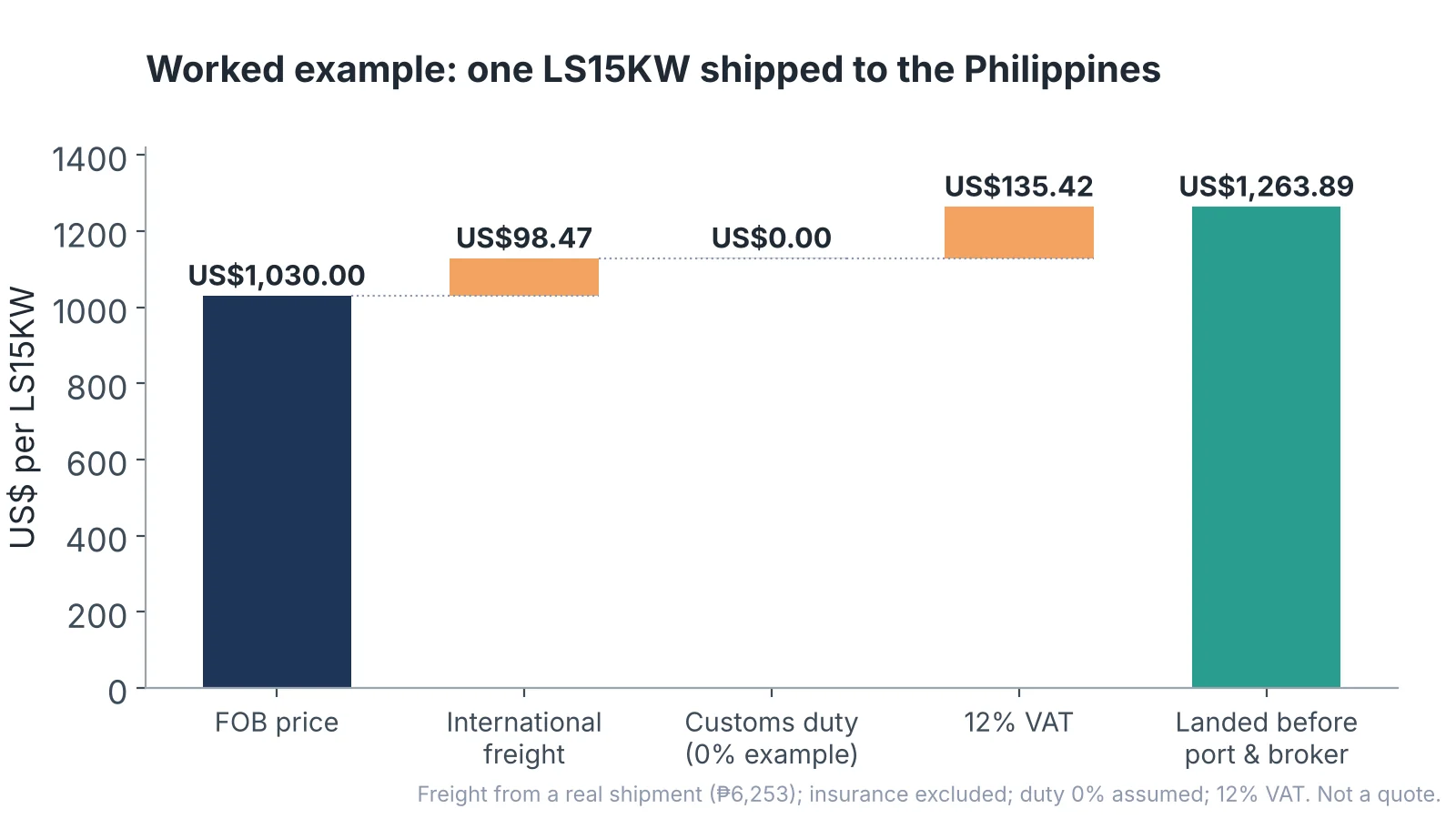
If your broker finds a duty rate other than zero, each 1% adds about US$12.64 here (US$11.28 of duty plus 12% VAT on it). Port charges, brokerage and delivery to the site come next, and for a single crate they are a noticeable share of the total because most are charged per shipment. Up to this point the battery has gone from US$1,030 at the Chinese port to roughly US$1,264 at the Philippine port, before anyone has installed it.
Layer 4: port, broker and inland delivery
After customs, the shipment still has to leave the port and reach a warehouse or site. Expect separate lines for port handling (arrastre and wharfage), the customs broker’s fee and documentation charges, and trucking. Most of these are charged per shipment or per container rather than per battery, which is why they matter far more for one crate than for a full container.
Two choices change this layer. Shipping directly to Cebu or Davao can avoid a long domestic leg from Manila for a Visayas or Mindanao project, if your forwarder has a reliable dangerous-goods service on that route. And a door-delivered quote only helps if it names the address, the unloading method and who handles an 86 kg wall unit or a 121 kg floor cabinet at the other end.
Hybrid solar inverter price: why the same kW costs different amounts
An inverter’s price follows its job more than its kW rating. Compare two ZJBESS models:
| ED6.2kW off-grid inverter | MAX-II 13.2kW hybrid inverter | |
|---|---|---|
| Rated output | 6,200 W, 12,400 VA peak | 13,200 W |
| PV input | One input, 6,200 W, 60–500 VDC MPPT | Two inputs, 8,000 W each, 90–450 VDC MPPT |
| Battery charging | Up to 120 A | Up to 160 A solar, 140 A from AC |
| Grid connection | Grid-connected data not published | 220/230/240 VAC grid output, 195–253 VAC range, 50/60 Hz |
| Communication | RS232, BMS/RS485 | RS232, RS485, Wi-Fi, BMS |
| Ex-factory price | ¥2,300 (≈ US$342) | ¥3,500 (≈ US$521) |
| Ex-factory price per kW of rated output | ≈ US$55 | ≈ US$39 |
Ex-factory prices are our selling prices in Chinese yuan, converted at ¥6.7174 per US dollar (the 12 November 2026 central parity rate), before inland transport to the port, export handling and freight. The hybrid costs about half as much again per unit, yet less per kW of output, partly because parts such as the enclosure, control board and display are spread over twice the power. That is why price per kW is a poor way to choose between them: an off-grid site does not need grid synchronisation, while a site that wants to export solar under net metering does. Decide first which system the site needs; What Is a Hybrid Solar Inverter and How to Choose One and our off-grid solar system guide for the Philippines cover that choice. Then compare inverter prices within the same class.
Layer 5: what installation adds
A battery and inverter on their own do not make a working system. Ask the installer to list each of these as a separate line, even if the total is a package price:
| Item | Why it changes the price |
|---|---|
| DC cables, lugs and battery breaker | Sized for the battery current; a 6,200 W inverter draws roughly 129 A from a 48 V battery before losses |
| AC breakers and a backup sub-panel | Needed when only selected circuits stay on during brownouts |
| PV modules, mounting and DC isolators | Usually the largest item after the battery on a new system |
| Labour, testing and commissioning | Includes setting the inverter to the battery’s protocol and charge limits |
| Permits and utility paperwork | Local electrical permits; a net-metering application if the system exports |
Red flags in a Philippine solar battery quote
| The quote says | Ask | Why it matters |
|---|---|---|
| “10 kWh battery, ₱X” | Nominal or usable kWh? Which model? | Our 10.24 kWh BG10KW delivers about 8.5 kWh to AC loads after the discharge window and inverter losses |
| “Delivered price” | Delivered to which port or address, under which Incoterm? | FOB, CIF and door delivery are different prices |
| “Duty-free” | Under which preference or programme, and whose name is on the certificate? | RA 9513 duty-free importation is for registered RE developers |
| “VAT inclusive” | Was VAT calculated on the landed value? | VAT on equipment value alone understates the cost |
| “Works with any inverter” | Which protocol is pre-loaded, and is there a configuration record? | Without BMS communication the inverter falls back to voltage-only control |
| “Installation included” | Which cables, breakers and mounting are included, and at what size? | Undersized DC cabling is a common way to cut a price |
Questions buyers ask about solar battery prices
Can a homeowner import one battery directly from China?
Yes, but the shipment is still dangerous goods, still above the ₱10,000 de minimis line, and still needs a broker to clear it. For one or two units, a local distributor holding stock can be cheaper once LCL minimums and broker fees are counted, and service is closer. Direct import starts to pay when the order fills a meaningful share of a container.
Why do two suppliers quote the same battery at different prices?
Check the layer first, then the contents: one may be FOB and the other delivered; one crate may include cables, protocol set-up and customs documents while the other does not. Our home battery quote comparison guide shows how distributors line up several offers on the same basis.
Ask for a quote that shows every layer
Send us the battery and inverter models (or the loads and backup hours if you have not chosen yet), the quantity, the destination port or delivery address in the Philippines, whether you already work with a customs broker, and whether you want FOB or a delivered price. With that we can send a written quotation, the crate dimensions and weights, the loading plan for your quantity, and the UN38.3 test summary and MSDS your broker will need. Compare our formats on the home battery range, or contact ZJBESS with your project details.
Freight figures are from past shipments, and duty and exchange rates change; replace them with your forwarder’s and broker’s current quotes for your own order.
Discuss Your ProjectBack to Blog