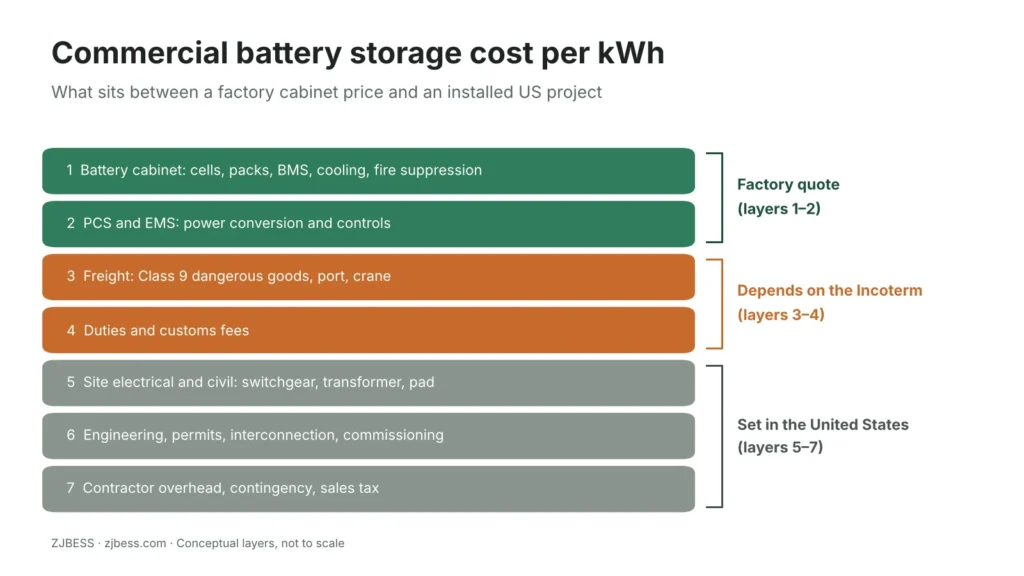

A complete battery document package should let a distributor answer three questions: what is being supplied, which evidence applies to it, and what will happen if that configuration changes. Receiving several PDFs is only the beginning. A datasheet can be accurate while describing the wrong option; a genuine certificate can cover a component rather than the assembled product; a packing list can use “set” differently from the quotation.
The practical way to review the package is to follow one order from its quoted identity to its ratings, installation requirements, supporting evidence and delivered serial numbers. This battery documentation checklist uses worked examples to show which differences can be explained, which need corrected documents, and which prevent a purchasing or installation decision.

Give each document a specific decision to support
A product datasheet, installation manual and production test record describe different things. The datasheet states the product’s published ratings and their conditions. The manual tells the reader how the identified configuration is intended to be installed or operated. A production or sample test record states observations for the units and method it identifies. An order confirmation defines the agreed supply scope; it cannot create technical evidence merely by repeating a marketing claim.
This distinction matters when a supplier answers a request with the easiest available file. A brochure listing a cabinet’s outside dimensions does not supply a mounting drawing. A laboratory report for a cell does not identify the contents of a shipment. An invoice that says “battery system” does not establish whether a communication cable, base, bracket or inverter is included.
| Document or record | The purchasing question it helps answer | A substitution that leaves a gap |
| Quotation and order confirmation | Which product, options, quantity and accessories are being purchased? | A generic brochure does not define the order’s included items |
| Model datasheet | What ratings and operating conditions are published for that configuration? | A different capacity option is not an interchangeable specification |
| Installation manual and assembly drawing | What physical and electrical requirements apply to installation? | Shipping dimensions and gross mass do not define mounting requirements |
| Compatibility or configuration record | Which battery, inverter, versions and mode were assessed together? | A CAN or RS485 connector label does not establish a supported pairing |
| Test report or production record | What was measured, on which units, by which method? | A nominal specification is not a measurement of delivered units |
| Certification and transport evidence | Which identified design or product falls within the document’s scope? | A logo or component certificate does not establish the whole system’s status |
| Packing list and label record | Which packages, units and accessories were actually supplied? | “Ten sets” is incomplete if the contents of a set are undefined |

Figure 1. A useful package connects different kinds of evidence. A large number of files does not compensate for a missing connection.
The priority changes with the stage of the order. A final serial-number list may not exist when a sample is being quoted. It should not be invented to complete a checklist. Conversely, the applicable installation method cannot be deferred until the installer is standing beside a delivered wall-mounted unit. Agree when each record becomes necessary and which decision remains open until then.
Establish the configuration before comparing the numbers
Start with the complete orderable model and the options that distinguish it. “15 kWh battery” is a capacity class. It does not identify whether the offer is one floor-standing cabinet, a tower of modules or a rack assembly, nor which accessories complete that arrangement. The battery format comparison explains those physical choices; the order record must go further and identify the actual configuration.
Keep product identity, equipment version and document revision in separate fields. A model describes a product or order option. A hardware revision describes a design version where the manufacturer uses that system. Firmware belongs to a particular controller. A serial number identifies a unit; a batch number groups units. A document revision identifies a publication. Those identifiers need an explicit relationship, not identical numbers.
For example, a manual marked Rev C may legitimately cover hardware H1 and H2. A datasheet downloaded in October may still be the applicable specification for a battery ordered in September. Neither fact is a mismatch by itself. The important question is whether the issuer identifies the file as applicable to the equipment being supplied. If that connection is missing, “latest version” does not resolve it.
A record can therefore read: order line 2; model BAT-15-A; hardware H1; controller firmware F1; datasheet DS-A Rev B; manual IM-A Rev C; receiving serial range to follow. These names are fictional examples, not ZJBESS product codes. The relationship lets a reviewer locate the relevant file without turning the date of a download into a manufacturer revision.
Save the accepted file itself as well as its public URL. Websites and shared folders can replace a file at the same address. A local date and file hash can show which copy the purchasing team retained, but neither proves that the manufacturer approved it. Applicability still comes from the supplier’s identified document or written confirmation.
Work through a capacity discrepancy before accepting a rounding explanation
Suppose a hypothetical quotation states 51.2 V, 300 Ah and 15.36 kWh for BAT-15-A. The attached datasheet states the same model name but 51.2 V and 280 Ah. This is more specific than a heading rounded to “15 kWh.” The nominal-energy arithmetic is:
Quotation: 51.2 × 300 ÷ 1,000 = 15.36 kWh.
Attached sheet: 51.2 × 280 ÷ 1,000 = 14.336 kWh.
The difference is 1.024 kWh, about 6.7% of the quoted nominal energy. That calculation identifies a configuration or transcription question; it does not prove which file is correct or that a battery has failed a capacity test. Possible explanations include an attachment for another option, an outdated specification, or an incorrect quotation. The supplier needs to identify the intended configuration and correct the affected record before it is used to approve the order.
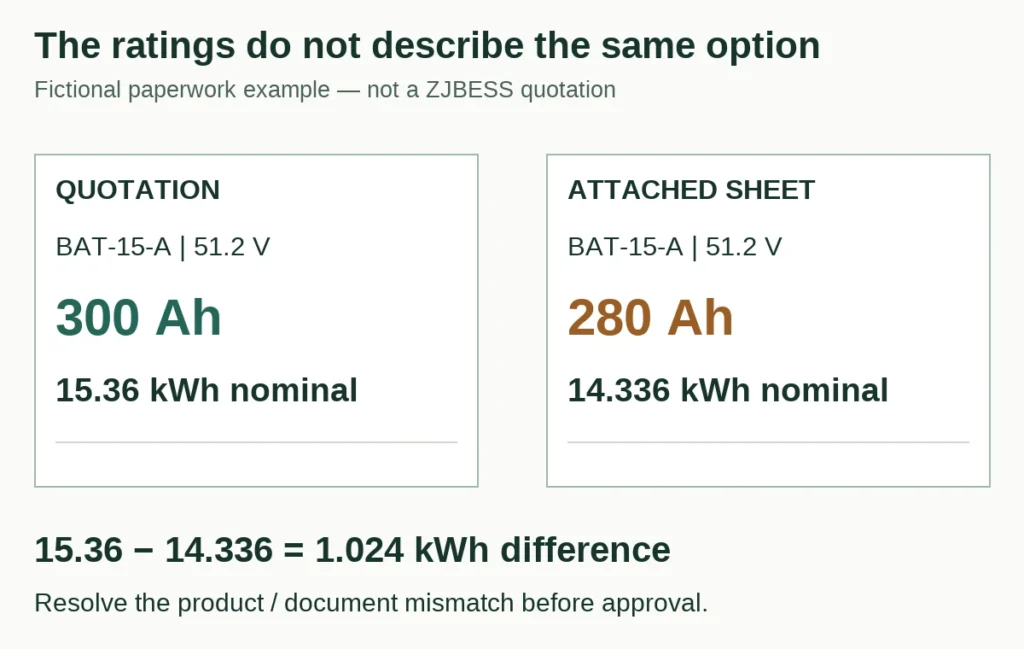
Figure 2. Arithmetic distinguishes an approximate capacity label from inconsistent underlying ratings. This fictional paperwork example is not a ZJBESS quotation or test result.
By contrast, “15 kWh” in a product-family heading and 15.36 kWh in a consistent 51.2 V, 300 Ah table may simply describe a rounded class. The way to distinguish the cases is to compare voltage, Ah, configuration and the definition of energy, rather than require every displayed number to be identical.
The quantity also needs a measurement boundary. Nominal energy is not automatically energy available to AC loads. A usable-energy statement needs its operating window and conditions; an AC figure also needs its conversion and auxiliary-load boundary. A report ending at a particular discharge cutoff cannot be compared with another test using a different endpoint without explaining the difference. Use the home battery sizing guide when the decision is backup energy and power, rather than whether two documents describe the same product.
Keep kW and kWh separate. A value expressed in kWh describes energy. It does not establish an inverter’s continuous output or a battery’s short-duration power capability. A product code containing “KW” is also an identifier, not permission to treat the number in the code as a measured AC power rating.
Separate the battery mass from what was packed and installed
Different weight figures can all be correct if they describe different objects. Shipment gross mass can include a pallet, protective packaging and separately packed accessories. Equipment net mass refers to the equipment as defined by the issuer. Installation mass depends on what is actually supported in the installed arrangement. The words need to be attached to the object being weighed.
Consider a hypothetical shipping record that explicitly defines one package as 113 kg gross: a battery, 17 kg of pallet and packaging, and a separately packed accessory box weighing 4 kg. If those quantities were actually established on the same scope, the battery portion would be 113 − 17 − 4 = 92 kg. Subtracting only the packaging would give 96 kg and incorrectly include the accessory box in the battery mass.

Figure 3. Weight subtraction is useful only when every component and its scope are known. The illustrated values must not be used for a ZJBESS handling or mounting design.
That example explains why estimating “a few kilograms for the box” cannot recover an unknown net mass. It also shows why even a confirmed battery net mass may not be the complete installed mass: an assembly may add a bracket, base or other supported components. Mechanical design then has further requirements concerning load distribution, fixing, substrate and applicable instructions. A weight number by itself does not establish a safe wall or support design.
For actual ZJBESS records, the reviewed BG10KW sheet labels 86 kg as gross weight, while the LS15KW sheet labels 121 kg as gross weight. Those labels should remain intact when comparing offers. They should not be relabeled as net or installation mass. The wall-mounted battery installation checklist addresses the separate site and mounting review.
This is a document question with a direct purchasing consequence. If unloading equipment is being selected, the complete handled package matters. If access through a doorway is being planned, the uncrated assembly and delivery method matter. If support is being designed, the applicable installed assembly matters. Asking for “the weight” without naming the task invites the wrong answer.
Read dimensions as a drawing of an object with an orientation
Three dimensions without axis labels or a measured object are incomplete installation information. Width × depth × height and height × width × depth can describe the same three values in a different order. Handles, terminals, wheels, a base and a bracket can also change the envelope relevant to access or installation.
For an illustrative rectangular product envelope of 1,000 × 500 × 300 mm, the enclosing volume is 1.0 × 0.5 × 0.3 = 0.150 m³. If the packed outer envelope is instead 1,150 × 650 × 500 mm, its corresponding geometric volume is 0.37375 m³, approximately 0.374 m³. The larger number is not evidence that the product specification is inconsistent; the objects differ. Neither calculation by itself establishes a carrier’s chargeable volume or a container loading plan.
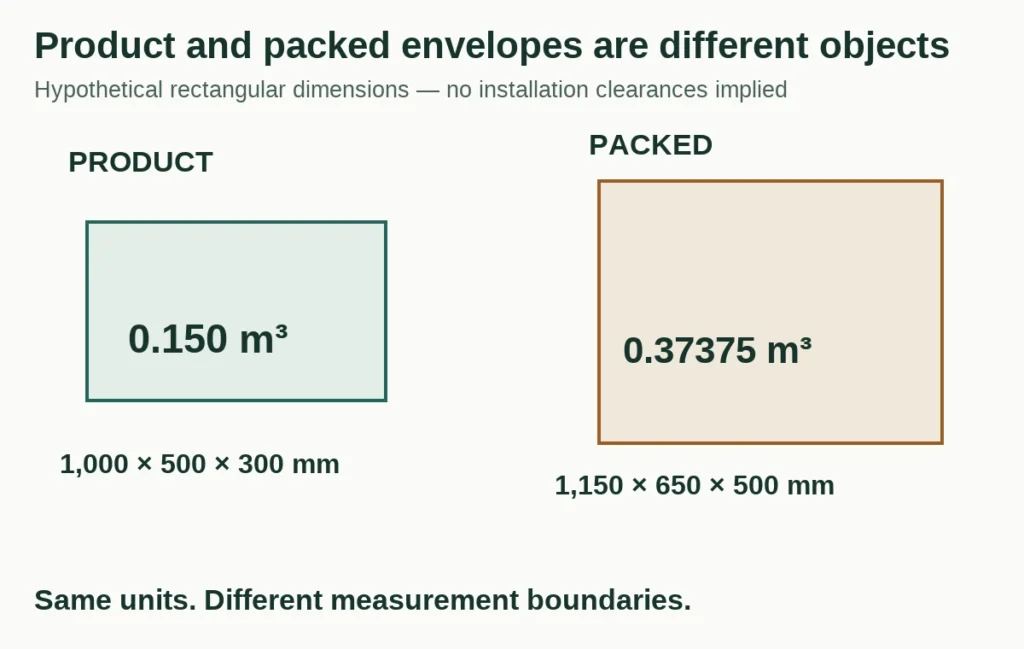
Figure 4. These hypothetical envelope calculations compare the same units while keeping product and shipment boundaries separate.
Module and assembled-system dimensions require the same care. Three modules each described as 175 mm high do not establish an overall tower height of 525 mm unless the manufacturer confirms how the complete assembly is dimensioned. A base, interfaces or other components may be part of the finished height. Conversely, an overall cabinet height should not be used as the height of one replaceable module.
The practical output is an applicable drawing showing axes, overall envelope, relevant projections, access and service requirements. A packing drawing can supplement it for delivery planning. It should not replace the installation drawing. Where two published volume or axis labels conflict, request a defined measurement and corrected file; do not repair the manufacturer’s engineering data by guessing from a photograph.
Verify the scope behind a certificate or test reference
A certificate or report has to connect to the product identity. Check the issuing organization, applicant or manufacturer, identified model or model family, relevant standard or test basis, report or certificate number, and any conditions or limitations. An authentic document for a different design does not establish the status of the ordered product.
The level of the object matters too. A cell can be a component of a module; a battery assembly can be part of a larger storage system with an inverter. Evidence for one level does not automatically establish the others. UL Solutions’ component guidance describes recognized components in relation to their use within an end product and their conditions of acceptability. It is a reason to read the certification scope rather than infer whole-system approval from a component mark.

Figure 5. Follow the identified object and conditions in the actual record. The illustration does not claim that any pictured level is certified.
Where a UL claim is material to the offer, Product iQ provides a verification route using identifiers such as a file number and product details. Match the result to the offered identity and category rather than stop at finding a familiar company name. An unsuccessful search is a reason to resolve the claim with the issuer or supplier, not proof of a counterfeit by itself.
Transport design-test evidence answers another question. PHMSA’s lithium battery test-summary guidance describes a standardized record intended to make the relevant design-test information traceable. It does not turn a transport test summary into evidence of residential energy yield, cycle life or every installation approval. The existing UN 38.3 guide explains that record in more detail; the document package here must connect it to the ordered model.
Requirements depend on the destination, installation and intended use. The distributor should identify the applicable approval path with the responsible parties before accepting a generic “all certificates available” response. This article does not establish certification status for a ZJBESS model whose complete supporting record has not been supplied.
Review a change according to the function it can affect
A new PDF can represent corrected wording, an updated drawing or a changed product. Those cases require different review. If a file only clarifies which dimension is height, that may close an editorial ambiguity. If the physical enclosure grew, access and mounting may need renewed review. If a BMS or communication implementation changed, compatibility and control evidence may be affected even when the cabinet looks identical.
| Proposed difference | Why it matters | Proportionate evidence before approval |
| Unit label corrected with no changed rating | Could resolve a documentation error | Issuer’s correction and confirmation of the unchanged product scope |
| Bracket or cabinet geometry changed | Could affect support, access and installation | Revised drawing and applicable mechanical review |
| BMS, firmware or communication changed | Could affect limits, messages or operating modes | Change description and review of affected configuration evidence |
| Packaging changed | Could affect handled mass, protection and package dimensions | Revised packing specification; product claims reviewed if the equipment also changed |

Figure 6. Review the affected function. Repeating an unrelated test does not resolve a missing drawing or an unidentified controller change.
There is a practical third-party example of version dependence: the Victron–BYD integration documentation identifies supported battery families, firmware requirements and communication equipment. It illustrates what configuration-specific evidence looks like. It does not approve a ZJBESS pairing. For the questions to ask about an actual proposal, use the battery–inverter compatibility guide.
An informative change notice identifies the old and new configuration, affected units or orders, reason, affected functions, supporting evidence and planned cut-in. Texas Instruments’ published notification process is an example of organizing such information. Its semiconductor process is not a battery-wide rule, and no claim is made that ZJBESS has adopted that formal standard.
The distributor’s decision should state which question has been resolved. Accepting a corrected packing dimension does not approve changed inverter firmware. Keeping this scope explicit makes the review faster and gives service staff a usable explanation later.
Carry the accepted version into receiving and service
The accepted configuration needs to survive the handover from sales to production, shipping and receiving. Reference it in the order confirmation, define the contents of a set, and obtain the serial or batch mapping when available. If ten sets each contain three modules, the receiving scope is thirty modules plus the defined shared items. That arithmetic does not authorize any electrical parallel arrangement; the approved assembly remains a separate requirement.
A fictional change cut-in makes the service issue clear. Suppose units A001–A050 were supplied under the earlier hardware record and A051–A100 under a revised one. Replacing the shared folder with only the newest manual can leave the earlier fifty units without their applicable instructions. Keep the older record attached to its units and mark what superseded it for new production.

Figure 7. A newer record can apply to later production while an earlier record remains necessary for units already delivered.
At receiving, compare the supplied identity and contents with that order record. An unexpected version is a difference to resolve, not automatic evidence of either an improvement or a defect. Preserve label photographs, affected serial numbers and the accepted documents so the supplier can identify the exact issue.
Keep the final handover compact: ordered identity and quantities; applicable document references; resolved differences; any remaining conditions; delivered unit range; and the responsible decision owner. Supplier and engineering personnel supply the technical applicability. Purchasing and receiving contribute the order and delivery evidence. Missing firmware or certification details remain open technical questions, with a named party responsible for resolving them.
Request the applicable documents for a ZJBESS proposal
For a proposed ZJBESS order, start with the model or installation format, intended application, destination and approximate quantity. If an inverter pairing is involved, add its complete model and the version information already available. Send those details through ZJBESS Distributor Support and ask for the documents applicable to that configuration and the unresolved purchasing decision.
For example, a wall-mounted quotation may need the defined installed mass and drawing before a site can be assessed; a replacement order may need the relationship between the delivered controller version and the existing configuration. Naming the decision gives the supplier a specific response to prepare. The broader 48 V supplier checklist remains the starting point for supplier selection; this document review establishes what supports a particular order.
Discuss Your ProjectBack to Blog