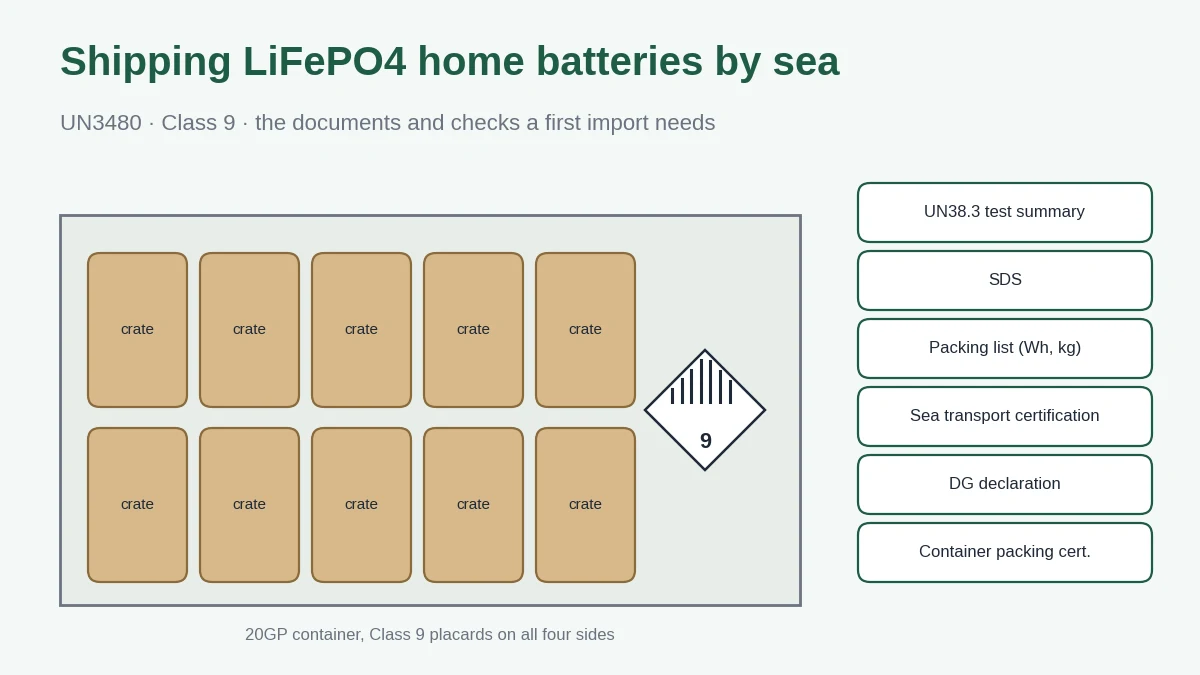
A LiFePO4 home battery travels by sea as dangerous goods: UN3480, lithium ion batteries, Class 9. Every home battery is far above the 100 Wh limit for small-battery relief, so it ships fully regulated. That means a carrier must approve the booking, each crate carries the UN number and a Class 9 label, the container is placarded, and the forwarder files a dangerous-goods declaration backed by the battery’s UN38.3 test summary and safety data sheet.
None of this is unusual. Container lines ship lithium batteries by sea every week, and the steps to ship LiFePO4 batteries by sea are the same for one pallet or a full container. What delays a first import is usually something smaller: a test summary for a different model, a packing list without watt-hours, a DG booking requested after the goods are packed, or a damaged crate that nobody separated on arrival. This guide follows a 20GP order of floor-standing batteries from booking to the importer’s warehouse. Rules are edition-dependent. IMDG Code Amendment 42-24 has been mandatory since 1 January 2026, and your forwarder applies the edition in force on the shipping date. Read this as a planning guide, not compliance advice.
Why a home battery ships as fully regulated Class 9
The UN number depends on how the battery is packed, not on its chemistry name. A battery shipped on its own is UN3480. If the same battery travels in one package with an inverter, or built into equipment, the entry becomes UN3481. A distributor order of batteries and inverters on separate pallets normally ships the batteries as UN3480. The inverters are general cargo, and the packing list should show them as a separate line.

Special provision 188 lets small lithium ion batteries of up to 100 Wh travel with reduced requirements. A home battery is a hundred times larger. The ZJBESS BG10KW is 10,240 Wh, the LS15KW is 15,360 Wh and the LS20KW is 20,480 Wh. Watt-hours are nominal voltage times rated capacity, for example 51.2 V × 300 Ah = 15,360 Wh. That is the figure the forwarder needs on the packing list.
Weight decides the packaging route. Packing instruction P903 allows a battery with a gross mass of 12 kg or more and a strong, impact-resistant outer casing to travel in strong outer packaging, in a protective enclosure, or on a pallet. These batteries weigh 86 kg (BG10KW) to 160 kg (LS20KW) gross and have metal enclosures, so they ship in wooden crates or on pallets rather than in small UN-specification boxes. Your forwarder confirms which provision the declaration cites.
LiFePO4 chemistry does not change the classification. Iron phosphate cells are more thermally stable than many other lithium ion types, but the transport entry is the same for all lithium ion batteries.
The documents a forwarder asks for, and who provides each
A DG sea booking pulls documents from three places: the battery design, the shipment itself, and the booking and loading. Most delays come from a document that exists but describes a different object, such as a cell-level report sent for a battery pack, or last year’s test summary for an earlier revision.

| Document | What it establishes | Who provides it | What to check |
|---|---|---|---|
| UN38.3 test summary | The battery design passed the UN transport tests | Manufacturer, from the test lab report | Model name and rating match the battery on the packing list. A cell summary does not cover the pack. |
| Safety data sheet (SDS / MSDS) | Hazards, handling and emergency measures | Manufacturer | Current version and company name. It does not replace the UN38.3 summary. |
| Sea transport condition certification | A lab’s assessment of the battery and its packing for sea transport, often requested by Chinese ports and carriers | Manufacturer, issued by an accredited lab | Issued for sea (not air), names the model, and has not expired |
| Commercial invoice and packing list | What is in the container | Manufacturer | Model, quantity, Wh per battery, net and gross kg, crate size, and inverters on separate lines |
| Dangerous goods declaration | The shipper’s legal declaration of UN number, class, packing and quantity | Shipper, usually prepared by the forwarder | UN3480, proper shipping name, Class 9, package count and gross mass agree with the packing list |
| Container packing certificate | The container was loaded, secured and placarded correctly | The person responsible for stuffing | Signed for this container number |
Since Amendment 42-24, the IMDG Code also says that manufacturers and later distributors must make the UN38.3 test summary available. For an importer, the practical step is to file the summary with the purchase order so it can go to a customer or an authority later. The UN38.3 test summary guide lists the fields to compare against the battery label. The battery documentation checklist covers the commercial documents in more detail.
Crate marks and labels
Each crate needs the UN number and proper shipping name, a Class 9 hazard label, and the shipper’s and consignee’s names. For lithium batteries this is normally the Class 9 lithium battery label, with vertical stripes in the upper half and a battery symbol below. The forwarder confirms the label version the carrier accepts. The container then carries Class 9 placards on all four sides. Most forwarders check this at the warehouse, but the importer should see a photograph before the container is sealed.

Two problems turn up often. Reused crates still carry old labels, so the packages no longer match the declaration. And the gross weight on the crate differs from the packing list because accessories were added late. Both are easy to fix before stuffing and slow to fix at the port.
Full container or shared container for a first order
For general cargo, a small first order would go LCL, sharing a container with other shippers. Class 9 batteries change that calculation. Fewer consolidators accept dangerous goods, they run fewer sailings, and the DG surcharge applies to the shared box. A forwarder may also have to wait for a container that has no incompatible cargo. An LCL quote for batteries can therefore come close to the cost of a full 20GP and still take longer.
FCL (own container) | LCL (shared container) | |
|---|---|---|
| DG acceptance | One booking, one carrier approval | Only consolidators with DG service; limited sailings |
| Cost per battery | Lower once the container is reasonably full | DG surcharge and minimum charges weigh heavily on small volumes |
| Timing | Fixed to the sailing you book | Depends on the consolidator’s DG schedule |
| Handling | Loaded at origin, opened by you | Unpacked and repacked at both hubs, with more chances of damage |
A practical middle route for a first order is a mixed FCL: batteries plus non-DG items such as inverters, cables and brackets in the same 20GP. The container is still declared as Class 9 for the batteries, but the freight cost is shared across everything you would have shipped anyway. Mixed-model containers are a normal ZJBESS order format. See distributor support for the order tiers.
How many batteries fit in a 20GP, and why weight comes first
ZJBESS publishes 20GP estimates of about 110–140 floor-standing units (LS15KW / LS20KW) and 180–240 wall-mounted units. Multiply those by the datasheet gross weight and the binding limit becomes clear. Floor-standing batteries fill the container’s payload faster than its volume.

LS20KW, upper estimate: 140 units × 160 kg gross = 22,400 kg of batteries, before pallets and dunnage.
LS15KW, upper estimate: 140 units × 121 kg = 16,940 kg.
Energy in the LS20KW container: 140 × 20,480 Wh = 2.87 MWh.Inputs: ZJBESS published gross weights and 20GP estimates. Final counts depend on crate size, the container’s tare and payload, and the destination road limit.
A 20GP that is legal at sea can still be too heavy for the truck at the destination port. Many countries limit the gross weight of a container on its chassis, and some inland routes are stricter than the port. Give your forwarder the destination city as well as the port, and ask for the maximum cargo weight on that route before you fix the quantity. For a heavy model, a slightly smaller count or a mix with wall-mounted units may deliver more usable kWh per dollar of freight than a container you have to transload.
State of charge: an air rule, not a sea rule
Buyers often ask whether batteries must ship at 30% charge. That limit comes from air transport. IATA requires lithium ion batteries shipped on their own to be at no more than 30% state of charge, and home batteries also exceed the air package limits by a wide margin. The IMDG Code does not set the same 30% limit for sea, but a carrier can add its own conditions, so ask the forwarder whether the line has one.
State of charge still matters to the importer for another reason. Batteries may sit in a container and a warehouse for two to three months before installation, and the BMS draws a small standby current. Ask the supplier which charge level the batteries leave the factory at, and how long they can be stored before a top-up charge. A low-voltage alarm on the first start-up is a storage issue, not a fault, and the state-of-charge guide explains how to read it.
Where the dangerous-goods steps add time
ZJBESS ships standard models 15 working days after the order is confirmed. Sea freight is quoted separately. A Class 9 shipment adds four steps that general cargo does not have: the DG booking request, carrier approval, a packing certificate at stuffing, and an earlier document cut-off before the vessel closes. None of them takes long, but each needs the previous document to be final.

The usual mistake is to start the DG booking once the batteries are packed. Start it as soon as the order is confirmed. The forwarder can request space with the model, quantity, Wh and estimated gross weight from the quotation, and the final packing list replaces the estimate before cut-off. If the carrier asks a question about the documents, it then arrives while production is still running.
Incoterms: who handles which DG step
| Step | FOB (you book the freight) | CIF / CFR (supplier books) |
|---|---|---|
| UN38.3 summary, SDS, sea certification, packing list | Supplier | Supplier |
| Crate marks and labels | Supplier | Supplier |
| DG booking and carrier approval | Your forwarder | Supplier’s forwarder |
| DG declaration and container packing certificate | Agreed between your forwarder and the supplier | Supplier’s forwarder |
| Destination charges, customs and delivery | You | You |
Under FOB, confirm early that your forwarder has a DG desk at the port of loading and will accept UN3480. Some general forwarders do not, and you learn this only when the booking is refused. ZJBESS quotes FOB and confirms the port of loading in the formal quotation. The quote comparison guide shows what a quotation should state about shipping terms.
At arrival: inspect before you move stock
Open the container and count the crates against the packing list before anything is moved into the warehouse. Look for crates that are crushed, wet, tilted against the orientation arrows, warm to the touch, or giving off a smell. Any of these crates should go to a separate area. Do not open it, connect it or charge it until the supplier has seen photographs.

This step also decides how a warranty claim can be handled. A damaged or defective lithium battery cannot travel back on a normal Class 9 booking. It needs special packaging under special provision 376 and the carrier’s approval, which is slow and expensive. That is why most claims are settled by sending replacement parts or a new unit out, and why the photographs, crate marks and serial numbers from the arrival check matter. The warranty claims guide lists what to record.
Destination checks to arrange before the vessel sails
Customs requirements vary by country, so confirm them with a licensed clearing agent at the destination before the goods leave. Two examples from markets we ship to often:
Nigeria. Imports generally need a Form M opened through an authorised bank before shipment, and regulated products need a SONCAP certificate from SON. Ask your clearing agent which documents they need from the supplier for the product certificate, and allow time for it.
The Philippines. Confirm with your customs broker whether your entity needs an import registration and whether the batteries need any product-standard clearance. Requirements depend on the importer type and the product description on the entry.
In both markets, the description, HS code, quantity and value must match across the invoice, packing list, bill of lading and DG declaration. A mismatch is a common cause of inspection holds.
Frequently asked questions
Can LiFePO4 home batteries be shipped by air?
In practice, no. Air rules require lithium ion batteries shipped on their own to fly on cargo aircraft only, at no more than 30% charge and within per-package weight limits that wall-mounted and floor-standing home batteries exceed. Plan samples by sea as well.
Is a LiFePO4 battery less regulated than other lithium batteries at sea?
No. LiFePO4 is a lithium ion chemistry and uses the same UN3480 entry, Class 9 label and documents as any other lithium ion battery of the same size.
Do I need a DG-qualified forwarder for one pallet?
Yes. Package count does not change the classification. One crate of home batteries needs the same DG booking, declaration and marks as a full container, which is why a mixed FCL is often simpler than LCL for a first order.
Can inverters ship in the same container as the batteries?
Yes. Inverters, cables and brackets are general cargo and can share the container. List them as separate lines on the packing list so the DG declaration covers only the batteries.
What happens if the test summary model name differs from the battery label?
The forwarder or carrier may stop the booking until it is explained. Ask the supplier for the summary that names the exact model and revision you are buying, or a written statement of which tested design the shipped model belongs to.
How do I return a battery that arrived damaged?
Do not book it back as normal cargo. A damaged lithium battery needs special packaging and carrier approval. Isolate it, photograph it, and report it to the supplier, who will usually resolve the claim by shipping parts or a replacement.
Plan your first battery shipment with ZJBESS
Send us the models and quantities, the destination port and final delivery city, your preferred Incoterm, and whether you already have a forwarder with a DG desk. We reply with a quotation that lists Wh and gross weight per model, an estimated container plan, and the transport documents available for those models. Compare the 48V LiFePO4 battery range or request a shipping quotation.
Discuss Your ProjectBack to Blog