
In the LiFePO4 vs lead acid battery for solar decision, the answer depends on how often the battery cycles. For a solar inverter that cycles the battery every day, LiFePO4 usually costs less per kWh delivered than lead-acid, even though a lead-acid bank of the same label size costs less to buy. The difference comes from three numbers: how much of the label capacity you can use each day, how many daily cycles the battery lasts, and how much charging energy is lost. Lead-acid can still be the cheaper choice where the battery rarely cycles, where it must charge below freezing without a heated space, or where the buyer only needs the system to run for a year or two.
This article works through that comparison with one example: a home or small shop that needs 8 kWh a day from the battery through a 48V inverter. ZJBESS figures come from our BG10KW 10.24 kWh wall-mounted battery datasheet. Lead-acid figures are typical assumptions for 12V 200Ah AGM batteries, stated where they are used, so you can replace them with the data sheet and local price of the battery you are actually comparing.
The comparison in one table
| Decision factor | LiFePO4 (51.2V) | Lead-acid (AGM / gel / flooded) | Why it matters to the buyer |
|---|---|---|---|
| Daily usable window | Typically 80–90% of nominal, set by BMS and inverter | Often limited to about 50% to protect cycle life | Sets how many kWh you must buy to cover the load |
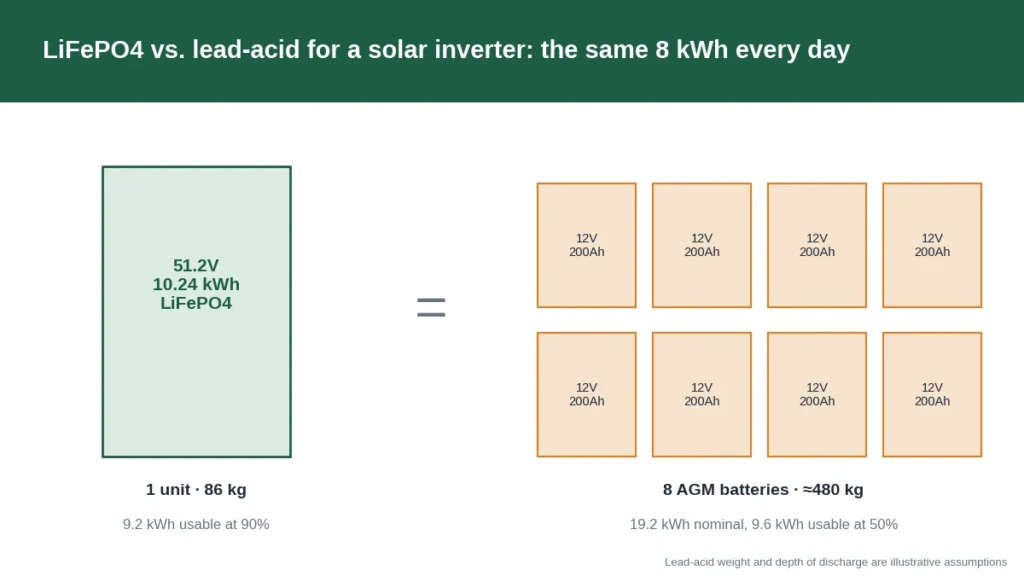
| Bank size for 8 kWh/day | One 10.24 kWh unit | About 19.2 kWh nominal (8 × 12V 200Ah) | Space, weight, cabling and parallel strings |
| Weight for that bank | 86 kg gross (BG10KW) | About 480 kg (assumed 60 kg per battery) | Wall mounting, floor loading, freight cost |
| Cycle life used in this article | 3,650 cycles counted (10 years × 1/day) | 600–1,200 cycles at 50% DoD (assumed range) | Number of replacement banks over the system life |
| Recharge in a short window | Accepts full current until close to full | Bulk, then a long absorption taper | Load-shedding and generator run-time |
| Partial state of charge | Tolerated; no equalization charge | Sulfation if left partly charged for days | Sites where the battery rarely reaches 100% |
| Round-trip efficiency | About 95% (assumed) | About 80–85% (assumed 82%) | PV array size and fuel use |
| Heat | Separate cycle-life curves at 25°C and 35°C on the datasheet | Life falls quickly above 25°C | Most of Nigeria, the Philippines and the Gulf |
| Charging below 0°C | Not allowed (BG10KW charge range 0–60°C) | Possible with reduced acceptance | Unheated sites in cold climates |
| Inverter communication | CAN or RS485 to the inverter | None; the inverter reads voltage only | Accurate SOC and charge limits |
| Maintenance | Sealed; BMS monitors cells | Flooded types need water and ventilation | Service visits after handover |
| Purchase price | Higher per nominal kWh | Lower per nominal kWh | Cash available on day one |
The rest of the article explains the four rows that decide most projects: usable energy, cost per delivered kWh, recharge time and efficiency.
Usable energy: why the label kWh misleads
A battery’s label shows nominal energy: nominal voltage times rated capacity. The BG10KW is 51.2V × 200Ah = 10.24 kWh. A 12V 200Ah lead-acid battery is 12V × 200Ah = 2.4 kWh, so four in series make a 48V bank of 9.6 kWh. On the label, the two banks look almost equal.
The daily window is different. Lead-acid cycle life drops steeply as depth of discharge increases, so solar designers commonly limit lead-acid to about 50% per day. A LiFePO4 battery is usually run inside an 80–90% window, controlled by the BMS and the inverter’s cut-off settings. This article assumes 90% for the BG10KW and 50% for the AGM bank.

Worked example: bank size for 8 kWh a day (assumptions stated)
LiFePO4: 10.24 kWh × 0.90 = 9.22 kWh usable. One BG10KW covers 8 kWh with about 1.2 kWh to spare.
Lead-acid at 50% DoD: 8 ÷ 0.50 = 16 kWh nominal needed. A 48V bank is built in strings of four 12V batteries (9.6 kWh each). One string gives 4.8 kWh usable, which is not enough. Two strings in parallel: 8 × 12V 200Ah = 19.2 kWh nominal, 9.6 kWh usable.
Weight, assuming about 60 kg per 12V 200Ah AGM battery: 8 × 60 = ≈480 kg, against 86 kg gross for the BG10KW.
Many quotations compare one 10 kWh lithium battery with one string of four lead-acid batteries, because the labels match. That lead-acid bank then runs well past 50% every night, and its life is shorter than the data sheet figure the buyer was shown. If you are replacing an old bank, ask how long it lasted and how often the inverter shut down on low voltage. Those two answers usually show it was undersized.
Discharge rate also reduces lead-acid capacity. A Trojan T-105 Plus 6V battery is rated about 225Ah at the 20-hour rate but about 185Ah at the 5-hour rate. An inverter running a 4–5 kW evening load draws closer to the faster rate. LiFePO4 capacity changes much less with current, which is one reason the 90% window holds in daily use. For a full load-by-load method, see the home battery sizing guide.
Cost per kWh delivered, not price per battery
The fair price comparison is battery cost divided by the energy it delivers over its life. Use the same daily load for both chemistries and count cycles honestly.
Worked example: battery cost per delivered kWh (assumptions stated)
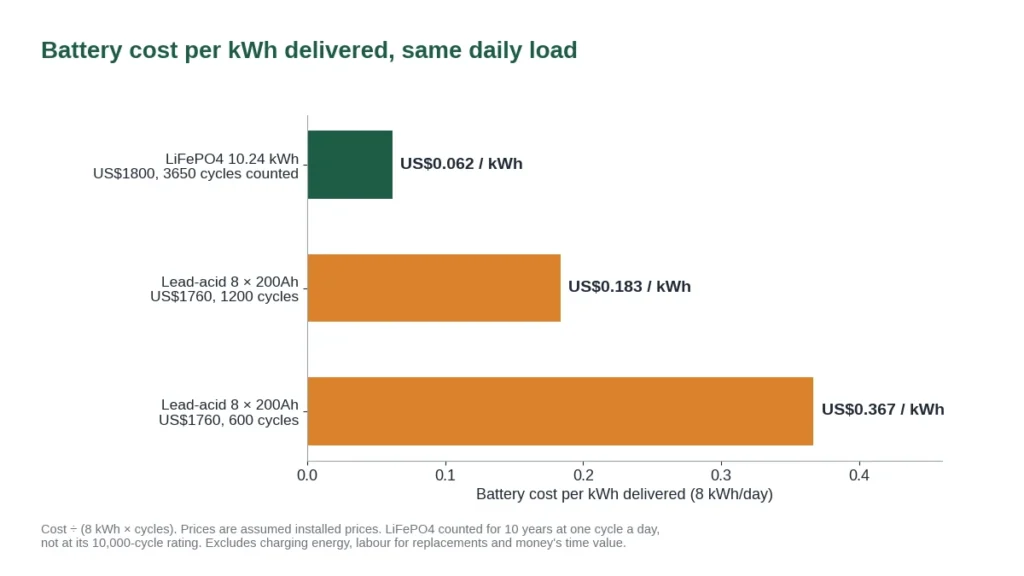
Prices are illustrative installed prices to the end customer. The BG10KW FOB reference price is US$900 (published 6 November 2026). This example assumes US$1,800 after freight, duties, distributor margin and installation. Lead-acid: US$220 per 12V 200Ah AGM battery, so 8 × 220 = US$1,760.
LiFePO4 cycles counted: 10 years × 365 = 3,650. The datasheet rates 10,000 cycles at 25°C and 100% DoD. We count only the warranty period at one cycle a day, because a lab rating does not convert directly into years (see how to read a LiFePO4 cycle-life rating).
LiFePO4: 1,800 ÷ (8 × 3,650) = US$0.062 per kWh.
Lead-acid at 1,200 cycles: 1,760 ÷ (8 × 1,200) = US$0.183 per kWh. At 600 cycles: 1,760 ÷ (8 × 600) = US$0.367 per kWh.
Break-even: at US$0.367 per kWh, the LiFePO4 battery has matched the lead-acid cost after 1,800 ÷ (8 × 0.367) ≈ 614 cycles, about 20 months of daily use.
Three things follow from the example. First, the purchase prices are close once the lead-acid bank is sized for the same daily energy. The large gap only appears when the lead-acid bank is undersized. Second, at 600 cycles a day-cycled lead-acid bank is replaced about six times in the ten years that one LiFePO4 battery covers, and each replacement adds labour, transport and disposal. Third, the result is sensitive to cycle life, so ask for the lead-acid cycle figure at your depth of discharge and temperature, not the headline number. Even at 1,200 cycles, lead-acid costs about three times more per delivered kWh in this example.
The calculation leaves out charging energy, replacement labour and the time value of money. When you compare actual quotations, line them up on the same basis. Our home battery quote comparison guide lists the fields to check and current FOB reference prices.
Recharge: what a short charging window puts back
On sites with daily load-shedding or a generator, the battery often has two or three hours to recharge. How much it takes back in that time matters as much as its size.
Lead-acid charges in stages. In the bulk stage it accepts the charger’s current. Once it reaches absorption voltage, at roughly 70–80% state of charge, the current tapers off and the last part of the charge takes hours. LiFePO4 accepts near-constant current almost until the BMS stops the charge. The BG10KW recommended charge current is up to 100A, which at about 52V is roughly 5.2 kW.

Worked example: a 2-hour window at 100A (assumptions stated)
LiFePO4 needs 8 ÷ 0.95 ≈ 8.42 kWh back. At 5.2 kW: 8.42 ÷ 5.2 ≈ 1.6 hours.
Lead-acid needs 8 ÷ 0.82 ≈ 9.76 kWh back. With bulk charging for the first part and an absorption taper after it, the illustrative profile reaches about 83% in two hours. The remaining energy needs several more hours at low current.
A lead-acid bank that ends each day short of full is the condition that causes sulfation. Sulfate crystals harden on the plates, capacity falls, and the battery needs periodic equalization charges that a short window cannot give. The short window shortens lead-acid life further, and the cycle figures in the cost example assume the bank is regularly fully charged. LiFePO4 tolerates staying at partial charge and needs no equalization. On a solar-only site, the same applies on cloudy days: the battery that refills faster uses more of the sun that is available. The off-grid solar system guide covers how to size the array and generator around those days.
Efficiency: charge losses come out of the solar array
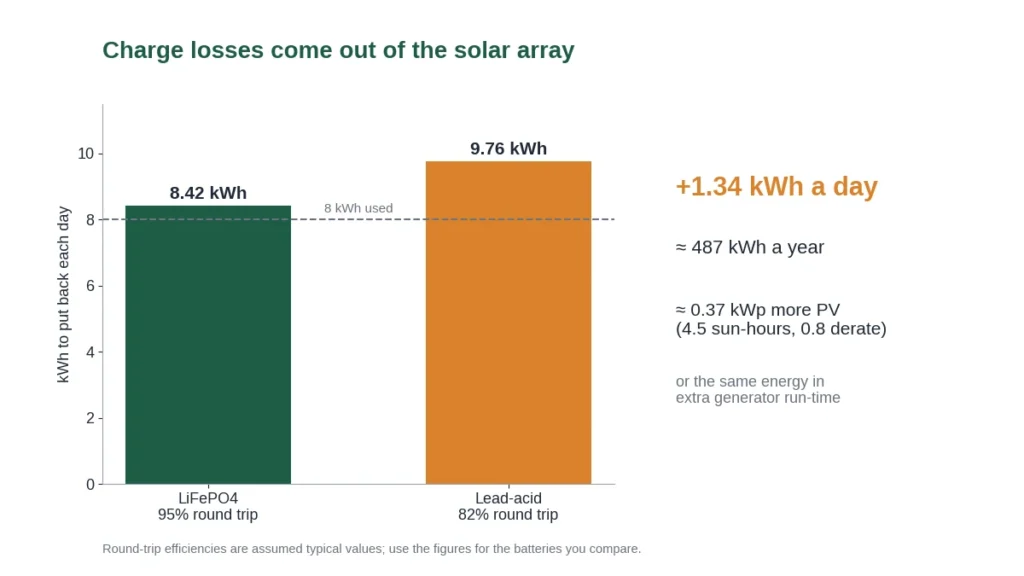
Every kWh the inverter draws from the battery has to be put back, plus losses. With an assumed 95% round-trip efficiency for LiFePO4 and 82% for lead-acid, the lead-acid bank needs 1.34 kWh more charging energy each day for the same 8 kWh.
Worked example: extra PV for the losses (assumptions stated)
Difference: 9.76 − 8.42 = 1.34 kWh a day, about 487 kWh a year.
At 4.5 peak sun-hours and a 0.8 system derate, one kWp of PV gives 3.6 kWh a day. 1.34 ÷ 3.6 ≈ 0.37 kWp of extra array, or one extra panel of about 400W, just to cover lead-acid losses.
On a generator-backed site, the same energy shows up as extra run-time and fuel. Neither cost appears on the battery quotation.
Heat, discharge current and inverter communication
Heat. A widely used rule from lead-acid manufacturers is that service life roughly halves for each 8–10°C of sustained temperature above 25°C. A battery room at 33–35°C, common in Lagos, Manila or Dubai, can cut lead-acid life to about half of its data sheet figure. LiFePO4 also ages faster in heat, but less steeply. The BG10KW datasheet publishes separate depth-of-discharge curves at 25°C and 35°C ambient. Ask any supplier, lithium or lead-acid, for the cycle figure at the temperature where the battery will actually sit.
Cold. This is where lead-acid keeps an advantage. The BG10KW charge range is 0–60°C, and LiFePO4 cells should not be charged below 0°C without heating. Lead-acid charges in the cold with reduced acceptance and needs temperature compensation. For unheated sites, see LiFePO4 battery charging temperature limits.
Discharge current. A 5 kW load on a 48V inverter at 93% efficiency draws about 5,000 ÷ (48 × 0.93) ≈ 112A. The BG10KW is rated up to 200A continuous discharge. A 400Ah lead-acid bank can supply that current, but its voltage sags under load and the inverter may hit low-voltage cut-off before the planned 50%. A small lithium module has the opposite limit: the 100Ah JJ5KW rack battery is rated up to 100A continuous, so a 5 kW load needs two modules in parallel.
Communication. Lead-acid tells the inverter nothing; the inverter estimates state of charge from voltage. A LiFePO4 battery with CAN or RS485 communication sends its charge and discharge limits and its real state of charge to the inverter. That is the main reason lithium state of charge on the inverter screen is reliable. Check the protocol pairing before you order with our LiFePO4 battery inverter compatibility guide.
When lead-acid is still the right choice
The cost example assumes one full cycle a day. Change that assumption and the answer can change.
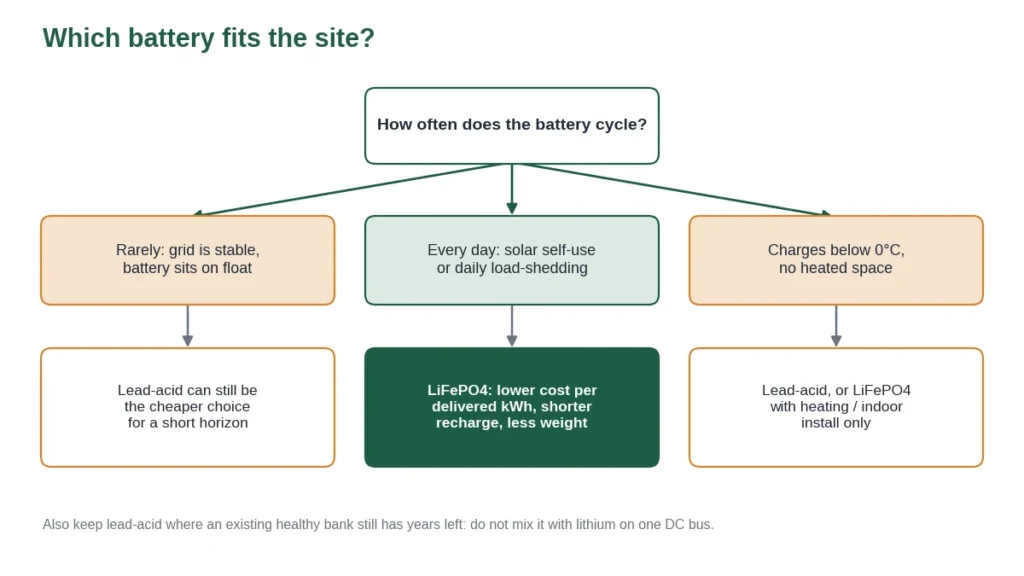
Standby on a stable grid. If outages happen a few times a month, the battery spends most of its life on float. Calendar ageing, not cycle count, ends its life, and a sealed lead-acid bank may last several years at a lower purchase price. Cost per delivered kWh matters less when few kWh are delivered.
Charging below freezing with no heated space. Choose lead-acid, or a LiFePO4 battery installed indoors or with built-in heating.
Short ownership horizon. A rental property, a temporary site office, or a buyer who expects to move within two years may never reach the break-even point of about 614 cycles from the example.
An existing healthy bank. If the current lead-acid bank still has years left, it can be cheaper to use it out and change chemistry later. Do not add LiFePO4 to the same DC bus in the meantime; the two chemistries need different charge voltages and will not share current correctly.
For everything else, including daily solar self-consumption, daily load-shedding and generator-hybrid sites, LiFePO4 is usually the better buy.
If you switch: what changes at the inverter
Most 48V hybrid and off-grid inverters made in the last several years have a lithium battery setting, and many support closed-loop BMS communication. The changes at changeover are the battery type setting, charge and cut-off voltages, removal of equalization and lead-acid temperature compensation, and current limits that match the battery. Our step-by-step guide to replacing lead-acid with a 48V LiFePO4 battery covers inverter settings, amp-hour equivalence, wiring and the change-over order.
If you are choosing a new inverter and battery together, the ZJBESS 13.2kW single-phase hybrid solar inverter is designed for 48V batteries; confirm the battery communication protocol for the model you choose before ordering. For a 5–8 kVA system that needs a longer overnight reserve, the 15.36 kWh LS15KW floor-standing battery is the usual starting point. All seven models are compared by size, capacity and FOB price on the 48V LiFePO4 battery for solar and inverter page.
Frequently asked questions
Is LiFePO4 better than lead-acid for solar?
For a battery that cycles daily, yes in most cases. It gives about 80–90% of its label energy each day against about 50% for lead-acid, lasts several times more cycles, refills faster in a short charging window and loses less energy. Lead-acid can still suit standby systems that rarely cycle and unheated sites that must charge below 0°C.
Is LiFePO4 more expensive than lead-acid?
Per label kWh, yes. Per usable kWh the purchase prices are often close, because a lead-acid bank must be about twice the size for the same daily energy. Per kWh delivered over the system life, LiFePO4 usually costs less. In this article’s example it was US$0.062 against US$0.183–0.367.
How many lead-acid batteries equal one 10kWh lithium battery?
At a 50% lead-acid depth of discharge and a 90% lithium window, a 10.24 kWh LiFePO4 battery matches about eight 12V 200Ah lead-acid batteries (19.2 kWh nominal), not four.
Can I use my lead-acid solar inverter with a LiFePO4 battery?
Usually, if the inverter is 48V and has a lithium or user-defined battery setting. The charge profile must be changed and equalization switched off. Check the inverter’s battery current limit and whether it supports BMS communication with the battery.
How long does a LiFePO4 solar battery last compared with lead-acid?
Lead-acid used for daily solar cycling commonly lasts about two to four years, less in hot rooms. A ZJBESS LiFePO4 battery carries a 10-Year Warranty under its written terms, and its datasheet cycle rating is well above the 3,650 daily cycles that ten years represent.
Is LiFePO4 safe indoors?
LiFePO4 cells are more thermally stable than many other lithium chemistries, and the BMS disconnects the battery on over-voltage, over-current and temperature faults. Flooded lead-acid gives off hydrogen while charging and needs a ventilated space. Follow local installation rules for either chemistry; our wall-mounted battery installation checklist lists the site checks.
Compare your current bank with a LiFePO4 option
Send us your inverter brand and model, the daily kWh you need from the battery (or a list of the loads and hours), the lead-acid bank you have or were quoted (voltage, Ah and number of batteries), the length of your typical charging window, and the battery room temperature. We will reply with a matched ZJBESS model, the number of units, FOB price and the inverter settings to check. Request a LiFePO4 vs lead-acid comparison. Distributors can also see our distributor terms.
Sources and assumptions: ZJBESS figures (BG10KW 10.24 kWh, 200Ah, 86 kg gross, up to 100A recommended charge current, up to 200A continuous discharge, 0–60°C charge range, 10,000 cycles at 25°C and 100% DoD, 10-year warranty; JJ5KW 100A) are from current ZJBESS datasheets. The US$900 FOB reference price was published on zjbess.com on 6 November 2026. Trojan T-105 Plus rate capacities are from the Trojan Battery data sheet. Lead-acid depth of discharge, cycle life, weight, price, round-trip efficiencies, the temperature rule and the charge profile are typical or assumed values for illustration, not measurements. Worked examples are estimates, not operating settings.
Discuss Your ProjectBack to Blog