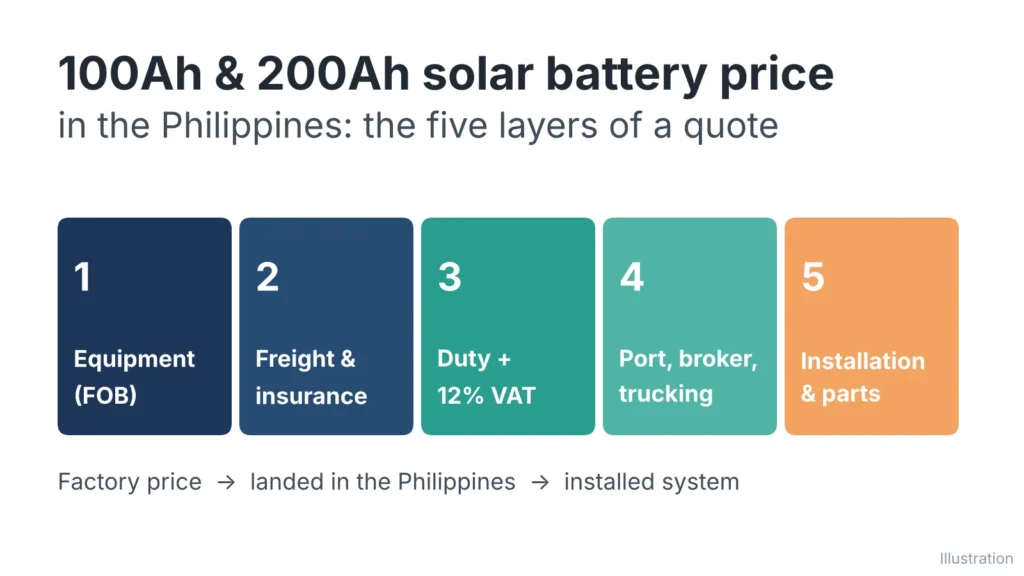

There is no single price per kWh for commercial battery storage, because quotes stop at different points. A factory price for a cabinet covers the battery, its controls and usually the power conversion system. An installed price in the United States adds freight, import duties, the electrical work around the cabinet, engineering, permits, interconnection, commissioning and the installer’s margin. For a typical commercial project the battery hardware is a large line, but not the majority of the installed cost.
Three public reference points show the gap. BloombergNEF’s 2025 survey put the average price of a stationary-storage battery pack at US$70/kWh. NREL’s 2025 cost projection put a complete, installed 4-hour utility-scale system at US$334/kWh in 2024 dollars, and commercial systems usually cost more per kWh than that because fixed costs are spread over fewer kWh. Lazard’s 2025 analysis put the levelized cost of a 1 MW, 2-hour commercial standalone system at US$319–506/MWh discharged.
Our own ex-factory prices for complete commercial storage cabinets currently work out at about US$103 to US$152 per nominal kWh. A cabinet at those prices still needs freight, US duties, site electrical work, engineering, permits and installation before it is an operating system. This guide breaks a quote into those layers, shows what changes when the cabinet is imported from China, and gives the checks that make two quotes comparable.
Which kWh is the price divided by?
Before comparing any two prices per kWh, check the denominator. Suppliers commonly divide by nominal DC energy, the number on the datasheet. Your site receives usable AC energy, which is smaller.
Take a 261 kWh cabinet from our range as an example, using the published ratings of the 261kWh liquid-cooled cabinet (model HLY-ELS26001Y261K):
| Step | Basis (published value) | Energy |
| Nominal DC energy | Datasheet rating | 261 kWh |
| Cycled window | Cycle-life rating is stated at 95% depth of discharge | 261 × 0.95 = 247.95 kWh |
| AC energy delivered (estimate) | System round-trip efficiency ≥86%; one-way ≈ √0.86 ≈ 0.927 | 247.95 × 0.927 ≈ 230 kWh |
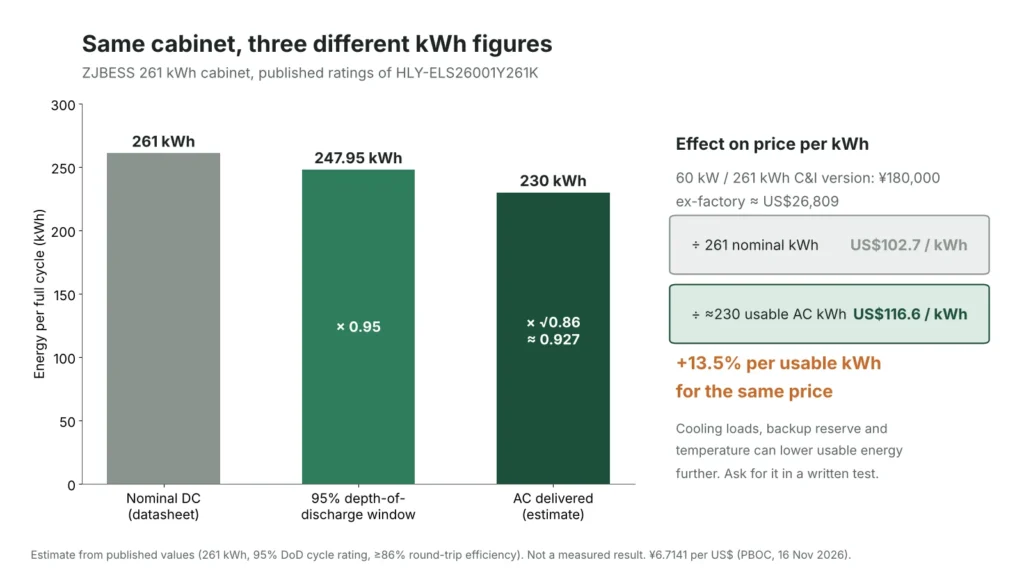
The same cabinet price is therefore about 13.5% higher per usable AC kWh than per nominal kWh. Our 60 kW/261 kWh C&I version costs ¥180,000 ex-factory, about US$26,809 at ¥6.7141 per US$. That is US$102.7 per nominal kWh but about US$116.6 per usable kWh. The 230 kWh figure is our estimate from published values, not a measured result; auxiliary loads such as cooling, the reserve you keep for backup, and temperature can reduce it further. Ask each supplier for the usable AC energy it will accept in a written test, and divide every quote by the same number.
Where the money goes: seven layers of a commercial storage quote
| Layer | What it covers | What makes it swing | Ask for |
| 1. Battery cabinet | Cells, packs, BMS, thermal management, fire suppression, enclosure | Cell grade, cooling method, fire-protection design, duration | Cell maker and model, cooling type, nominal and usable kWh |
| 2. Power conversion and controls | PCS (inverter), EMS, metering interface | Power rating (kW), grid voltage and frequency, grid-code certification | PCS rating, voltage/frequency, which certifications the PCS carries |
| 3. Freight and handling | Crating, ocean freight as Class 9 dangerous goods, port charges, inland trucking, cranage | Weight, container type, destination port | Incoterm, container type, who books the crane |
| 4. Duties and customs fees | Customs duty, Section 301 duties, processing and harbor fees, broker | Country of origin, tariff classification, entry date | Classification used, every duty line itemized |
| 5. Site electrical and civil | Switchgear, transformer, protection, cabling, metering, foundation pad, fencing | Distance to the service, transformer need, utility protection rules | Single-line diagram and a scope split by item |
| 6. Engineering, permits, interconnection | Design, fire-code review, permit fees, utility application and studies, commissioning | Jurisdiction, utility, fire marshal requirements | Which documents the authority will require |
| 7. Contractor overhead, contingency, tax | EPC overhead, profit, contingency, sales tax | Project size, risk, state | Margin and contingency shown separately |
Layers 1 and 2 are usually in the manufacturer’s quote. Layers 3 and 4 depend on the Incoterm. Layers 5 to 7 are set in the United States, by your installer, the utility and the local authority. NREL’s cost models treat the battery pack as a significant cost but not the majority of system cost, which matches what you see when a factory price is set beside a turnkey bid.
What a factory cabinet price includes
These are our current ex-factory prices for complete cabinets (November 2026). They exclude tax, transport to the port and everything after it. US dollar figures use the People’s Bank of China central parity of ¥6.7141 per US$ (16 November 2026).
| Configuration | Version | Ex-factory price | ≈ US$ | ¥ per nominal kWh | ≈ US$ per nominal kWh |
| 30 kW / 112 kWh | Solar-storage (built-in MPPT) | ¥110,000 | 16,383 | 982 | 146 |
| 30 kW / 157 kWh | ¥155,000 | 23,086 | 987 | 147 | |
| 60 kW / 157 kWh | Solar-storage all-in-one | ¥160,000 | 23,830 | 1,019 | 152 |
| 60 kW / 261 kWh | C&I | ¥180,000 | 26,809 | 690 | 103 |
| 60 kW / 261 kWh | Solar-storage | ¥200,000 | 29,788 | 766 | 114 |
| 250 kW / 522 kWh | ¥380,000 | 56,597 | 728 | 108 |
Two patterns are useful when you read anyone’s quote. With the same 60 kW PCS and solar input, the 261 kWh solar-storage cabinet costs ¥766 per kWh against ¥1,019 for the 157 kWh one, a quarter less, because the enclosure, PCS, controls, cooling and fire protection are needed once per cabinet whatever its capacity. And on the same 261 kWh battery, the solar-storage version costs ¥20,000 (about US$2,980) more than the C&I version, which is the price of being able to connect PV strings directly. The 261 kWh battery is also offered with a 125 kW PCS, the version on our product page, quoted per project.
For that 125 kW version of the 261kWh cabinet, the factory supply is the enclosure with five liquid-cooled LFP packs (3.2V/314Ah cells, 1P260S, 832V nominal), the 125kW bidirectional PCS, the BMS (one monitoring unit per pack plus a cluster controller), the EMS, the glycol-water cooling loop and per-pack fire suppression (perfluorohexane plus aerosol). External switchgear, transfer equipment, cabling, foundations and commissioning are defined in the project scope and are not part of the cabinet supply.
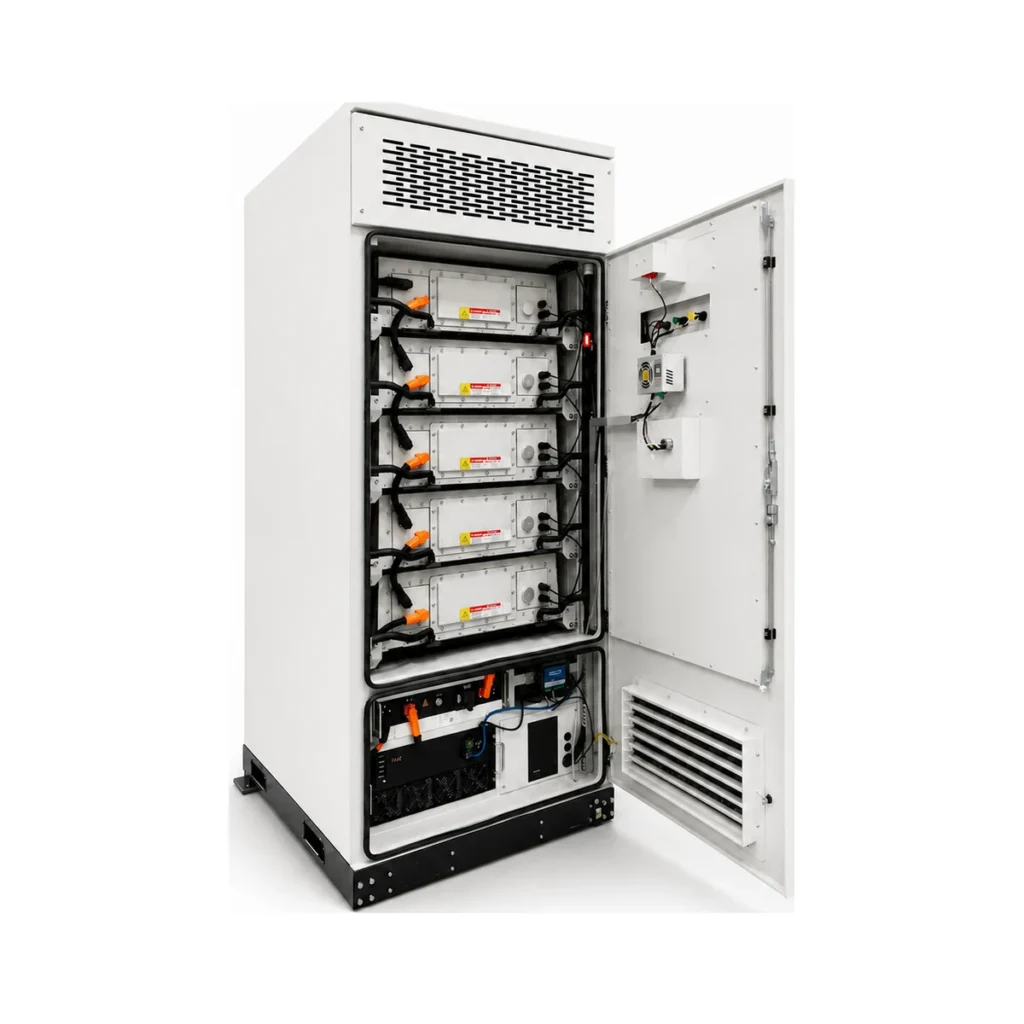

Each cabinet goes through a full charge-discharge cycle at rated power before shipment, with BMS alarm thresholds, cell balancing, coolant flow and suppression-system continuity checked on the line. The standard lead time is 15 working days after order confirmation, shipped FOB Qingdao or Shanghai. Those facts set what the factory price covers; they do not cover anything on the US side of the boundary.
What changes when the cabinet is imported into the United States
Four US-specific items can change a project’s cost more than the difference between two cabinet prices. Check each before comparing an imported cabinet with a domestic turnkey offer.
1. Grid voltage and frequency
Our 261kWh and 60kW/157kWh cabinets are published for a 400V three-phase, 50Hz connection. US commercial services are 60Hz, commonly 480Y/277V or 208Y/120V. A 50Hz-rated PCS cannot simply be connected to a 60Hz service, and a voltage mismatch needs a transformer. For a US project, the quote therefore has to name either a PCS variant rated for 60Hz at your service voltage, or a separate power-conversion and transformer arrangement, and the cost of that line belongs in layer 2 or 5. Grid-interactive inverters in most US jurisdictions also need certification to the utility’s interconnection requirements, so ask which certification the proposed PCS holds before you budget the interconnection.
2. Listing and fire-code evidence
The National Electrical Code (Article 706) requires an energy storage system to be listed, and UL 9540 is the system listing standard inspectors look for. Fire codes add large-scale fire test data (UL 9540A) for many commercial installations. These requirements fall on the system as installed, so a cell or battery report alone does not satisfy them. Our product pages list UL 1973 and UL 9540A as certification references to be matched to the quoted model; a UL 9540 system listing for a US configuration is not published. If your authority requires one, budget for it, or for a turnkey system that already carries it, before you compare cabinet prices.
3. Import duties
For a lithium-ion storage cabinet made in China, the duty lines stack on the customs value (broadly, the price of the goods without international freight):
| Line | Rate | Per US$10,000 of customs value |
| General (MFN) duty, HTS 8507.60.00 | 3.4% | US$340 |
| Section 301, non-EV lithium-ion batteries (from 1 January 2026) | 25% | US$2,500 |
| Section 301 forced-labor action (from 24 July 2026), if it covers your entry | 12.5% | US$1,250 |
| Merchandise processing fee (capped per entry) | 0.3464% | US$34.64 |
| Harbor maintenance fee (ocean entries) | 0.125% | US$12.50 |
| Total | 28.9% to 41.4% | US$2,887 to US$4,137 |

Applied to the 60 kW/261 kWh C&I cabinet, whose customs value would be roughly its ex-factory price plus inland transport to the port, the duties and fees come to about US$7,740–11,091. The cabinet then stands at about US$34,500–37,900 at the US port, or US$132–145 per nominal kWh, before ocean freight, inland delivery and any site work.
US tariffs on Chinese goods changed several times in 2025 and 2026, and the forced-labor action carries product exemptions. Treat this table as the structure to check, not a rate to rely on: have your customs broker confirm the classification and every line for the expected entry date, and keep the confirmation with the purchase decision.
4. The federal investment tax credit
Under Section 48E, standalone storage can earn a 30% credit (Plante Moran, October 2026). Systems under 1 MW of output, such as one or several of the cabinets above, qualify for the 30% rate without the prevailing-wage and apprenticeship requirements. Since the 2025 tax law, however, a storage project that begins construction after 31 December 2025 loses the credit if it receives “material assistance” from a prohibited foreign entity. The test is a cost ratio: in 2026 at least 55% of the relevant manufactured-product costs must come from non-prohibited sources, rising by five points a year to 75% after 2029.
Companies organized or headquartered in China fall within the prohibited categories (Nixon Peabody on IRS Notice 2026-15). ZJBESS is such a company, so the cost of a cabinet we manufacture will generally count against that ratio. For a project whose storage hardware is mainly an imported Chinese cabinet, assume the 30% credit is not available unless your tax adviser calculates otherwise.

That makes the decision simple to frame. If the project only works with the credit, compare domestic or compliant systems first and have the cost ratio checked before signing. If the project already works without the credit, as many demand-charge, backup and off-grid projects do, compare the imported cabinet on landed cost, compliance and service. Our cabinets are also sold for projects outside the United States, where none of this applies.
Why 2-hour storage costs more per kWh than 4-hour storage
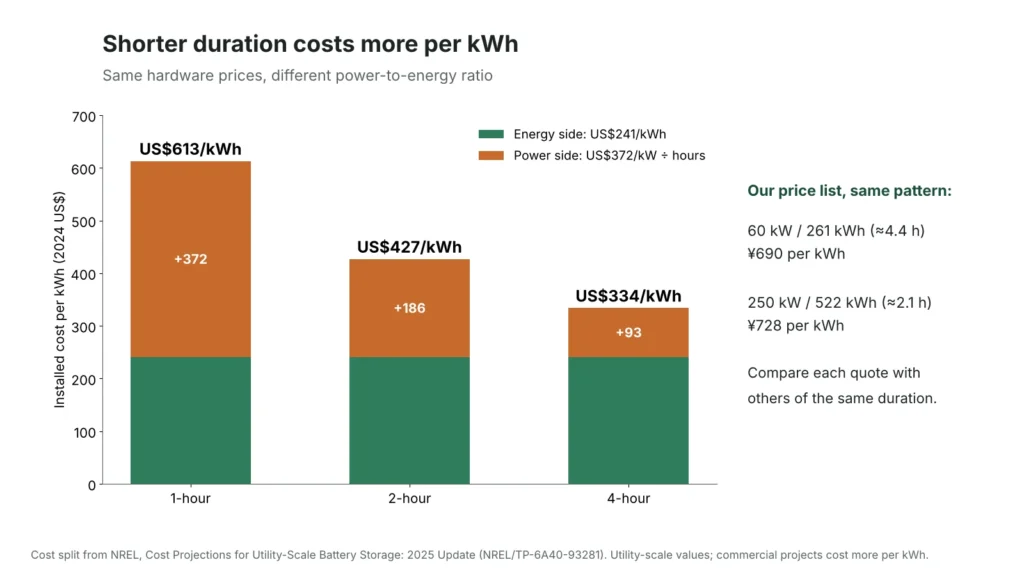
The power side of a system (PCS, transformer, switchgear) is priced per kW, while the battery side is priced per kWh. A shorter-duration system has more kW for every kWh, so its price per kWh is higher even when the hardware is identical.
NREL’s 2025 projection splits a utility-scale system into an energy cost of US$241/kWh and a power cost of US$372/kW (2024 dollars). Applying that split, our arithmetic gives about US$334/kWh at 4 hours, US$427/kWh at 2 hours and US$613/kWh at 1 hour. The absolute values are utility-scale and lower than most commercial projects, but the pattern holds. Our own price list points the same way: the 60 kW/261 kWh cabinet (about 4.4 hours) is ¥690 per kWh, while the 250 kW/522 kWh cabinet (about 2.1 hours) is ¥728 per kWh even though it is twice the size. Compare each cabinet with quotes of the same duration: the 125 kW version of the 261 kWh cabinet is a roughly 2-hour design (261 kWh ÷ 125 kW ≈ 2.1 h), the 60 kW version a roughly 4-hour one.
Is the price worth paying? Work out what the site can afford
A quote is easier to judge once you know the most the system can cost and still pay back in the period you need. Here is an example for one 60 kW/261 kWh cabinet, the C&I version priced above. Every input below is an assumption; replace them with your tariff and interval data.
| Input | Assumption |
| Monthly peak reduction | 50 kW (inside the 60 kW PCS rating), achieved in every billing month |
| Demand charge | US$15/kW per month |
| Time-of-use spread | Charge at US$0.15/kWh, discharge at US$0.25/kWh |
| Cycling | One full cycle on 250 working days a year |
| Energy per cycle | 229.94 kWh delivered (the ≈230 kWh estimate above); 229.94 ÷ 0.86 ≈ 267.37 kWh drawn to recharge |
- Demand-charge saving: 50 kW × US$15 × 12 = US$9,000 a year
- Energy-shift value: (229.94 × 0.25) − (267.37 × 0.15) ≈ US$17.38 a day × 250 ≈ US$4,345 a year
- Total ≈ US$13,345 a year, before maintenance, insurance and battery ageing
For a 7-year simple payback, the installed cost could be up to about US$93,400, or US$358 per nominal kWh. The cabinet itself reaches the US port at about US$34,500–37,900, which leaves roughly US$55,500–58,900 for ocean freight, delivery, switchgear, the 60Hz arrangement, engineering, permits, installation and margin. At a US$10/kW demand charge, the same calculation allows only about US$72,400 (US$277 per nominal kWh) in total. The example assumes the same daily cycle can both shave the peak and shift energy, which only holds when the site’s peak falls inside the expensive tariff window.

NREL’s survey of more than 10,000 US utility tariffs estimated that about 5 million commercial customers could face demand charges of US$15/kW or more, so the US$15 assumption is realistic in many service areas but far from universal. Where peaks are rare, or the tariff spread barely covers losses, the same cabinet may never pay back on bill savings alone. In that case, size for backup value or do not buy storage yet.
How to rank commercial battery systems by cost
Ranking systems by headline price per kWh rewards the quote with the largest denominator and the shortest scope. A fairer basis is the cost per kWh the system is expected to deliver over its rated life:
Cost per delivered kWh = installed cost ÷ (usable AC kWh per cycle × rated cycles × average retained capacity)
For our 261kWh cabinet, the published rating is 5,000 cycles at 95% depth of discharge to 80% end-of-life capacity. Using 230 kWh per cycle and an average retention of 90% over that life, the rated throughput is about 230 × 5,000 × 0.9 ≈ 1.03 million kWh. Do the same for every quote, using each supplier’s own rating and the same assumptions, and compare the result together with what each warranty actually guarantees. A cycle rating is a test result, not a warranty; our article on LiFePO4 cycle-life claims shows how to read one.
| Quote says | Ask | Why it matters |
| “US$/kWh” with no basis | Nominal DC or usable AC? At what depth of discharge? | Changes the per-kWh price by 10–15% or more |
| “Turnkey” | Itemized list of what is outside the scope | Switchgear, transformer and commissioning are often excluded |
| “UL certified” | Which standard, which model, which certificate holder | A cell or module report is not a UL 9540 system listing |
| “Grid-ready” | Rated voltage and frequency of the PCS | A 400V/50Hz PCS needs a different solution on a 60Hz service |
| “10-year warranty” | Capacity retained at what point, measured how | Cycle life and warranty answer different questions |
| “Delivered price” | Incoterm, and are duties included (DDP)? | Duties alone can add 29–41% of customs value |
| “ITC eligible” | Who calculated the material assistance cost ratio? | An imported Chinese cabinet generally fails the 2026 test |
For the documents behind these answers, see our battery documentation checklist and the guide to evaluating a LiFePO4 battery supplier in China.
Getting the freight and site line right
The two 261 kWh versions differ in size: the 125 kW version weighs 4,900 kg and measures 1,440 × 1,000 × 2,391 mm, the 60 kW version 2,600 kg and 1,150 × 1,500 × 2,550 mm, both before crating. Both are taller than the door opening of a standard 20ft or 40ft dry container (typically about 2,280 mm). A high-cube door (about 2,585 mm) leaves little room once a crate and skid are added, especially for the 2,550 mm cabinet, so open-top or flat-rack equipment is often the practical choice; confirm the crated height with the packing list before booking. As a lithium-battery system it moves as Class 9 dangerous goods, which narrows carrier choice and adds handling charges; our guide to shipping LiFePO4 batteries by sea covers the documents.
On site, the published requirements for the 125 kW version are a concrete pad of at least 1,600 × 1,100 mm rated ≥7 t/m², 1,000 mm clearance in front and 500 mm on the heat-rejection side, plus crane access for unloading. These are inputs to layer 5. If you are adding the cabinet to an existing PV system, the choice between AC and DC coupling also changes the electrical scope; see AC vs DC coupled battery storage.

What to send for a comparable quote
A quote can only be compared if it starts from the same site facts. Send these with your enquiry:
- Service voltage, frequency and phase, and the available capacity at the connection point
- 12 months of 15-minute interval data, and the tariff with its demand-charge and time-of-use terms
- The main goal (peak shaving, solar self-use, backup) and any critical loads with their starting power
- Whether the project relies on the federal tax credit, and who will calculate eligibility
- The installation location, with a site plan or single-line diagram if you have one
From these, we can confirm whether one of our cabinets fits the power and energy, what the factory scope would include, which US-side items you need to source separately, and whether a 50Hz design is workable for your site at all. Start on the commercial and industrial energy storage page.
FAQ
What did commercial battery storage cost per kWh in 2025?
Published 2025 reference points cover different scopes. BloombergNEF reported stationary-storage packs at US$70/kWh on average. NREL’s 2025 projection gave US$334/kWh for an installed 4-hour utility-scale system, in 2024 dollars. Commercial projects sit above that per kWh because permitting, engineering and interconnection cost about the same for a small system as for a large one. Lazard put the 2025 levelized cost of a 1 MW, 2-hour commercial system at US$319–506/MWh.
Is the PCS included in a commercial battery cabinet price?
It depends on the product. Some cabinets are battery-only and need a separate PCS; ours integrate the PCS, BMS and EMS. Check the quote for the PCS model and rating, and check that its voltage and frequency match your service.
How much does maintenance add?
For our liquid-cooled cabinets, the published service items are an annual coolant test (concentration and pH) and coolant replacement every 3 to 5 years; the pump and heat exchanger are field-replaceable. Ask any supplier for the service schedule, the cost of each visit and who performs it in your country, and add monitoring and software fees if the EMS uses a paid platform.
Does a larger system always cost less per kWh?
Usually, because fixed costs such as engineering, permitting and commissioning are spread over more kWh. That only helps if the site can use the extra energy. An oversized battery that never fully cycles raises the cost per delivered kWh.
The landed-cost, payback and throughput examples above use stated assumptions and published ratings; they are not measured results, tax advice or a price offer.
Discuss Your ProjectBack to Blog