

10kWh Low-Profile LiFePO4 Home Battery
For home solar and backup.
Key product details
The ZJBESS WS10KW is a 10kWh low-profile LiFePO4 battery (51.2V 200Ah) for home solar storage and backup. The horizontal chassis on casters stores 10.24kWh, runs a 1kW load for about 8.5 hours and carries a 48V inverter up to 8kW, with screen, breaker and terminals on one front panel. Built and tested in our factory in Shandong, China.
- 10.24kWh · 51.2V 200Ah · 200A continuous discharge
- Screen, breaker, terminals and ports on one front panel
- 18 inverter protocols · 8,000+ cycles · 10-year warranty
- Up to 15 units in parallel for 153.6kWh · 15.36kWh WS15KW option
A low, wide 10kWh battery with everything on the front
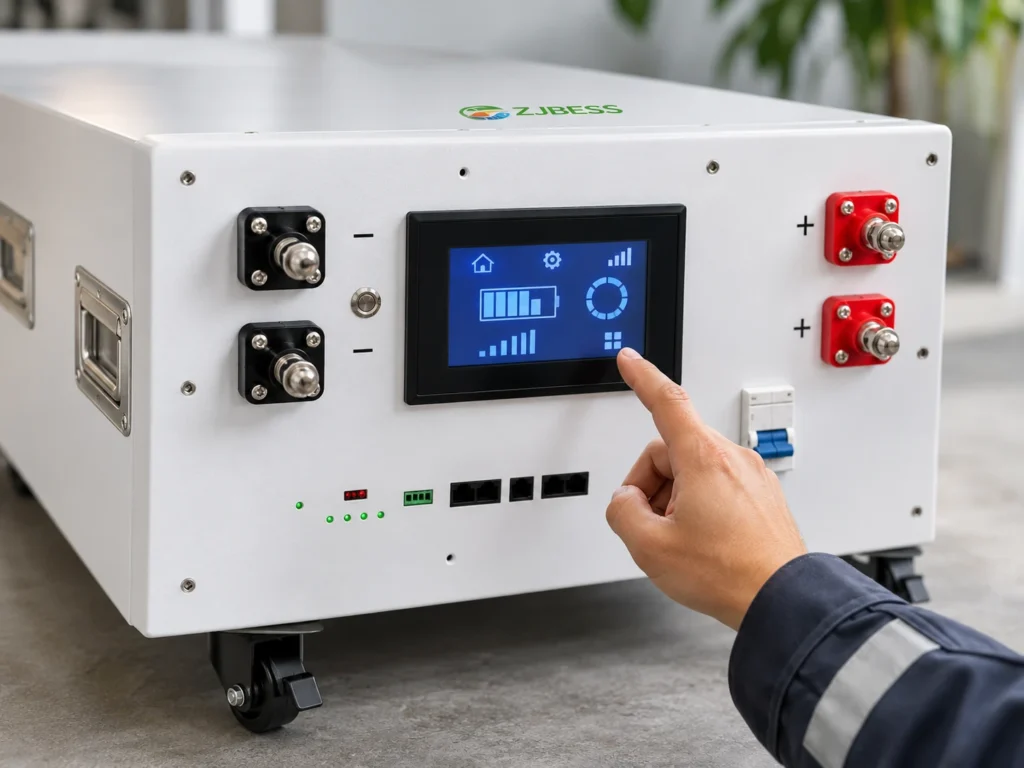
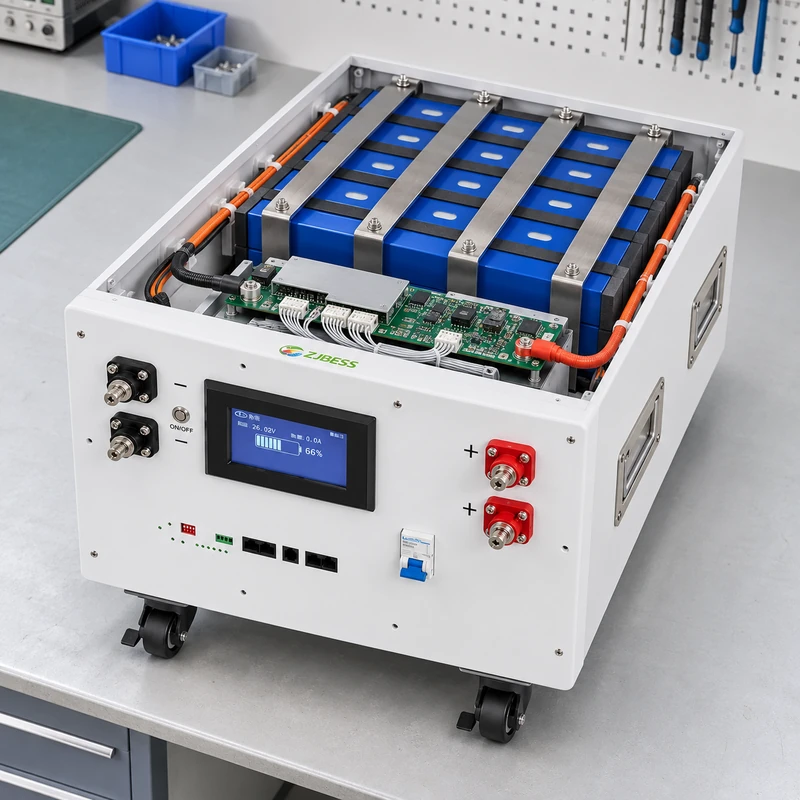
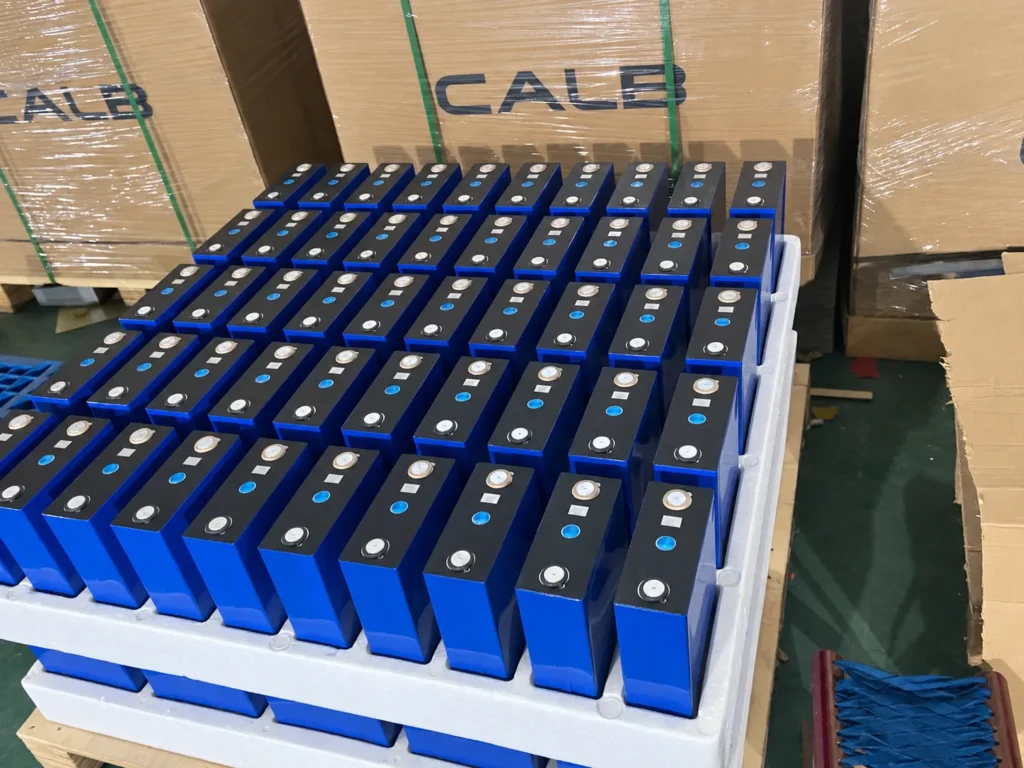
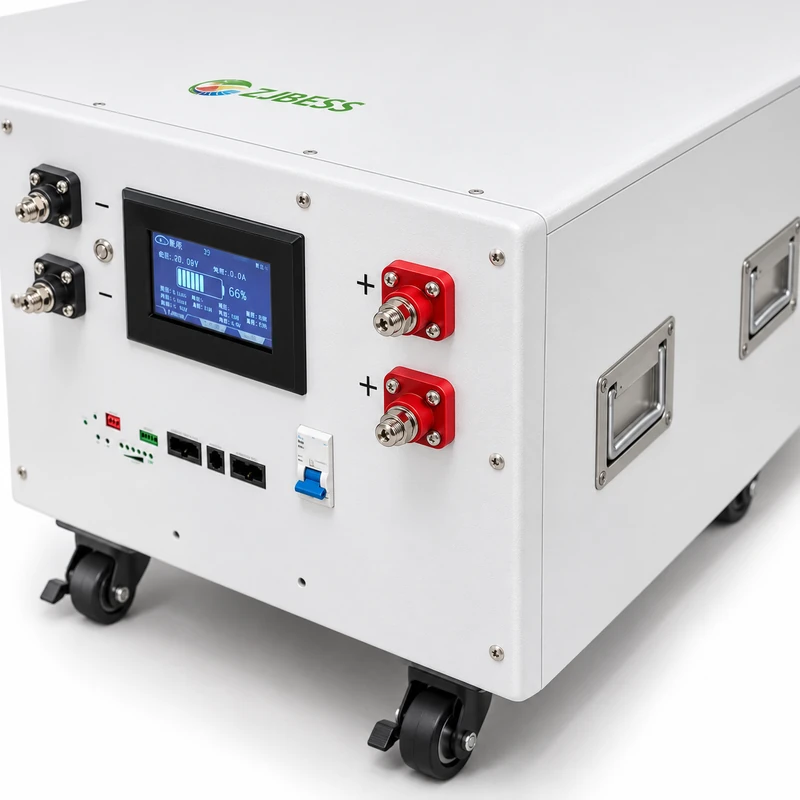
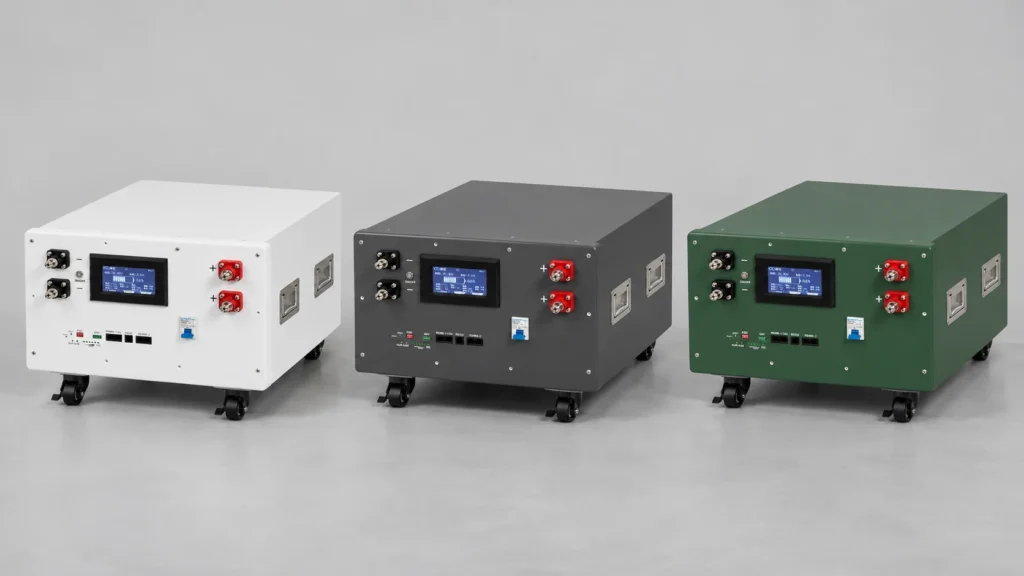
The WS10KW is the low-profile 10kWh model in the ZJBESS home battery range. Grade A 3.2V LiFePO4 cells in a 16-series, 51.2V 200Ah pack lie flat in a horizontal steel chassis on casters, held with steel banding. The 3.5-inch touch screen, breaker, power terminals and communication ports all sit on the front panel.
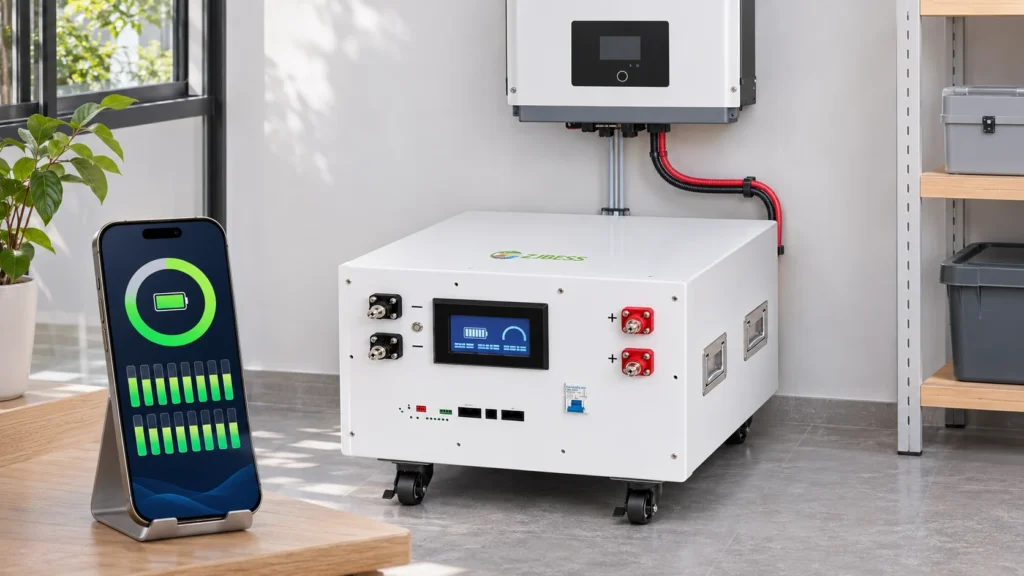
It is a battery-only product. Pair it with any 48V hybrid or off-grid inverter that uses one of the 18 built-in battery protocols, or with a ZJBESS inverter. For more energy in the same format there is the 15.36kWh WS15KW; for a tall cabinet, the 15kWh floor-standing LS15KW.
- Fit under counters, shelves and stair spaces where tall cabinets do not
- Wire and service from the front without moving the unit
- Roll into place on casters, no wall fixing
- Grow from 10.24kWh to 153.6kWh with the same SKU
What can a 10kWh low-profile battery power?
One full WS10KW puts about 8.5kWh into the sockets. The table uses shop and small-home loads, where low-profile units are most often installed.
| Average AC load | Typical loads | Runtime, 1 unit | Runtime, 3 units |
|---|---|---|---|
| 250W | Router, LED lights, CCTV | 34 h | 102 h |
| 400W | Shop lights, POS, router | 21 h | 64 h |
| 800W | Drinks fridge, fans, laptops | 10.6 h | 32 h |
| 1,500W | Small inverter air conditioner | 5.7 h | 17.0 h |
| 2,500W | Kitchen appliances in turn | 3.4 h | 10.2 h |
How many solar panels charge a 10kWh battery? About 2.6kW of PV, or 5 × 550W panels, refills one WS10KW in a day with 5 peak sun hours (10.24kWh ÷ 5h ÷ 0.8 system factor = 2.56kW). Add the panels needed for daytime loads on top.
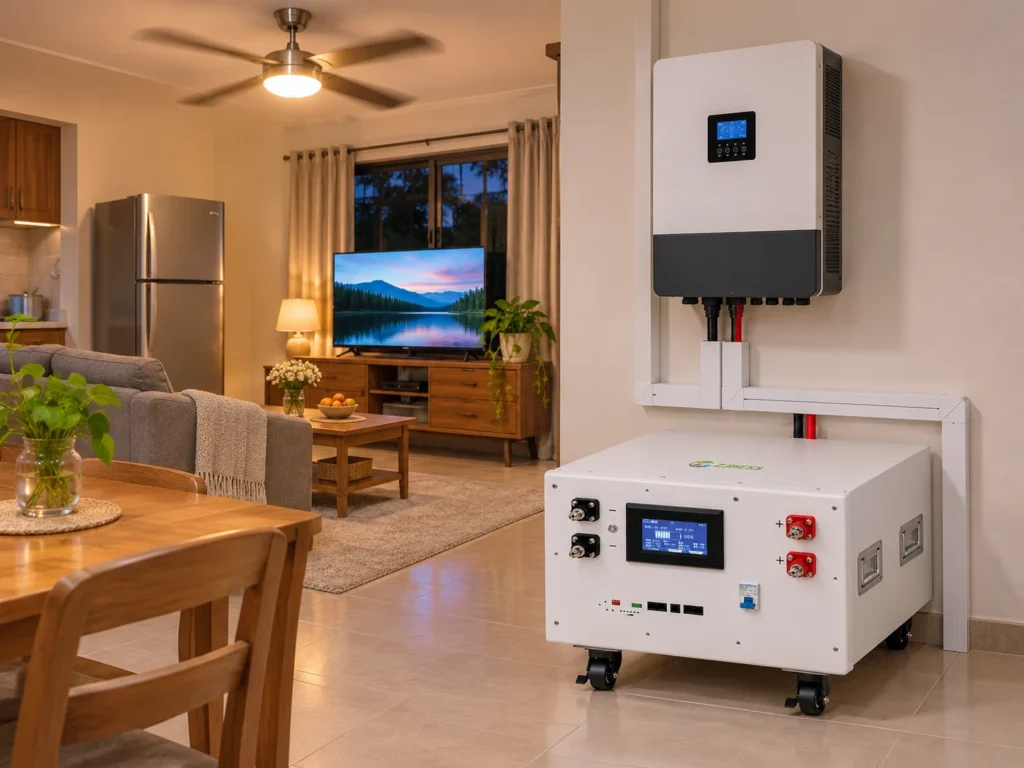
Low-profile on casters: roll it in, wire it from the front
The WS10KW sits low with a low centre of gravity. It needs no wall fixing and no rack, and every connection is on the front.
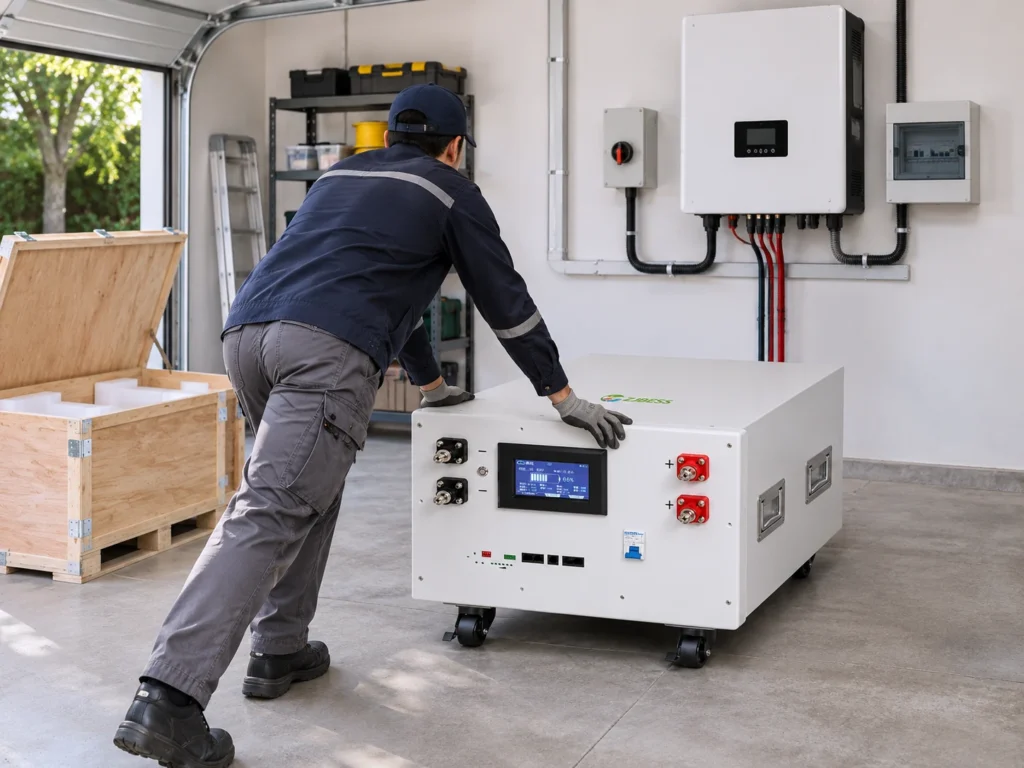
Roll into place
Take it off the pallet and roll it on its casters to the inverter. No wall-load check and no bracket.
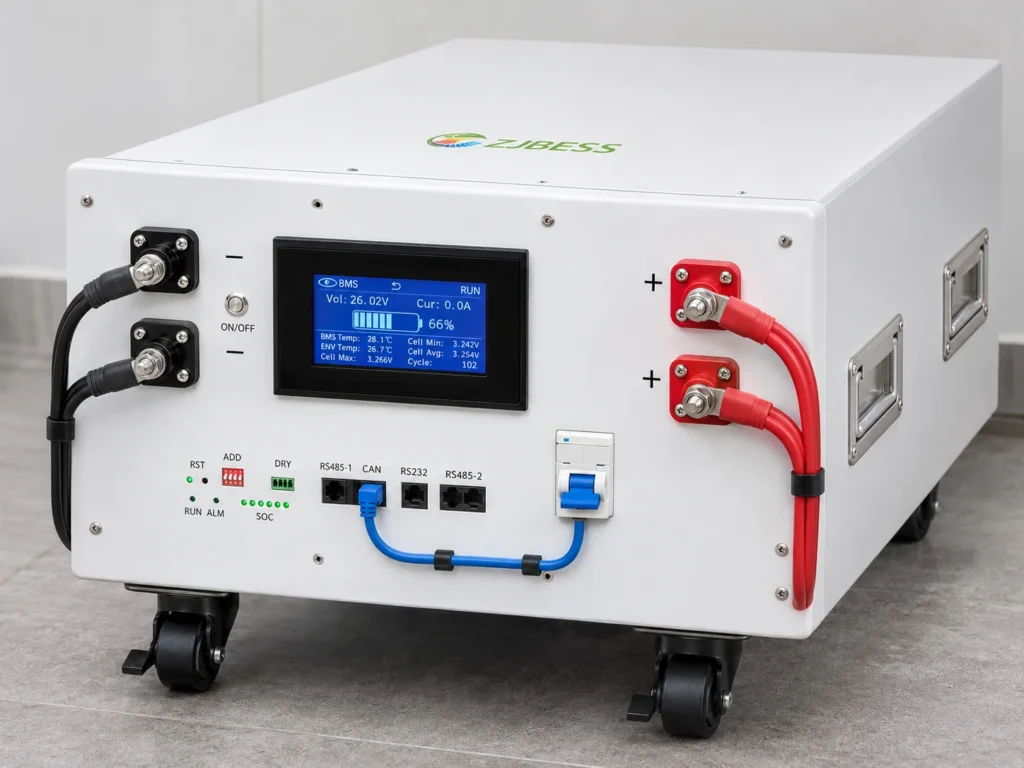
Wire from the front
Screen, breaker, positive and negative terminals and CAN / RS485 ports are on one panel. Nothing to reach behind.
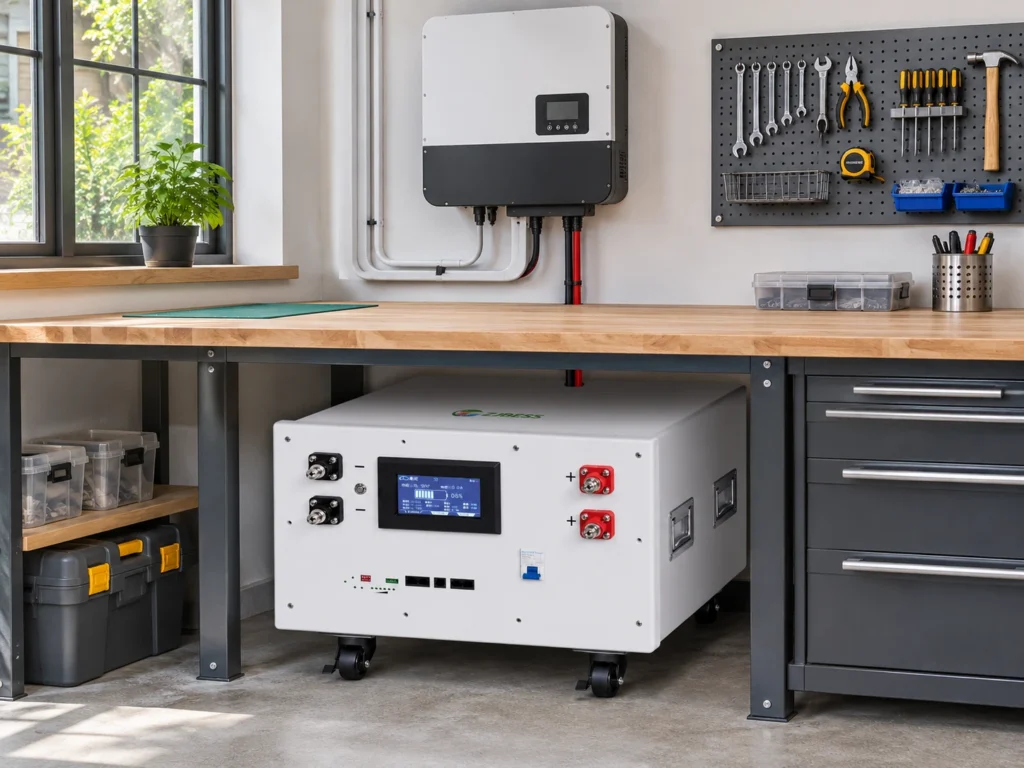
Under benches and shelves
At 260mm high the body fits under a workbench, a shelf or a staircase, leaving the wall free.
Tap. See. Control. A BMS your installers can read on site
CAN or RS485 to the inverter, Bluetooth and Wi-Fi to the ZJBESS app, and a 3.5-inch touch screen where the installer picks the inverter protocol.
Protocol Direct Select
Pick the inverter brand on the front screen while kneeling at the unit; no laptop needed.
Screen beside the terminals
Readings and wiring on one panel: the installer checks SOC while tightening the cables.
Cell-level alarms
Voltage and temperature of all 16 series cells, balanced from 52.8V.
Remote service
Wi-Fi monitoring for units tucked under counters, where the screen is hard to see.
Eight protections, set at the factory
Charging stops at 58.4V
Recommended cut-off 44.8V, BMS cut-off 40V
Continuous discharge held within 200A
Instant disconnect on a terminal fault
Charging blocked below 0°C
Charge and discharge stop above 60°C
Peak up to 11kW
Balancing and alarm per cell
Key performance advantages of the WS10KW
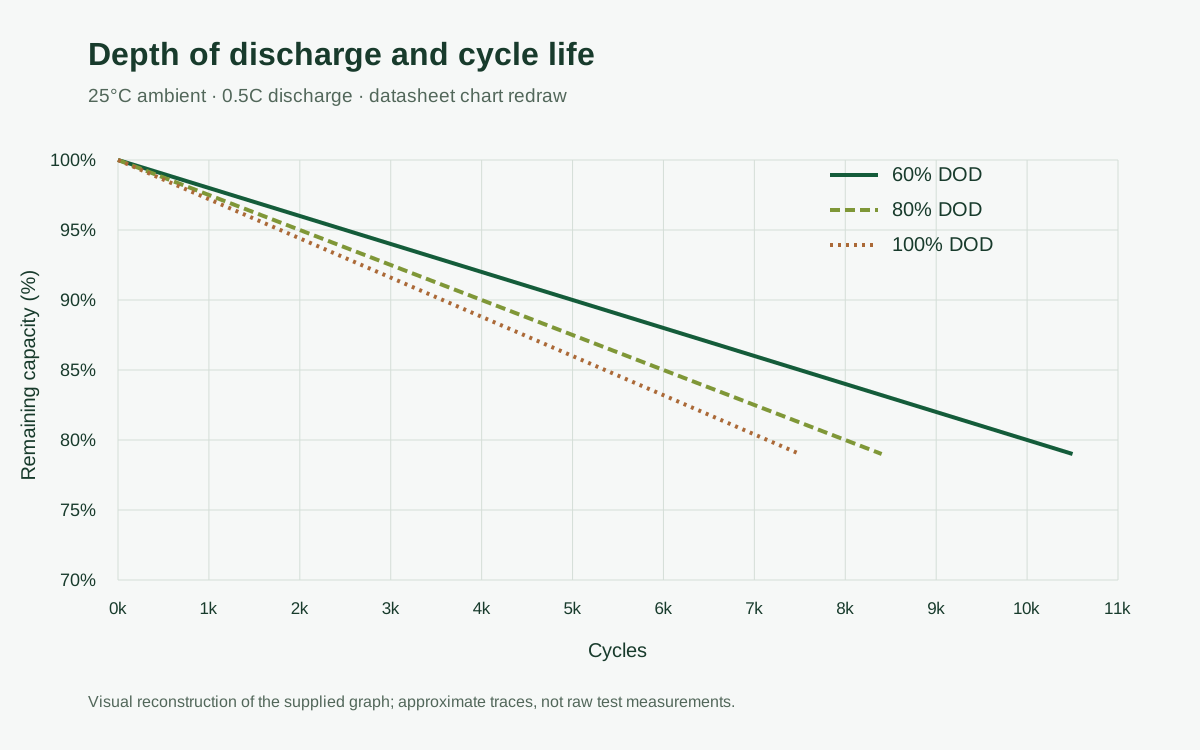
Rated at 25°C, 0.5C and 100% DOD with more than 80% capacity left. One full cycle a day is more than 21 years of cycling, so the 10-year warranty, not cell wear, sets the planning life.
200A continuous from a 200Ah pack, enough for an 8kW inverter on one unit. Peak loads up to 11kW for motor starts.
Up to 15 identical units on one 51.2V bus. Energy and current add up, voltage stays the same.
Screen, breaker, terminals and ports in one place. Installers commission and service it without moving it.
What 8,000+ cycles mean for your customer
At one full cycle a day, 8,000 cycles is more than 21 years of cycling, against 500 to 1,500 cycles for lead-acid at 50% DOD. The 10-year warranty, not cell wear, sets the planning life, and shallower daily cycles extend it further.
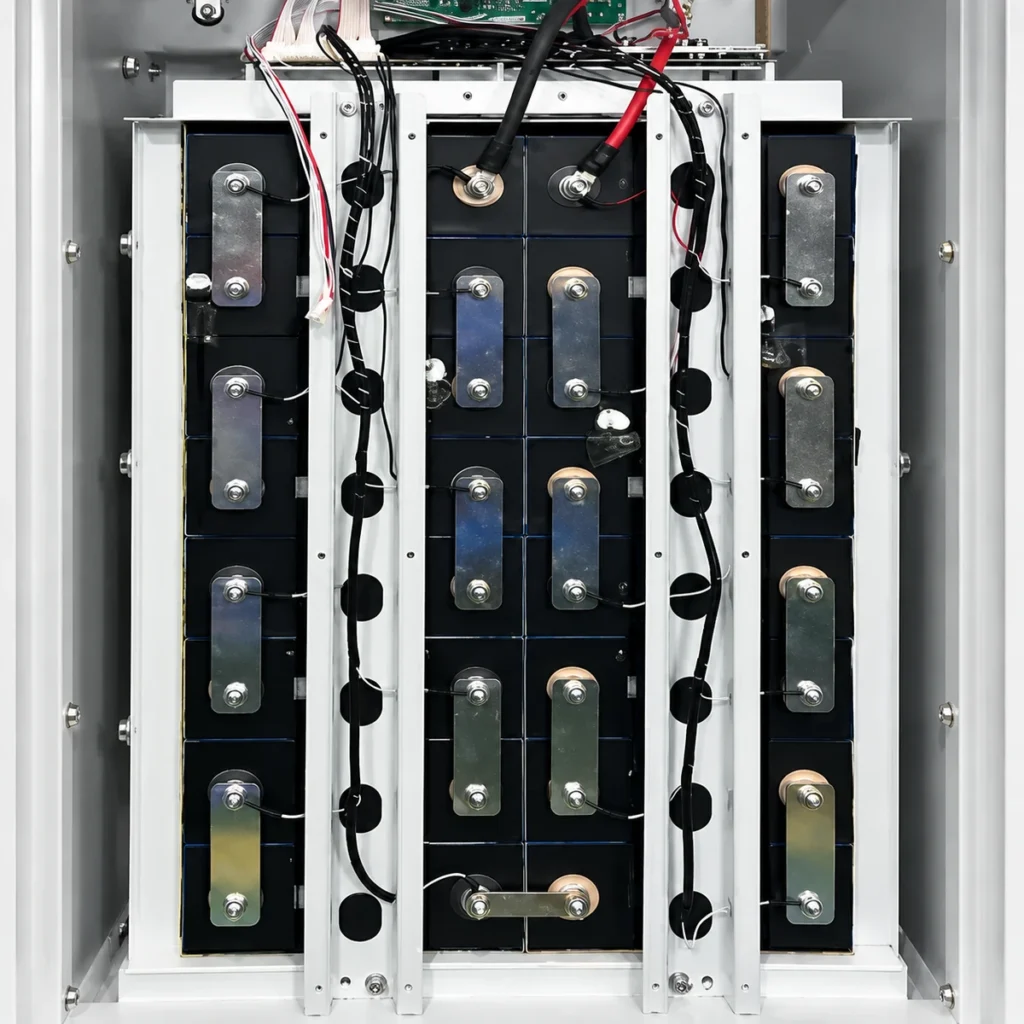
Steel-banded cells laid flat in a low chassis
Inside the chassis the cells are compressed and strapped with steel bands, the module process used in EV power batteries.
- Steel-banded Grade A cells. New, QR-scanned, matched cells held at constant pressure, which slows capacity fade.
- Low centre of gravity. The horizontal layout keeps the weight low, so the unit is stable on its casters.
- Front-panel service. The breaker, terminals and ports are on the front panel beside the screen.
Which inverters work with the WS10KW?
Protocols for 18 inverter brands are built in, so the inverter charges by the WS10KW BMS limits, not a fixed voltage.
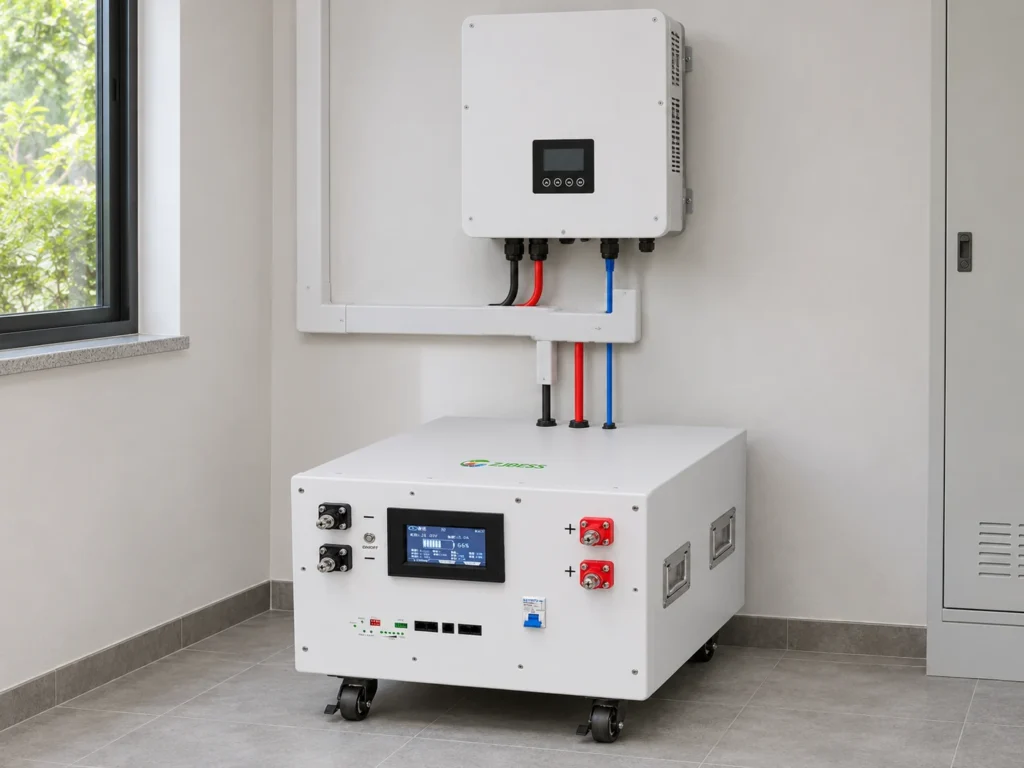
A typical WS10KW system is one unit on a 5–6kW inverter such as the ZJBESS 6kW ED, tucked under the inverter shelf; two units suit the 13.2kW hybrid inverter.
Select the protocol
Kneel at the front panel and choose the inverter brand on the screen.
Connect CAN or RS485
Plug CAN or RS485 into the front port, next to the power terminals.
Set lithium mode
Set the inverter battery type to lithium / BMS communication.
Check the readings
Confirm the inverter reads SOC and the WS10KW limits before closing the shelf.
Pre-loaded for your market. Tell us the inverters you sell and our BMS engineers set the protocol before the WS10KW is crated. For a brand outside the list, send the model and firmware and we build the match.

Where the WS10KW is used
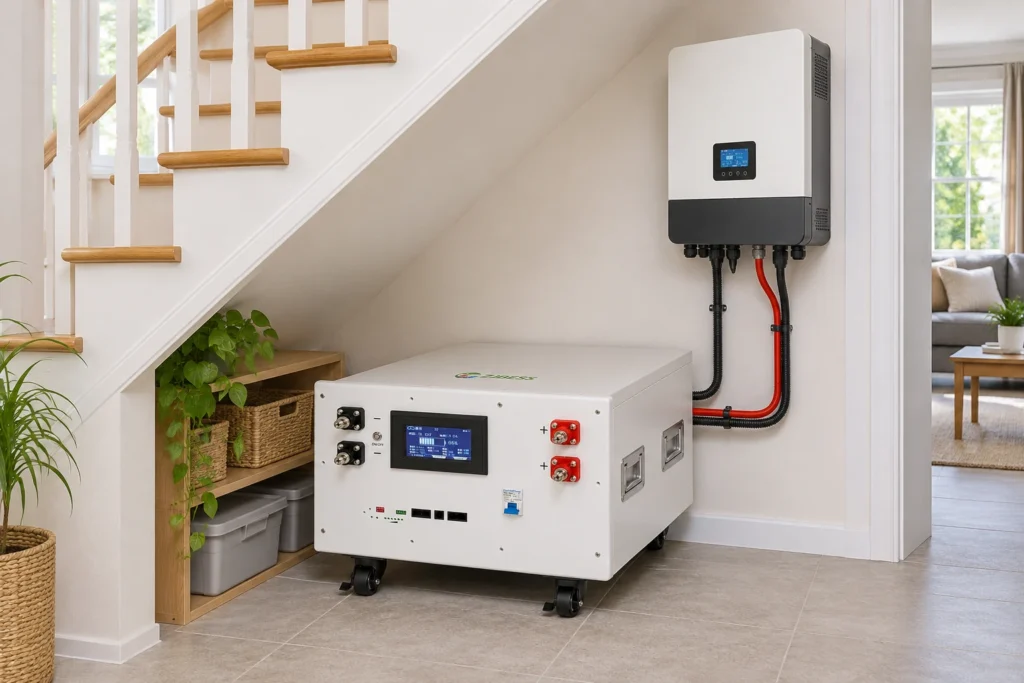
Under-stair and low spaces
Homes where the only free space is under the stairs or a counter. At 260mm high the WS10KW slides into gaps no tall cabinet fits.
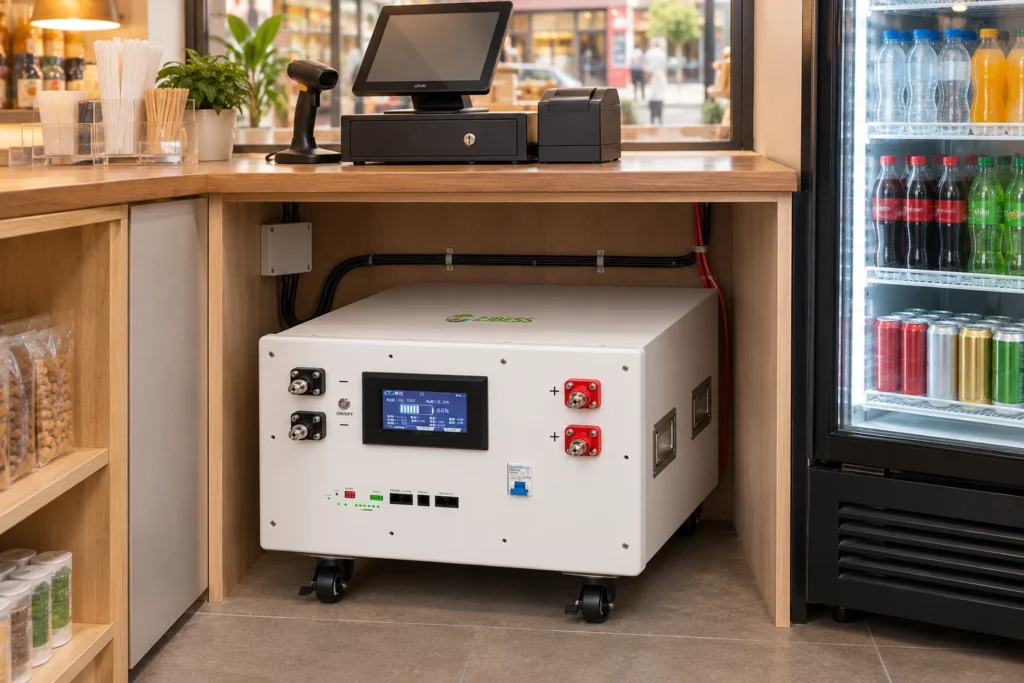
Shops and kiosks
Lights, POS, router and a drinks fridge kept on through outages, the battery out of sight under the counter. About 21 hours at a 400W shop load.
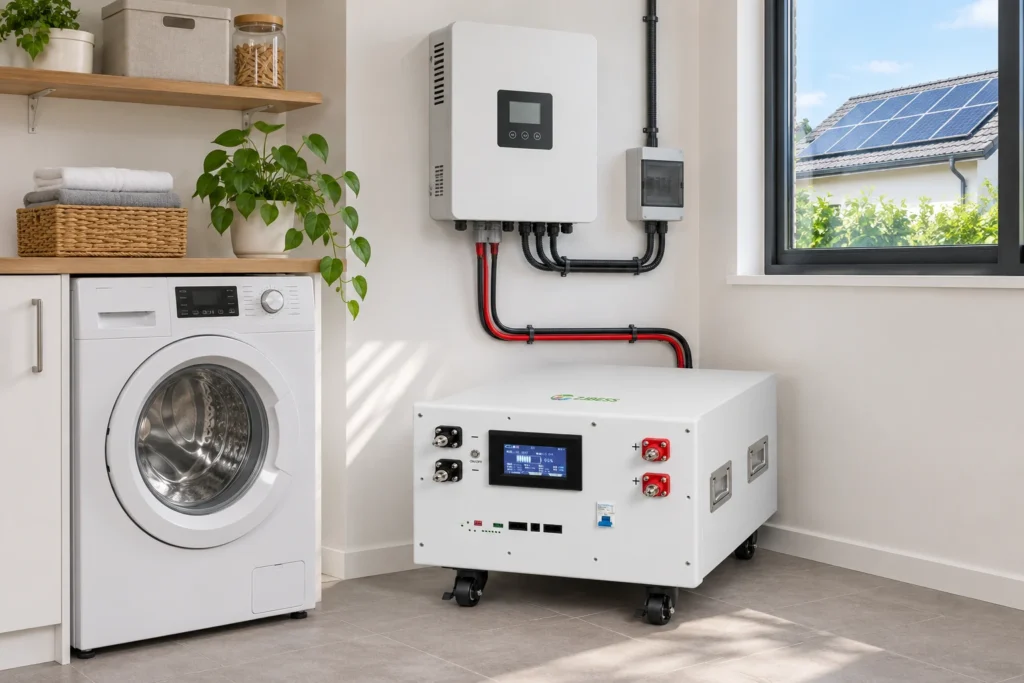
Residential solar storage
Store midday PV and run the home through the evening peak. Three units side by side give 30kWh for larger homes.
One low-profile SKU from 10kWh to 150kWh
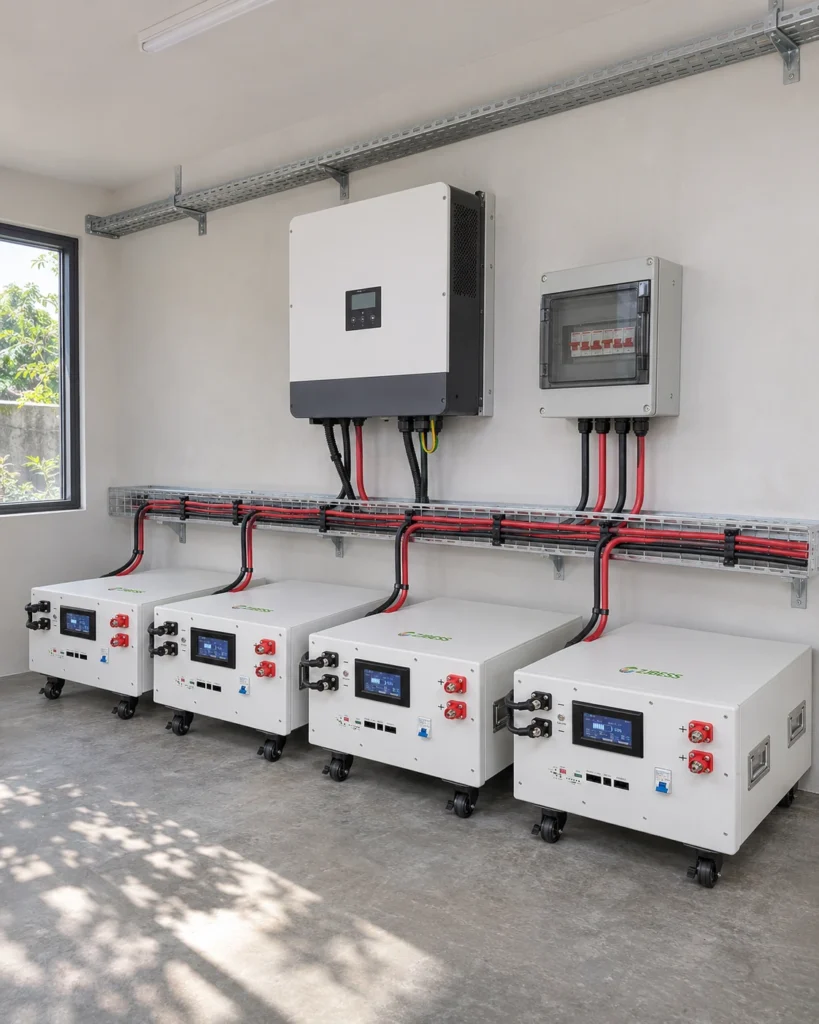
Up to 15 WS10KW units run in parallel on one 51.2V bus. Units sit side by side or on a sturdy shelf.
| Units | Nominal energy | At the AC loads | Continuous current | Typical system |
|---|---|---|---|---|
| 1 | 10.24kWh | 8.5kWh | 200A | Under-stair home system |
| 3 | 30.72kWh | 25.4kWh | 600A | Shop with fridges and AC |
| 4 | 40.96kWh | 33.9kWh | 800A | Row under a long workbench |
| 6 | 61.44kWh | 50.9kWh | 1,200A | Small office or clinic |
| 12 | 122.88kWh | 101.7kWh | 2,400A | Two-inverter site |
| 15 | 153.6kWh | 127.2kWh | 3,000A | Maximum, 153.6kWh |
WS10KW limits your installers should know
Plan on 8.5kWh
Of the 10.24kWh nameplate, about 8.5kWh reaches the sockets. Our runtime figures use that number.
260mm high
The chassis is 720 × 410 × 260mm. Measure the height under the bench or shelf, and leave room in front for the cables.
Inverter not included
Order a 48V hybrid or off-grid inverter with it, or one of ours. One unit runs up to about 8kW.
WS10KW with WS10KW
A bank uses one model only. WS15KW and other brands go in a separate bank.
Indoors, off wet floors
Install it indoors or under cover, out of rain and direct sun, and keep the chassis off wet garage floors.
Charge above 0°C only
In cold outbuildings the BMS stops charging below 0°C. Choose a room kept above freezing.
How every WS10KW is built and tested
WS10KW and WS15KW share the same eight stations as every ZJBESS battery, with one difference at station five: the pack is laid flat in a 260mm-high chassis.

Incoming cell inspection
The 200Ah cells for each WS10KW are scanned on arrival and checked for voltage, internal resistance and casing damage.
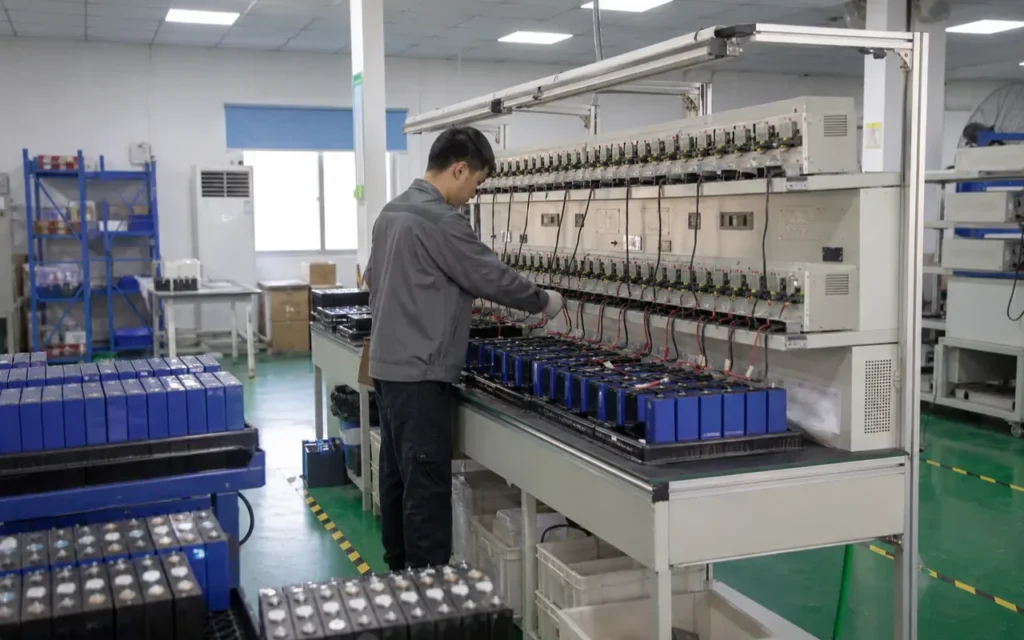
Sorting & matching
Sixteen series positions are filled with matched cells, laid out in one flat row for the low chassis.
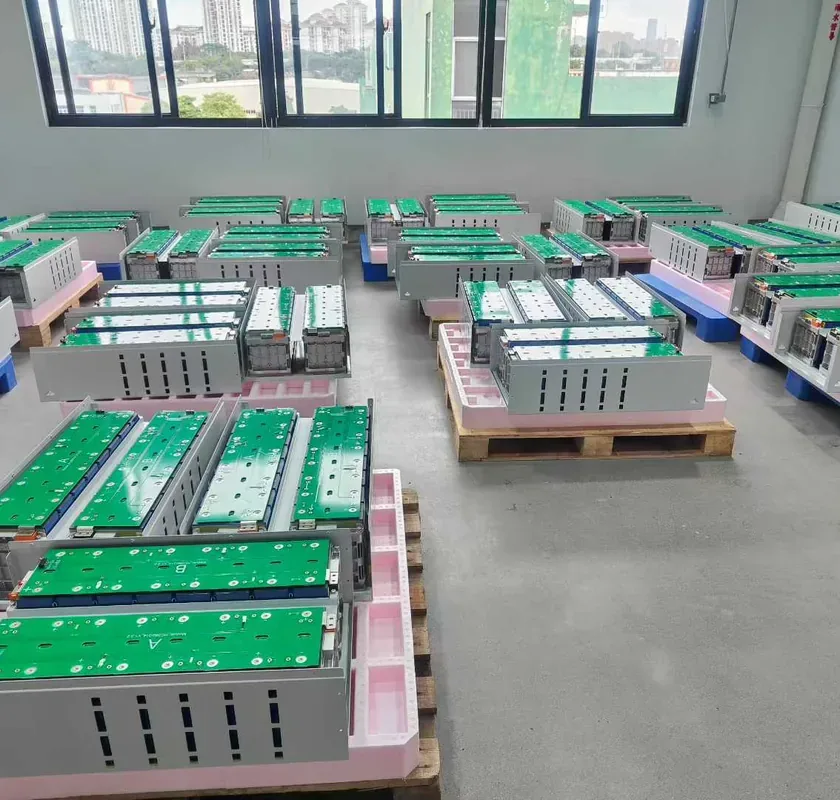
Steel-band module assembly
The flat pack is compressed and steel-banded so it stays rigid on casters.

BMS wiring
Sampling leads run to the BMS directly behind the front panel, then are checked against the wiring map.

Chassis integration
Pack, BMS, breaker, screen and front terminals go into the 720 × 410 × 260mm chassis on casters.

Charge–discharge aging
Each WS10KW is fully charged and discharged; capacity and aging curve are saved per serial number.
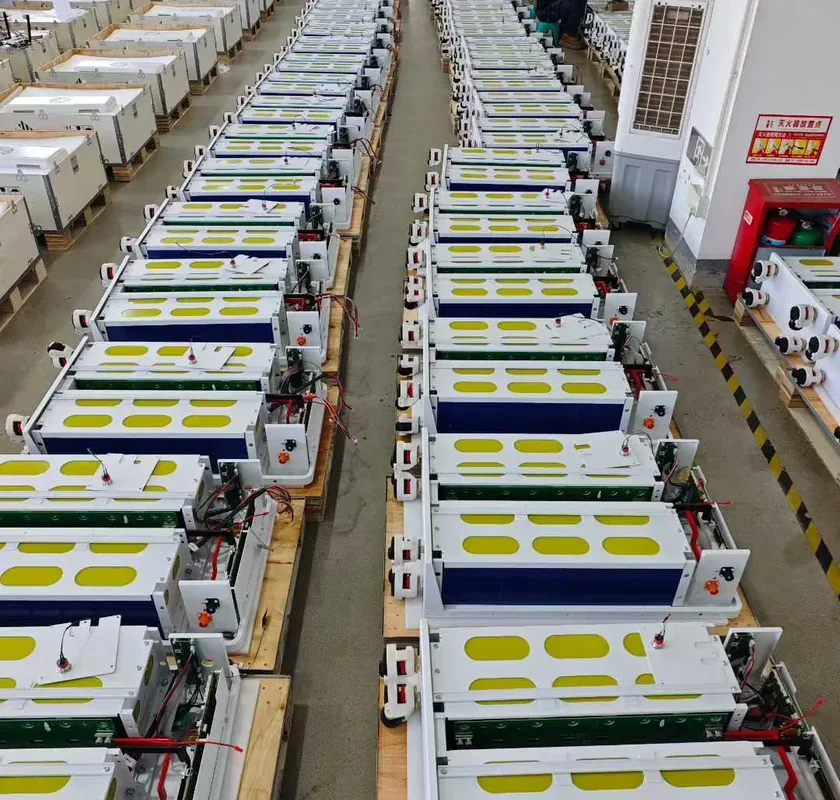
Final inspection & protocol
Front-panel screen, breaker and ports are tested, and your inverter protocol is set.
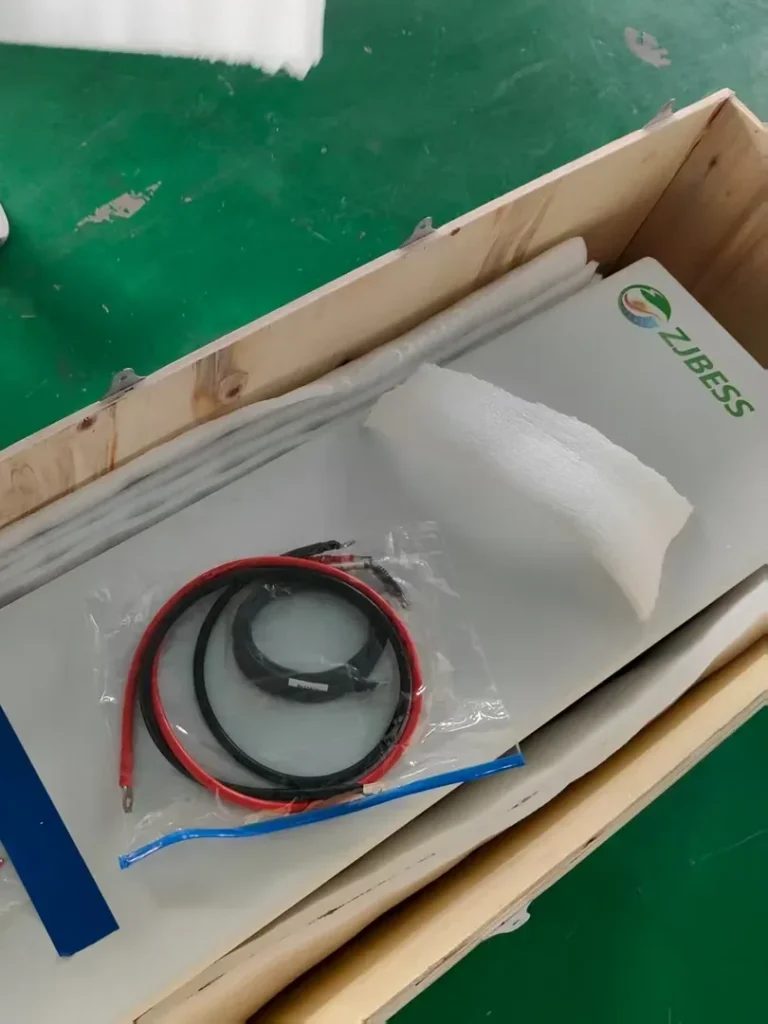
Crating & documents
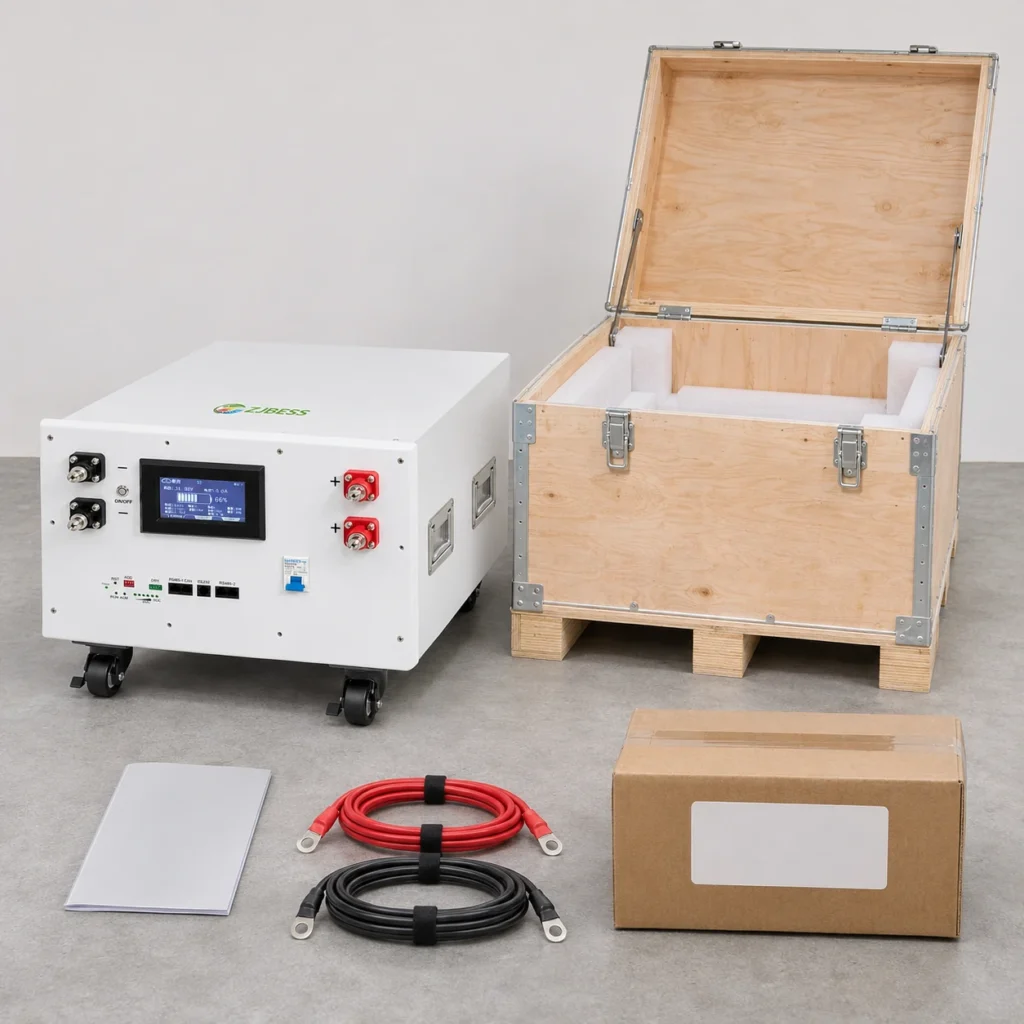
Crated in UN3480 wood with cables, manual and QC pack; the unit rolls off the pallet on its casters.
Distributor terms for the WS10KW
Our published terms for distributors, installers and EPC buyers, written into every WS10KW quotation.
Standard WS10KW orders leave the factory within 15 working days of the confirmed order.
Your logo on the WS10KW front panel and boot screen from 3 units.
Every WS10KW service request is answered within 24 hours, with a handling plan within 3 days.
Order one WS10KW to test with your inverters before a pallet or container order. Mixed containers with other ZJBESS models are available.
Included in the WS10KW quotation
- WS10KW with your inverter protocol pre-loaded
- Front-panel power and communication cables, manual
- Per-unit QC pack and configuration record
- UN38.3 test summary and MSDS for customs
Payment and order options
- One unit to test under your shelves and inverters
- WS10KW and WS15KW in one shipment
- Alibaba Trade Assurance or letter of credit (L/C)
WS10KW OEM and ODM under your brand
Colour, logo, boot screen, app, carton and manual change for your market; cells, BMS and tests stay the same. For a full range, pair the WS10KW with the floor-standing LS15KW, wall-mounted BG10KW or rack-mounted JJ5KW.
Brief
Market, inverters, quantity
Artwork
Front-panel logo and colour proofs
Sample
One branded unit to test
Production
Same eight stations and records
Inspection
Photo, video or third-party check
Shipping
Crated, documented, tracked


ZJBESS home batteries in the field
Nigeria

Philippines

United States
WS10KW and WS15KW specifications
Two low-profile capacities on the same BMS, touch screen and LiFePO4 cell platform. Pick the energy your customers need; the electrical limits stay the same.
| Model | WS10KW · This page10.24kWh51.2V 200AhDatasheet PDF | WS15KW15.36kWh51.2V 300AhDatasheet PDF |
|---|---|---|
| Battery & energy | ||
| Nominal energy | 10.24kWh | 15.36kWh |
| Nominal capacity | 200Ah | 300Ah |
| Cell configuration | 16S LiFePO4 · 200Ah | 16S LiFePO4 · 300Ah |
| Nominal voltage | 51.2V | |
| Chemistry | LiFePO4, Grade A prismatic cells | |
| Recommended SOC window | 0–100% | |
| Internal resistance | ≤50mΩ @ 50% SOC | |
| Cycle life | 8,000+ cycles (25°C, 0.5C, 100% DOD, >80% capacity) | |
| Charge & discharge | ||
| Charge voltage (recommended / BMS cut-off) | 57.6V / 58.4V | |
| Low-voltage disconnect (recommended / BMS) | ≤44.8V / ≤40V | |
| Balancing start voltage | ≥52.8V | |
| Charge / continuous discharge current | ≤100A / ≤200A | |
| Load power (recommended / ultimate) | ≥8.2kW / ≥11kW | |
| Communication & expansion | ||
| Inverter communication | CAN / RS485 / RS232 | |
| Wireless | Bluetooth (app) · Wi-Fi (remote monitoring) | |
| Display | 3.5-inch touch screen | |
| Inverter protocols | 18 brands built in, selected on screen | |
| Max. parallel | 15 units | |
| Max. parallel energy | 153.6kWh | 230.4kWh |
| Environment | ||
| Temperature (charge / discharge / storage) | 0 to 60°C / −30 to 60°C / −30 to 60°C | |
| Installation location | Indoors or under cover, out of direct sun and rain | |
| Mechanical, shipping & warranty | ||
| Dimensions | 720 × 410 × 260mm (L × W × H) | 726 × 440 × 266mm (L × W × H) |
| Net weight (approx.) | About 85kg | About 120kg |
| Installation | Low-profile, floor-standing on casters | |
| Packing | Wooden crate, UN3480 | |
| Transport and EU documents | UN38.3 test summary and MSDS with the quotation; CE EMC, RoHS | |
| Warranty | 10 years, free replacement of covered faults | |
Certificates
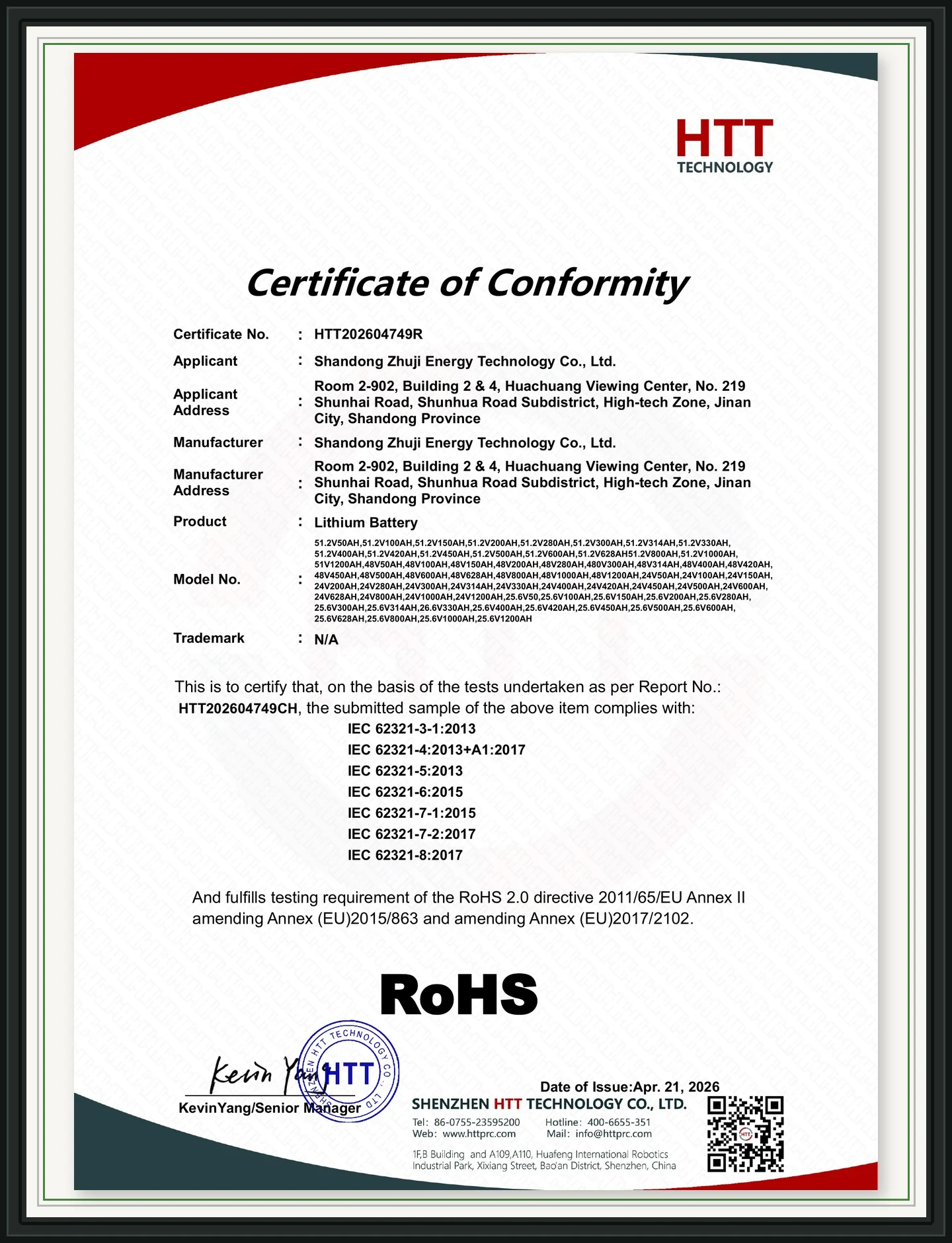
ZJBESS 51.2V LiFePO4 battery model families hold CE EMC certificate HTT202604749E and RoHS certificate HTT202604749R, issued by HTT in April 2026. The UN38.3 test summary and MSDS for the WS10KW come with your quotation.

WS10KW 10kWh battery FAQs
What distributors, installers and EPC buyers ask us before ordering.
Will the WS10KW fit under my counter or shelf?
The chassis is 720 × 410 × 260mm (L × W × H) on casters. Measure the clear height under the bench and leave about 200mm in front for the cables, which all connect on the front panel.
How long does the WS10KW run a small shop?
It delivers about 8.5kWh to the AC loads: about 21 hours for a 400W load of lights, POS and router, or 10.6 hours at 800W with a drinks fridge. The basis is 10.24kWh × 90% × 92%.
What size inverter can one WS10KW run?
A 48V inverter up to 8kW. At full output that inverter draws about 181A from the battery, under the 200A limit. Above 8kW, add a second WS10KW alongside.
Why choose a low-profile battery instead of a wall battery?
No wall fixing, no load-bearing check and no lifting onto a bracket. The WS10KW rolls into place on its casters and keeps its weight low. A wall battery like the BG10KW keeps the floor clear instead.
Can several WS10KW run together?
Up to 15, all WS10KW, for 153.6kWh. Three units make 30.72kWh and five make 51.2kWh. They stand side by side; we set the addresses at the factory and ship the parallel cables.
WS10KW or WS15KW: what is the difference?
Same 51.2V platform, BMS and front panel. The WS10KW stores 10.24kWh (200Ah) in a 720 × 410 × 260mm chassis; the WS15KW stores 15.36kWh (300Ah) in a 726 × 440 × 266mm chassis, almost the same footprint.
Which inverters are compatible with the WS10KW?
18 brands are built into the BMS, including Pylontech protocol, Growatt, Voltronic, Deye, Victron, SMA and Solis. Connect over CAN or RS485 from the front panel. See our inverter compatibility guide.
Can the WS10KW stand in a garage or outbuilding?
Yes, if the garage or outbuilding is covered and dry. Keep it off wet floors and out of direct sun, and remember it will not charge below 0°C. LiFePO4 charging temperature explained
How many solar panels charge a WS10KW?
About 2.6kW of PV, or five 550W panels, with 5 peak sun hours (10.24kWh ÷ 5h ÷ 0.8 = 2.56kW). Shops with daytime fridges need extra panels on top.
Can I sell the WS10KW under my own brand?
Yes, from 3 units: front-panel logo, colour, boot screen and app. Order one unit first to test with your inverters. OEM / ODM
What warranty does the WS10KW have?
10 years, with free replacement of covered faults, an answer within 24 hours and a handling plan within 3 days. How warranty claims work
WS10KW documents
| Document | What it shows | How to get it |
|---|---|---|
| WS10KW datasheet | Electrical ratings, temperatures, dimensions, compatible inverters | Download PDF |
| WS15KW datasheet | Electrical ratings, temperatures, dimensions, compatible inverters | Download PDF |
| Per-unit QC pack | Serial number, cell QR codes, IR matching report, aging curve | In every WS10KW crate |
| Configuration record | BMS version, inverter model and firmware, protocol and settings | With your order |
| UN38.3 test summary, MSDS, CE EMC and RoHS certificates | For customs and tenders | With your quotation |
| WS10KW manual and warranty card | Installation, settings, maintenance, claim process | With your quotation |
Guides for your sales team: sizing · inverter compatibility · rack vs wall vs floor-standing · sample acceptance test · 48V supplier checklist
ZJBESS Home Batteries
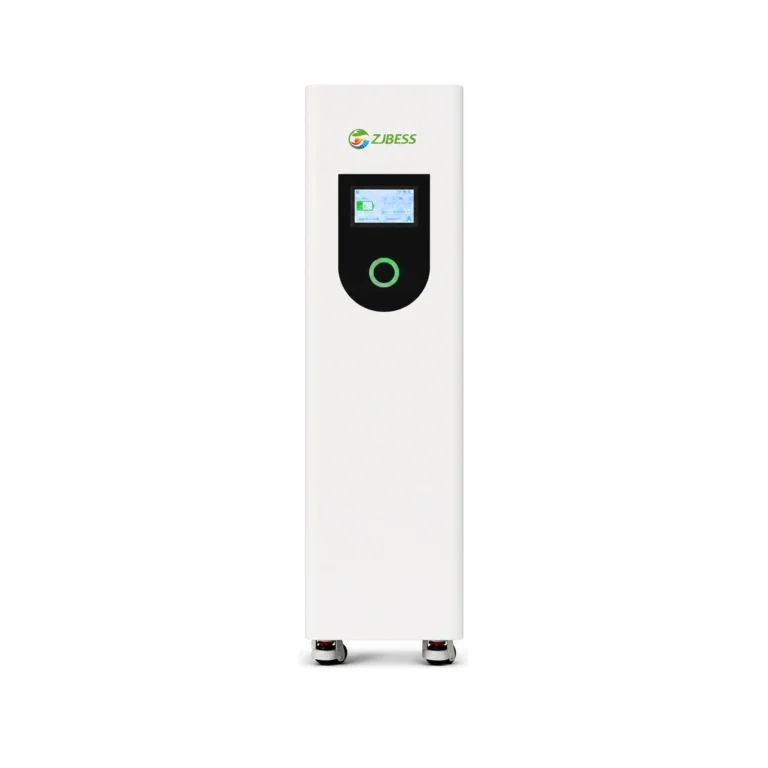
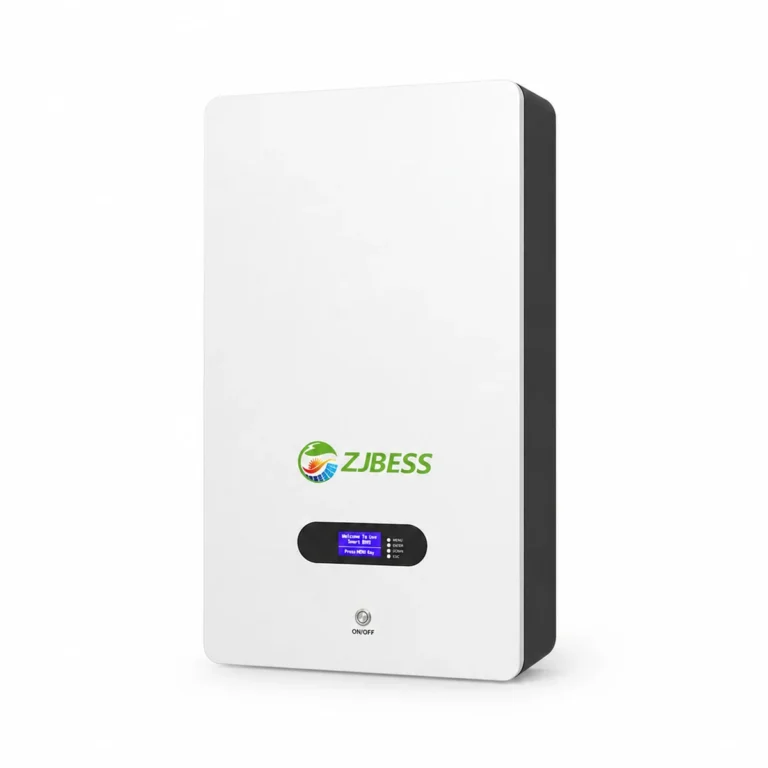
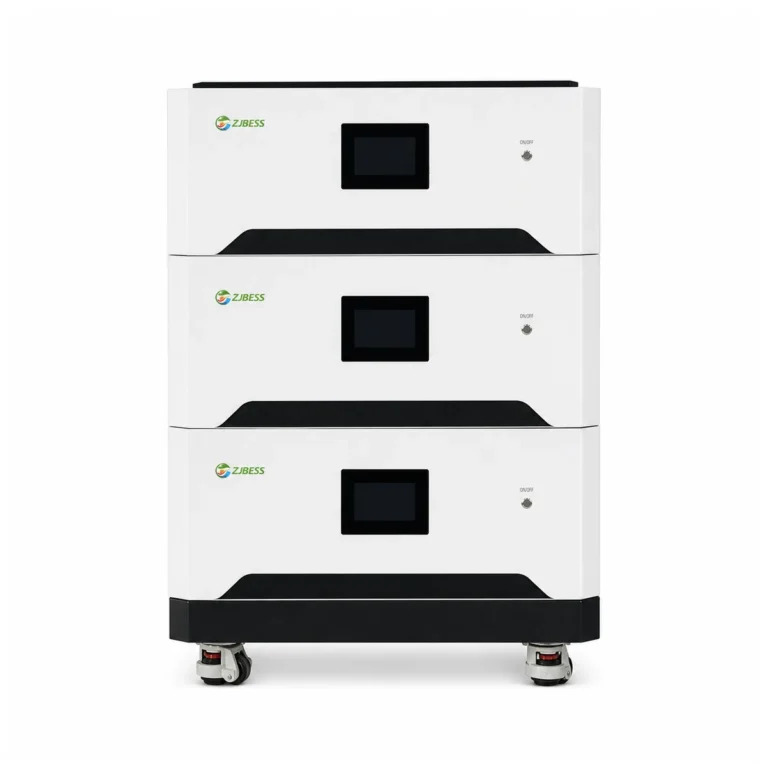
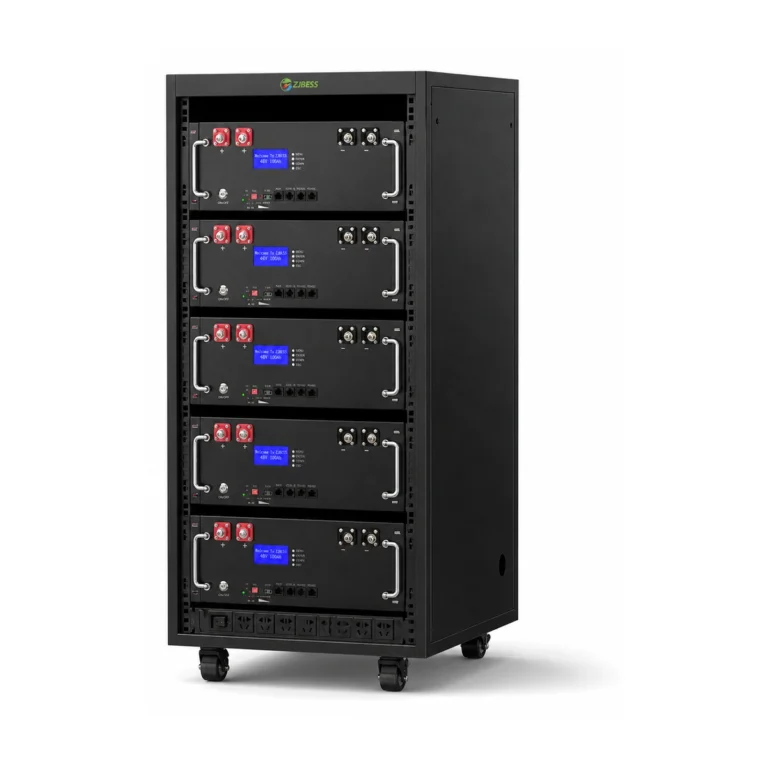
Compare other ZJBESS home battery formats when a low-profile 10kWh battery is not the right physical layout.
Get a Wholesale Quote
Tell us your required battery capacity, application and inverter model. We will confirm the suitable configuration before quotation.